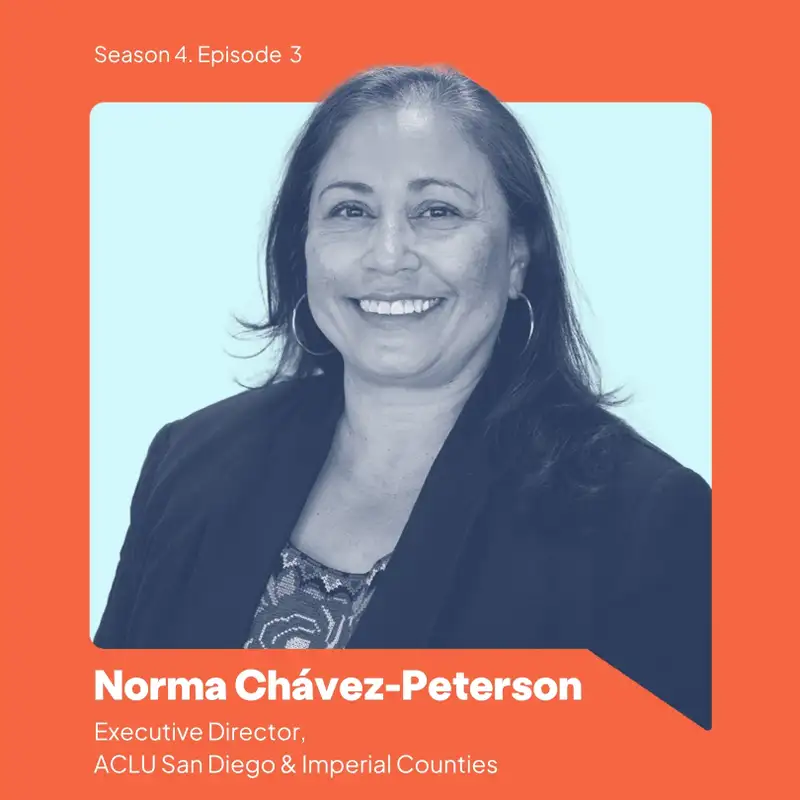
Norma Chávez-Peterson: Courage, Community, and Defending Civil Liberties
Crystal Page 0:00
Welcome back to stop and talk.
Grant Oliphant 0:12
Thank you, Crystal, how are you?
Crystal Page 0:13
I'm well. How are you?
Grant Oliphant 0:15
I am good. We just had a terrific conversation with Norma Chavez Peterson from the ACLU, who leads the local affiliate here in San Diego, and fascinating conversation.
Crystal Page 0:29
Yeah, I think many of us have known Norma Chavez Peterson for a number of years.
Grant Oliphant 0:33
You've known her a long time,
Crystal Page 0:34
yes, and I think her commitment to organizing and community is something we can all learn from. So I'm excited to dive in on this one.
Grant Oliphant 0:44
Yeah, well, why don't we do that? Why don't we just dive right in and listen to the conversation, and we'll have a lot to talk about at the back end.
Crystal Page 0:51
Yeah, see on the other side. All right.
Grant Oliphant 0:53
All right. Norma Chavez Peterson, thank you so much for being here.
Norma Chavez-Peterson 1:00
Thank you so much for inviting me, Grant.
Grant Oliphant 1:01
Yeah, this is a, this is, this is an important conversation in terms of what's happening in San Diego and what's happening nationally. But I do want to start by asking you to say a bit about for those of of our audience who understand, or perhaps don't understand the ACLU, what does your work actually look like here in San Diego and in the context of what you're doing nationally?
Norma Chavez-Peterson 1:30
Perfect? That's a great question. Well, ACLU, right. The American Civil Liberties Union was founded in 1920 and it's a national federated organization. So a lot of people just think of ACLU and and don't understand our structure. What's beautiful about the ACLU is not only our 120 something years, but the fact that we have a presence in every single state in this country, and Puerto Rico, and we're a federated organization, which means that we're made up of affiliates. So I have really the honor and the privilege to lead our local affiliate, which is our ACLU of San Diego and Imperial Counties California is complex. We have three affiliates, but the role of the affiliates, the way I see it grant, is we're really the eyes and ears and boots on the ground in local communities when it comes to defending, protecting and advancing civil rights and civil liberties. And so we have that presence in every single state and in California, because we're so huge, we're broken up by three affiliates. And so I have the two southernmost counties and in our state, right in the border region, and I feel like that gives us the opportunity to be even more rooted in community
Grant Oliphant 2:41
that structure is designed, then to let each affiliate express the particular needs and opportunities of that place. Is that right?
Norma Chavez-Peterson 2:50
Exactly, really Again, our role is to be super connected to what's happening on the ground, and to be responsive to that, to identify our own kind of issue priorities. And I think especially in this moment, you know, a lot of what we're facing in terms of, you know, the threats to democracy, to due process, those are things that we have to fight at all levels, right, whether it's in the Supreme Court or in local city council meetings and local school school, board meetings, etc, and so that's the role of the affiliates. Like, let's do the work locally.
Grant Oliphant 3:25
So we're going to get into all of that, and it's a lot, but before we do, I'm I would love to hear from you about what drew you to this work in the first place, why you wanted to do this as your as your career.
Norma Chavez-Peterson 3:41
Yeah. So I was born in Michoacan Mexico. I'm an immigrant to California. I came to this country when I was five and a half years old, and I was raised by a single mother, single immigrant mother. I was undocumented until 1986 Ronald Reagan's, you know, immigration. You know, Reform Act that created the path for close to 3 million folks to get a path to legalization. So I would say that my lived experience as an immigrant, as undocumented family that's really lived kind of in poverty or grew up in poverty here in San Diego, really informed and shaped my commitment to being involved in social change, social justice, and so that's been my entire life's career has been community organizing and advocacy, and you know now at the ACLU, for almost 15 years,
Grant Oliphant 4:37
amazing well and so well known and so well respected in this community for the role that you play in that so you chose your career well, and what a what a fascinating and direct through line in terms of the immediacy of the issues that we're facing in our society right now. Do you sometimes feel as though you were made for this moment?
Norma Chavez-Peterson 4:59
And I really do feel like I was, I think, one my lived experience, but also my work, right? So in those decades of work, because, you know, it's now been, I guess, like, three decades, I really started organizing in in when I was in high school, right? And I think all of the work that's been rooted in mostly low income communities of color in this county. And then the work that I did prior to ACLU, I did faith based organizing, so I really through JOB justice overcoming boundaries, and that work, I really think, prepared me for it, because I was raised, you know, a National City, Chula Vista, South Bay, where, if you go to those communities, it's majority Latino, right? And it's majority communities of color. And I really think that my eight years of faith based organizing and working with folks across the region, across faith, across class, across race and working really around different issues really is what prepared me to lead the ACLU because it put me in close proximity and relationship with really amazing people that maybe weren't people of color and weren't poor and had privilege, but were committed to social change, and that really, I think, prepared me for this moment.
Grant Oliphant 6:15
So let's talk about this moment and dive right in. And I think we'll inevitably go back and forth between national and local, national issues, local manifestations of it, and maybe a place to begin, is what the country was exposed to in terms of federal overreach through The lens of the ice enforcement actions in Minneapolis, when we had people being shot on the streets for protesting and allegedly being in the wrong place at the wrong time, we had infringements of protesters rights. We had an we had a level of enforcement action that many in the in the country saw for the first time as being beyond the pale. What what people don't necessarily see is how this is manifesting in their own communities. And I just love for you to reflect for a moment about what has been going on here in San Diego, and how we're experiencing this in what ways?
Norma Chavez-Peterson 7:27
Yeah, so I want to step back even further back than just this administration, because I think, you know, we're a border region. We're a binational region, and issues of federal government overreach, whether it's Border Patrol, ICE are absolutely not new. You know, I talked about my own path to legalization in the 80s. It was really in the 80s that the militarization of the border region began to occur, and so, you know, so deaths on the border, I mean killings at the hands of borders. So I want to note that, because I do think that it's something that if you talk to folks that have been documenting human rights abuses or have been working in the immigrant rights space, folks know that this has been happening for decades, and that it's not new, and that it's not just this administration. It's been every single administration since the 80s. So again, to me, this is not a partisan issue. This is about kind of the state of our national politic in terms of how we see and or want to treat immigrants and whether or not we want to be a welcoming nation.
Grant Oliphant 8:38
I appreciate that answer. I think it's such an important framing, because in some ways, you're saying we've been building to this moment for a long time. There have been moments in our history, even our recent history, where the country has been able to think through that we need a comprehensive solution to immigration. And I, I'm curious how you view that conversation through the aclu's lens, why we adhere simply to militarization and to these excesses and are not making progress on the comprehensive solution?
Norma Chavez-Peterson 9:20
Yeah. I mean, I think, I mean, this is a, it's not a tough question, but it's, it's a complex question, because I think part of the reality is that it has been challenging to get the rest of the country or everyone to align around you know what a just, fair and humane immigration system might look like? Even in other times, when there's been movement for immigration reform, we've seen that really the majority of the country. And I don't remember the numbers right now because there's been polling, but like 60 or 70% Of Americans actually believe that there should be common sense comprehensive immigration reform, and that you really have a couple folks that maybe don't fully understand it, or don't know, maybe aren't impacted, and that you really have 10% of, like, staunch anti immigrant, I'll say many white nationalist folks that really don't want any more immigration in this country, but that's the minority. I mean, again, I've been doing this work in immigrant rights for a long time, but what has happened in the last 10 years or more, I mean, from Trump 1.0 to now, is that that 10% has been really loud, and they also obviously have are dominating the political dynamics of our time and so. So I really do think that the moment we're in right now is has been taken over by that 10% however, what we've seen in the last year, which we could talk about Operation Metro surge right in Minnesota and Chicago, but we could also talk about Buona Forchetta And, you know, in South Park, say something about that. Yeah, so, you know, I'll step back again and say, like, Look, we all knew from just the campaigning, the rhetoric of, you know, the 2024, presidential election and the last election, that immigration was going to be that wedge issue that was going to be used to divide and to promote a narrative of fear and division. So we knew what this current administration was threatening to do right? We not only from the debates and the deport them all signs at the conventions, but project 2025, so there was no doubt what they were preparing for. Right? The election happens, the inauguration happens. And on the day of the inauguration, the first thing that the administration signs is an end to birthright citizenship. Fast forward a couple months later, and I really do believe that the incident we saw Buona Forchetta a Friday evening. I believe it was in May or June of last year, families celebrating graduations and other family functions at Buena Forchetta. Many of us love that place in South Park, right? And on a Friday, popular local race, very popular. And no great neighborhood in San Diego. And what happens? You have this excessive, abusive, total, militarized ice presence that, you know, handcuffs, all of the workers. I mean, people that were enjoying dinner were in shock. Yes, they were looking for a couple of workers. The business, who's an immigrant, ran business, Italian owned, was also impacted. But you also saw how the neighbors responded. And, you know, you don't mess with South Park. There's so many amazing, great humans there. And you saw elders, you saw young families, you know, yelling. I don't think people were prepared for that, but I think that was this administration's, you know, beginning to test out this really vile, excessive, you know, brute force in terms of how they're doing immigration enforcement. So that happened again, I remember if it was May or June, and then it moved on to LA so you saw that targeting of cities, and you saw community response. And so again, I don't think it's new. I think it's very intentional. I mean, one of the things they said in terms of targeting immigrants was, you know, deport them all. They wanted to have quotas of a million a year.
Grant Oliphant 13:46
So the way this, and I really appreciate the historical perspective, because I think it's important to understand that we've been for decades now, the country has been avoiding dealing with comprehensive immigration reform, and instead indulging in this broken debate and behaving in the ways that we've seen, culminating in what this administration is doing. So thank you for reminding us of that. Now, though, the way the conversation gets framed is if you if you care about borders, you have to do this stuff. And people who are fighting for the rights of immigrants don't care about borders. And I'm curious how you talk about this, as you talk to audiences about what your real perspective is, as opposed to the cartoonish way in which it gets characterized sometimes by the opposition.
Norma Chavez-Peterson 14:51
Yeah. I mean, I think the reality, right and ACLU is, you know, formal position is like, look, every country has a right, right? to to have borders, etc, and all of those things, right? Like we have a right as a sovereign nation to have that, I think how we do that, how we secure our borders, how we, you know, manage immigration, our country is what is needed for us to actually wrestle with. But it's really a false narrative. It's, again, this, this narrative that's intended to just divide and to make a very complex issue very simple. And it's easier to say, well, you know those immigrant rights advocates, they just want open borders. I mean, I will say there are folks within the immigrant rights movement that don't believe we have borders. That's not the majority of folks. I mean, it's like the majority of folks is like, yes, a country has a right to have, you know, rules and laws. However, our current immigration system is completely out of touch with not only the needs, you know, not only the impact it has on families, right, but also, like our economic needs and our, you know, just everything else. And so I do think that, like from our perspective, you know, there, there is a way for our Congress, you know, if they had the courage. There's been many other iterations, and it was actually during George Bush, there was some efforts during Obama, you know, we have DACA. There's been a lack of willingness and political courage, you know, at the congressional level, to actually pass bipartisan, comprehensive immigration reform. And I think it's I, I'm hoping that, you know, given the moment that we're in. I think there's an opportunity for us to build, to continue to see how we bring more folks on board and create a real vision for once we get past this administration, how do we actually really address this issue in a comprehensive and humane and dignified way?
Grant Oliphant 16:58
I want to, I definitely want to talk about that. That's that's something we should explore a bit before we get to it. Though. Let's come back to the local reality. What's happening here in San Diego. So you, you mentioned the incident at Buena Forchetta which many have characterized as a kind of training run for what then has unfolded elsewhere around the country in terms of the militarized intrusion into people's schools and homes and businesses. Is that ongoing here in San Diego?
Norma Chavez-Peterson 17:33
Yeah, you know, I think that was probably the first and only incident where we saw that level of force, what we have seen, and it was cal matters that just a few weeks ago, released, you know, a report. They analyzed some data around ice arrest and reported that ice arrest and detentions in San Diego County are up 1500% so what we're seeing in San Diego is not that overt, aggressive, you know, that we've seen in Minneapolis, but we are seeing increased arrest. And I'll share a couple of examples right early, early on last year. And so it's happening. It's a little quieter, but communities are responding. And you know, one of the first examples that comes to mind of early last year, and this video went viral, was a young woman. I don't remember if she's like, 19 or 20, but a young person who's, you know, ICE agents went to her house, this was an Escondido, and they were looking for her uncle. And this young woman actually knew her rights. She had just attended and know your rights. And she actually said, Do you have a judicial warrant, you know, through the screen door, and they didn't have one. They're like, No, we don't have one. Bottom Line. She didn't open the door, and then they were trying to kind of intimidate her. And then she, like, literally read her little red card and said, No, we're not going to open the door. And the right, right to, like, not open the door. So you began to see these, you know, they were doing targeted arrests people that maybe had a formal deportation order. You know, part of their narrative is, we're going after criminals. The data shows like less than 1% or actually have any kind of violent crime. Everybody still has a right to due process. But what we have seen is either people that you know, maybe had, I don't know, information
Grant Oliphant 19:17
They're going after the abuelas, and not the criminals,
Norma Chavez-Peterson 19:21
not the criminals. I mean, we saw another incident in Encinitas. Forget the name of the local store was all over the news as well. Of like, he's an immigrant. He's going through immigration status, he's, you know, dealing with his immigration process, but has owned a little corner, little store in Encinitas, and all of a sudden he got picked up, and the entire community of Encinitas that goes shops there, you know, was, you know, in an uproar, and saying, Why are you taking our neighbor? And so, you know, this is happening where people are dropping off their children at school. We've heard about it in City Heights and Chula Vista and Oceanside. We saw super vile, I think this was another. Kind of, I think, really excessive brute incident in in Oceanside, where immigration and agents went in to look for they were looking for the father. They ended up taking not only the father and the mother, like at five, six in the morning, but they broke the windows, you know, and they left these teenage children by themselves, like it's happening here, right? So many times, you know, we'll hear about it in the news, you know we'll see it on social media, but there's absolutely no doubt. And not only is the data there, but the stories are there that they're targeting people, and many times they say they're targeting criminals, but they're just racially profiling, right? We've heard of stories of folks driving on their way to work because they're construction workers, right? And they're picked up on their way to work, and then they leave their car there, right? And then families are trying to find them. Like these are things that are happening literally all over the county every day, and
Grant Oliphant 20:58
according to the data, rates much higher than anybody realizes or suspects.
Norma Chavez-Peterson 21:04
Yeah, it does. And I will say that there's, you know, in this moment, there's so many people in our community, and that's one of the things I love about San Diego, is that, you know, not everybody's has an immigrant in their family, but I do think that more that people are seeing what's happening. People are volunteering. They're forming neighborhood patrols. They're like the PTAs are like, you know, outside of the school to see. I've heard of churches. I know a couple churches who because they want churches to be a safe space for people to go worship and to feel safe, and so they have other members of the congregation who are US citizens, who are volunteering to be eyes and ears on a Sunday, to just keep an eye out so that people feel safe and so that, to me, is also what's happening in our community, is that you have everyday people trying to figure out ways that they can protect and you know their neighbors, and at least be eyes and ears.
Grant Oliphant 22:04
So to there's so many questions that I want to explore on this, but because I think there's so much to understand here, the community response tells me people in community are seeing something that national policy makers, who are behind these policies are not and they're they're seeing something in the value of their neighbors. It is dismissed, often by the National by the administration and those who support it as just misplaced compassion, but the in in community, people see it as an expression of what they believe about themselves as Americans and about community. You spoke earlier about how it's okay to have an important to have immigration laws and a border, but how you would enforce it is important. So where, where? What is the administration missing in its how that communities are seeing here in San Diego?
Norma Chavez-Peterson 23:07
Well, this particular administration, I think, is missing all of it, because it's very clear from not only their statements, but you know, Stephen Miller's advice, that they're completely, completely, want to dismantle any sense of, you know, welcoming immigrants, or just like having, you know, a country that actually is, is multiracial and multi ethnic and all of that. I feel like at the end of the day. There's no question in my mind, and I think people see it, and I think that's why you have so many folks, including in places like Minnesota, right? Think of Minnesota, right? How many immigrants actually are there? And then the state, and you see so many folks that are out in negative 11 degree weather, protesting singing in choirs. Because I think it pulled at the heartstrings of who we are as a country like we. That's not who we are, you know, to to exclude and to vilify and to dehumanize and to criminalize. That's not I think, that, you know, struck a chord with as stricken as strict. I can't pronounce that word. It's striking a chord with a lot of people that this is not who we are. I mean, it's interesting. I was reading a New York Times story yesterday where they went through the Supreme Court justices to tell the story of their immigrant story background, their immigrant background, and part of it is, right, obviously, unless you're Native American and you're African American, connected to, you know, your ancestors being brought here by force, everyone has an immigrant story, right? Everybody, including our Supreme Court, just including the President, including Stephen Miller, but it's been this wanting to disconnect from that immigrant story that's fundamental to who we are as a country.
Grant Oliphant 25:17
So the failure to remember that resulting in these stronger enforcement actions that this administration is pursuing, and language and rhetoric that demonizes immigrants and actions designed to send them anywhere else is having what sort of effect on people in local communities, I
Norma Chavez-Peterson 25:40
think in local communities, I'm seeing here in San Diego more and more people that are appalled at what is happening, maybe because, again, they weren't directly impacted. But like this is not what I would
Grant Oliphant 25:54
but for the ones who you know I'm I see the same thing around communities stepping up to protect others in their midst. But for the folks who are afraid that they may be next, or that their family may be next, what sort of, what sort of changes are happening to them as a result?
Norma Chavez-Peterson 26:15
Yeah, well, I think what is happening is that, and I think a little bit about like the threats or the attacks on immigrants is is also an attack on all of us. I mean, we we're seeing how this administration is not only picking up folks based on the color of their skin and whether they work certain jobs, but also US citizens that might be exercising their First Amendment right to document, right to take pictures and videos and to or to speak, right? Like journalists, like they're really kind of going after anybody that might be critical of this administration. And that's where I think more and more people are saying, Okay, I might be next, right? Maybe I'm a US citizen, but maybe my spouse is not, or I have certain political opinions, and I might be on their target list. So I do think that this moment is getting folks to be thinking about the bigger picture, about the threats to all of our individual rights and individual freedoms to express ourselves and have an opinion.
Grant Oliphant 27:27
We hear stories about families who are afraid to go to church or to go to the grocery store or to go to work because of just what you described, that they worry they may be next. And we've also seen people turn out for protests in record numbers. How are you seeing people calibrate their personal safety in this environment?
Norma Chavez-Peterson 27:52
Yeah, I mean, I think it's a lot based on your own personal risk, right? Like, if you talk to someone who is undocumented, like them balancing their risk with someone who is a US citizen, etc, it's like a completely different calculation. What I think we are hearing and seeing is many folks who might be without status or in mixed status, not only maybe afraid to go to church, but also maybe not even showing up to their doctor's appointments. My sister is a teacher, and San Ysidro, all right, has been teaching at the same school for 29 years, and right after the administration, I mean, she's teaching second graders, and was telling me that, like especially the first months right after the inauguration, where she had so many kids that were missing school, and a lot of that because their parents were like even afraid to take their kids to school. So you're seeing that play out in all aspects of our everyday life, going to the doctor, going grocery shopping, and there are community groups that are even delivering groceries to folks that are so afraid to leave their homes. And I'll say, like all of us navigate fear differently, right? So there might be some folks, because there are folks that are courageous and that are in community and are resilient and are saying, You know what, we're going to do this together, and I'm not alone, and they have a plan, and they're folks that are so afraid that they don't even want to leave their house. And so I think you have kind of a broad range of that. And then in terms of, like, the protests, and you know, I was at the third no kings this last weekend, and it was great, right? Like we saw the first no kings was like 5 million people, I think 7 million. And I think they estimate 8 million people from across the country that took to the streets. And if you attend, it is so diverse. It's intergenerational. There's like elders in their 90s. And, you know, I saw a video of a senior home, and I think that folks from Casa de manana or something in La Jolla little. Like they organize their own little walk out, you know, outside of their senior facility. So you see seniors. You see young people. You know, my teenage daughter was out there with me this last weekend. And so it's intergenerational, it's it's diverse, and I will say you see a lot more white folks out there, which honestly, we need
Grant Oliphant 30:21
say more about why?
Norma Chavez-Peterson 30:23
Because I think in this moment like if, if, if immigrants, if people of color, if Black, indigenous folks, we have the biggest target on our back, right? This is a moment for good allies, for people that want to put their bodies and I mean, honestly, that's, that's what Renee good and Alex pretty were doing. I mean, a nurse, right? And a mom and a wife that just dropped off their kids was figuring out what they could do to keep an eye out for their neighbors. And so you're seeing that more and more. And I really think that in this moment, there's an opportunity to for us to continue to build bridges in communities and build relationships.
Grant Oliphant 31:02
I think that's a really powerful point. You know, one of the other groups that we're seeing being attacked right now is, well, it's truth tellers of various sorts, but we're seeing journalists being attacked and attempts to shut them down for reporting on these stories and sharing information. We've seen efforts to keep observers out of courthouses, actually to make to turn observers into criminals, by describing them as terrorists, for for bearing witness. In effect, how do you see this moment as having importance for the civil liberties of all of us.
Norma Chavez-Peterson 31:47
Well, I mean, I think what, what this administration wants to do is instill fear and division by any means necessary. So whether it's going after journalist or Jimmy Kimmel or the legal observers here at our own courthouse, the faith volunteers of San Diego organizing project or detention resistance, who have been there since last August, they started getting citations just a couple weeks ago to be deterred. You've had the Catholic Bishop going out to the courthouse, right? So what? What they want to do, and this is where authoritarianism will thrive, is if we stay quiet, if we don't speak up, if we, if we just, you know, give up. And I think that's, that's what they're really trying to do at this moment. But what we're seeing is that people are determined and very resilient and are continuing to speak up and speak out and challenge what what is happening.
Grant Oliphant 32:48
Now, there's so many things happening, and this is one of the strategies, actually, but there's so many things happening that it is hard to for people to decide, this is the thing I should pay attention to, and this is something I should ignore. And when you look at it from your very informed perspective, where are we? Where should we focus our energy, and what is just a distraction?
Norma Chavez-Peterson 33:19
Yeah, that's a great question, because even you know us as an organization, we've been super intentional. Like, I mean, think about everything that we've experienced this year. I mean, we're talking about civil rights and civil liberties, but the undoing of the federal you know, employees like everything. Like, to me, everything's under attack. And I think, to your point, it's intentional. So I think both as organizations and as individuals. Like, what are you? What do you care the most about? Like, we're you can't focus on everything. There's a saying in Spanish, and I'll say it, el que mucho abarca poco aprieta. I'll repeat it, el que mucho abarca poco aprieta, he, she or they, that takes on too much, does very little. So what does that mean? Is focus, focus, focus. Everybody has to, you know, do a little bit of of reflection, of discernment, of like, what is that issue that I care the most about that is really in my heart that I want to fight back on. Maybe it's immigrant rights, maybe it's the environment, maybe it's what's happening right now with a dismantling of our healthcare system and Medi Cal like, find the issue that you care the most about, and then connect with an organization. Of course, I would love for everyone to like, join the ACLU, but there's so many amazing organizations, right? Get involved if you're a person of faith. Are you involved in your faith community? Do you all have a social justice ministry? Do you know San Diego organizing project like you? We can't do it all, but this is where it's important to to figure out. What you care the most about, and where you can have the most and then focus, focus, focus on that. And then, of course, everything is connected, and this is, to me, super important too, is that we're clear about what we're focused on, but that we're also in relationship right with other organizations that are tackling other issues. Because at this moment, our strength is in our unity. It is in our solidarity, and it's in our ability to be strategic in terms of how we're pushing back without getting burned out and not being effective.
Grant Oliphant 35:35
You started to answer this question, but I'd just love for you to say a few more words about it. How can communities prepare themselves so that they're ready if, if the heat turns up and the level of of enforcement action becomes more overt, militarized, aggressive and in the in the damaging ways we've seen, how can communities prepare themselves? What are the pieces of infrastructure that they need to put in place to respond?
Norma Chavez-Peterson 36:13
Well, so one is, I mean, know your neighbors, right? Depending on where you live, whether it's North Park, whether it's Chula Vista, whether it's Oceanside, there's folks that are already doing work there. So, you know, find out who's already doing work in the neighborhood you live in. Figure out what you can plug into like you're not alone, and there's already a lot of work happening. So I think starting there right with knowing your neighbors and knowing who's doing what in your own local kind of neighborhood and community, I think, is important. In terms of infrastructure, there's lots of infrastructure, and we're continuing to build more infrastructure. Collectively, the ACLU just launched last week, I think, or the week before legal intake line specific to report, you know, abuse at the hands of federal law enforcement, part of it is in preparation, like if one of the things we heard from our colleagues in Minnesota when things were really bad was that the ability to capture, not just videos and pictures and documentation, to document what was actually happening, and then obviously investigating as quickly as possible to build a record, and then, of course, use litigation when it makes sense to file lawsuits challenging you know whether it was excessive use of force or racially racial profiling. So we do have this hotline now. I can share the numbers with your team so that we could share that with the audience. Because I think if you know it were to get escalated, and again, it's happening now, we want the community to have a centralized way to report abuses, and then our legal team is capturing all that information and doing that due diligence. So that's one way. There's also, we're working with several partners, again, because there's a lot of really important work. Is immigration legal services is really important. This is for immigrants that might be impacted by mass deportation, right? There's the legal defense fund that the county of San Diego that we advocated for. It's $5 million locally. And then there's the a coalition of nonprofit providers. So knowing where are the resources that you can direct people to? Is really important, and we're currently working with some really important partners that are leading work to build what we're calling a San Diego Regional, what's our name, San Diego Regional solidarity collective that is, is really looking at the entire kind of ecosystem of organizations and trying to create, like, a little bit more connective tissue so that if anybody gets a call that a parent from Escondido got picked up at Home Depot, that there's an org that they know who to connect to, so that that family can have support. So that is still all getting developed with partners, but the goal is to build more of that connective tissue so that not only we can provide support and respond in the moment, but that we could be prepared in case there is increased enforcement.
Grant Oliphant 39:14
So thank you for that answer. I think that that answer is, in some ways, what you're describing is using this moment to build and strengthen community. I'm also thinking about the unique role that people who you know we all think so much about what we can do and and we have a penchant for doing that we should is admirable in this country, but I'm also seeing the rise of a very old technique that has a religious tradition of bearing witness and using, you know, use, using this moment, not simply to protest or to. Go toward it, but to actively be a witness to what is happening, and that feels very passive. So for many of us, it feels insufficient. And yet arguably, it was very important in turning the tide in Minneapolis and Minnesota more generally. Why do you think it's important now? And similar question, why is why? Why are authorities who are pushing this agenda threatened by people who are just there to see
Norma Chavez-Peterson 40:36
Yeah, I mean, I think it's really powerful right now. And I think what's really it's an opportunity for people of good conscience, good conscience, and people that care about not just immigrants but their neighbors and care about democracy, to be those that want to to be prepared to be observers and to document and to be the storytellers of what's happening on the ground. I'll say one of the things that there's lots again happening, but there's an organization in San Diego called standing up for racial justice. They were born after the incident of George Floyd in 2020 and they're a national organization all volunteer, and they're really focused on, you know, standing up for racial justice. Again, that to me, like the issues we're seeing in terms of what's impacting immigrant communities. Again, it's intersectional, like the, you know, excessive law enforcement and the experience that African American communities had have had in our own community around racial profiling and excessive use of force at the hands of law enforcement, again, is not new, and so this is an opportunity, I think, to get communities to learn more about what's happening, to connect with each other. But surj in particular has been doing trainings in community to do I think, they call it bystander trainings, and it's also intended to be, you know, for white allies, for people that might not be directly impacted, but, you know, how do you and there's this whole framework that they have. They actually connected with some of the folks that were doing the training in Minnesota, for folks that were going to be, you know, documenting or observing or what was happening in the ground, in communities and so, so surge has been doing some of those trainings. You know, there's many other organizations that also do it, and I think it's an opportunity for folks to again, those that are willing to do it, because not everybody wants to take that risk. But I do think that it's a an important it's a good opportunity and tool to get folks you know out there, if they're able to
Grant Oliphant 42:47
so our audience includes philanthropists. It also includes nonprofit leaders, civic leaders of various types, and many, many others. You know, I think people who are in positions to argue for types of various types of change and to implement it, what would you hope they would be keeping in mind at a moment like this, when all of this is going on?
Norma Chavez-Peterson 43:14
Yeah, I think at this moment for leaders of whatever sector, whether it's a nonprofit sector, philanthropic sector, or even our local elected leaders. This is a moment for courageous leadership. This is not a moment to be comfortable. I mean, I don't know how you can be comfortable if you just watch the news and see what's happening to our neighbors, so I really think that at this moment calls all of us as leaders, to to be bold, to be courageous, to take risk, to also be innovative and and willing to take some risk. Everybody has to manage their own risk, but this is a moment where we need to be thinking out of the box.
Grant Oliphant 43:57
So what is? What is? And I love that answer. But what does courageous leadership look like to you? Where have you seen it and from, either in this community or elsewhere, where leaders have stepped up in a way that was helpful during this crisis?
Norma Chavez-Peterson 44:14
I mean, I just had a chance to have dinner with her. So I want to talk a little bit about Angelica Salas, who, to me, inspires me and is a courageous leader. Angelica Salas is the Executive Director of chirla, which is based in LA, but they're really a national immigrant rights organization that now is also doing work in Mexico. And Angelica, like me, has been part of the immigrant rights movement for a long time, and so in LA, you know, I feel like chirla does a combination of, not only direct services, right? They get government funding, not, you know, for important work like their immigration legal services. They also are doing leadership development and organizing and advocacy. And they have a c4 you know, and I think everyone last year and again. Everybody needs to manage their risk, but everybody, I heard from a lot of organizations, including from elected leaders, without mentioning names, last year that were like, We don't want to be a target of this administration. We don't want to risk, you know, losing funding. Guess what? We're all targets. And this was early on, again, I won't mention names, but some of them are city council members and different local cities again and and it's this, we can't approach this moment with fear guiding us. Yes, we need to manage risk. We all if we're executives, we need, you know, we have attorneys. We have to figure it out. But if you're operating out of fear, that's not that's not good leadership. I'll give you an example. I have another organization, again, I won't mention names, does amazing work in the community. Serves the community really well, but again, they get federal funding, so and I get it again, I'm kind of speaking from a point of privilege, because we don't do direct services and get no government funding. And so there's this whole fear of like, we don't know what to do. Please don't use my work email all this stuff about, how can we support immigrant families? I was like, how about you just figure out those 5000 families that you are doing X, Y and Z services for. How about you figure out how to connect them to a family preparedness plan and immigration legal services. I'll tell you who's doing that. Just connect the dots. Just do that, and you're doing enough. So there's this whole, like, all last year, I heard so much fear from so many different leaders, then you have Angelica Salas, who was one of the organizations that targeted. Was targeted, yeah. And what did Angelica do? She, like, you know, grounded herself in her mission, her values, the purpose of her organization. Of course, she's lawyered up, right? But it's like, this is the moment where you can't just operate out of fear. You have to. So to me, she's an example of a courageous leader that inspires me.
Grant Oliphant 47:14
Yeah, no, that's really helpful. And I, you know, I think your answer to the groups that were afraid that you were describing you, you were naming for them, a positive course of action where they acknowledged what was going on, who in their circle of caring was affected by it, and a service they could actually provide them to help them. And that may be what courage looks like in the moment, but, but pretending the issue isn't going on is not helpful. And I think to your point, I also hear you saying that there is no hiding right now
Norma Chavez-Peterson 47:53
and pretending like there's nothing you can do about it, right? Figure out what you can do about it with the resources you have, and from where you sit, that, to me, is courageous leadership, not assuming that it's not happening and then assuming like you have no power or no ability to do something.
Grant Oliphant 48:13
And so the I imagine, for individuals who are listening, the answer is the same that it's figuring out what you can do and doing that thing.
Grant Oliphant 48:24
Yeah, definitely. You know, not everybody wants to go to a protest, you know, but write to your elected officials. I also think, in this moment, and you know, we're talking a San Diego audience, this is an opportunity with what's happening at the federal government. I believe deeply that this is an opportunity for us in local communities to make sure that our school boards, that our city councils, that our county board of supervisors, that these elected offices that represent us really speak for us, and that we're holding them accountable to our values and Our vision of the kinds of policies that really protect people and lift everyone up. And so to me, it's an opportunity too. And like, how do we make democracy work at the local level?
Grant Oliphant 49:11
Yeah, so in some ways, that brings us full circle back to a statement you made early in this conversation about a sense you had that this current tumult was ultimately could lead us to a better place. And, and do you see an opportunity in this moment to for for good, to come from bad?
Norma Chavez-Peterson 49:36
Yeah, there's, you know, there's another saying in Spanish. I'll say it again. Muy mal que por vienno venga. There's always something good that comes out of of a bad moment. And I think in this moment and our country's history, you know, we've been through other dark times. I mean, I don't need to give anybody, any of your listeners, a history lesson in the history of this country, whether it was slavery. And, you know, reconstruct. I mean, you name it, right? We've been through darker times, but I really do think that it's the power of the people, right? This American experiment in our democracy is about representative democracy. It's about we, the people, making sure it means all of us. And so I think the opportunity is to really engage people in the things that matter the most to them, and making sure that we're building community organizing and building alliances across organizations, across issues, so that we can continue to make sure that government works for all of us, and that we're creating the kind of not only local communities, but country that really lives up to our highest ideals.
Grant Oliphant 50:45
What do you hope is the legacy of your work here?
Norma Chavez-Peterson 50:50
Well, you know, so I, you know, I've been now at the ACLU. When I started at the ACLU one, I'm not a lawyer, everybody used to say, yeah, it was a surprise, because everybody knows ACLU for our fierce litigation, but I'd say we're a membership organization, you know, we do policy work, we do community organizing, we do coalition building. And so I think part of my legacy, you know, when I when I came to the ACLU and the board hired me, you know, I'm an organizer, and I think they hired me because of how well connected I am in community and because I'm a good organizer and good leader. But I want my legacy. I feel like our affiliate is probably the most diverse affiliate in the country in terms of our staff and our board, and I what I want my legacy to be is that the Norma Chavez, the first Mexican immigrant to run an ACLU, built an organization that really transformed, you know, the life of people that live in San Diego and Imperial Counties for the better, making sure that, like everyone's rights are respected and really fulfilling that promise of a real, true, equitable society where everybody could thrive and be who they are.
Grant Oliphant 52:02
That's beautiful. And finally, last question, do you feel hopeful about that?
Norma Chavez-Peterson 52:09
I mean, I gotta say, Yeah, I'm hopeful. I have to be because, I mean, I think if I, if I give up hope, then, you know, then folks win So, yeah, I'm hopeful that we're gonna get past this moment and that we're going to look back at this time and we're going to say, You know what? We fought hard and we're going to continue to fight because this is the work for the rest of our lives.
Grant Oliphant 52:30
Well, Norma, I just want to say, on behalf of our audience, which is an audience that cares about the work that you're doing, I want to say, thank you for being the sort of leader who embodies exactly what you were describing during this conversation, and thank you for leading us through a difficult time.
Norma Chavez-Peterson 52:50
Thank you for having me.
Crystal Page 52:51
That was a really solid interview, Grant,
Grant Oliphant 52:58
well, that was a good conversation on a tough subject. And what I really appreciated about Norma was her clarity around the issues and the role of her organization, also about the role the rest of us can play.
Crystal Page 53:12
Yeah, I was really inspired by the role the rest of us could play, because she really reminded us, you know, check in. What can you do? What are you passionate about and make it happen. So I feel like she's trying to make it easier for us to engage.
Grant Oliphant 53:26
Yeah, there was a sense of not expecting people to be perfect or to hold themselves to some standard of perfection, but like you said, to do what they can. And that was particularly, I think, resonant during the conversation about what courage looks like at the moment. And, you know, I think she was saying number one, there's no place to hide on these issues, so it's important to to be clear about what you stand for and how you want to help. But she was also saying that do what you can as a mantra for leaders to keep in mind,
Crystal Page 54:05
oh yeah, and the idea that we can't lead with fear. You know, I think it's a good and constant reminder, but I also appreciated to kind of go back to that she talked about, making sure that we understood that this hasn't just been immigration enforcement in this moment, but it's been 40 years of this. It's been quieter, and so how do we intervene in that? I felt like she really pointed to that history.
Grant Oliphant 54:29
I think that was a really important point, because what she was saying was we need a comprehensive solution, and decades of failure to arrive at that have led us to this moment where there's been this Triumph of this really broken idea of who immigrants are and what they stand for, and whether this country can survive without them. And so we, you know, we. Clearly need that, that comprehensive solution. And she was also saying that as a result of the lack of that that we have been building towards a more and more rigid, militarized sort of response to the enforcement actions that take place, that was, I think, valuable to reflect on. At the same time, she was acknowledging that what's going on now is extraordinary.
Crystal Page 55:29
Oh, yeah, but it seemed like it's all the details that make the difference, right? The woman in Escondido who had her red card and just read the message like, Do you have a judicial warrant? You don't, I'm not going to open the door right having family preparedness plans, which she's advising nonprofits, to connect people with the right resources. All of these things that feel so basic can make such a difference in whether or not someone's taken or whether or not they have the right to have their civil rights protected and exercised.
Grant Oliphant 55:58
And I think for our audience, the ways in which she talked about what individual people could do really resonated. And I think her a useful guide. So we talked about bearing witness. We talked about community responses, like taking food to people and reaching out to neighbors and looking at, you know, being a lookout at the churches and and I, you know, what, what I was struck by was, in many ways, what she was describing is just what we would normally call being a good neighbor and building community. And it's tragic that that has to be applied in this way, in this moment. But boy, so important and so constructive for the future of community. Because, I think, because if people view their responsibilities that way, then they will be contributing to be building stronger community in the future.
Crystal Page 56:55
Yeah, and then she sort of left us with different types of reminders of, you know, this is not the first time, this is not the last time, but we can take something good from everything. So I really appreciate her acknowledging the opportunity of the moment.
Grant Oliphant 57:11
Yeah, I liked her, her two sayings that she shared in Spanish and and I really liked the idea that a person who feels like they have to do everything does very little. It's actually but I think for all of us, you know, we're there are just things we should focus on, to support each other and to support community and to be, you know, good community members, good allies, good and present in this, in this moment in history. You know, this does feel like so much is a stake. And she was clear about that too, that there are threats to our civil liberties that are they may be directed at the moment, at black and brown people, at immigrants, at journalists, but the implications are for all of us. And I thought the way she made that connection was really helpful.
Crystal Page 58:14
Yeah, I agree, even when she acknowledged having a diverse set of folks in the protest, all those things matter. So I think I walk away feeling like there's so much we can do in this moment to help and change and move well.
Grant Oliphant 58:27
Thank you for doing this with me, likewise, always. And what a pleasure to engage with people like Norma and talk about how our community and other communities can respond.
Crystal Page 58:39
Yeah. Thank you Grant, and thanks everyone for stopping and talking.
Grant Oliphant 58:47
This is a production of the Prebys Foundation,
Crystal Page 58:51
hosted by Grant Oliphant
Grant Oliphant 58:53
co hosted by Crystal Page,
Crystal Page 58:56
produced by Adam Greenfield, Tess Karesky, Edgar Ontiveros Medina and Crystal page,
Grant Oliphant 59:03
engineered by Adam Greenfield,
Crystal Page 59:06
production coordination by Tess Karesky,
Grant Oliphant 59:09
video production by Edgar Ontiveros Medina
Crystal Page 59:13
Special thanks to the Prebys Foundation team.
Grant Oliphant 59:16
The stop and talk theme song was created by San Diego's own Mr. Lyrical Groove,
Crystal Page 59:22
download episodes at your favorite podcatcher, or visit us at prebysfdn.org.