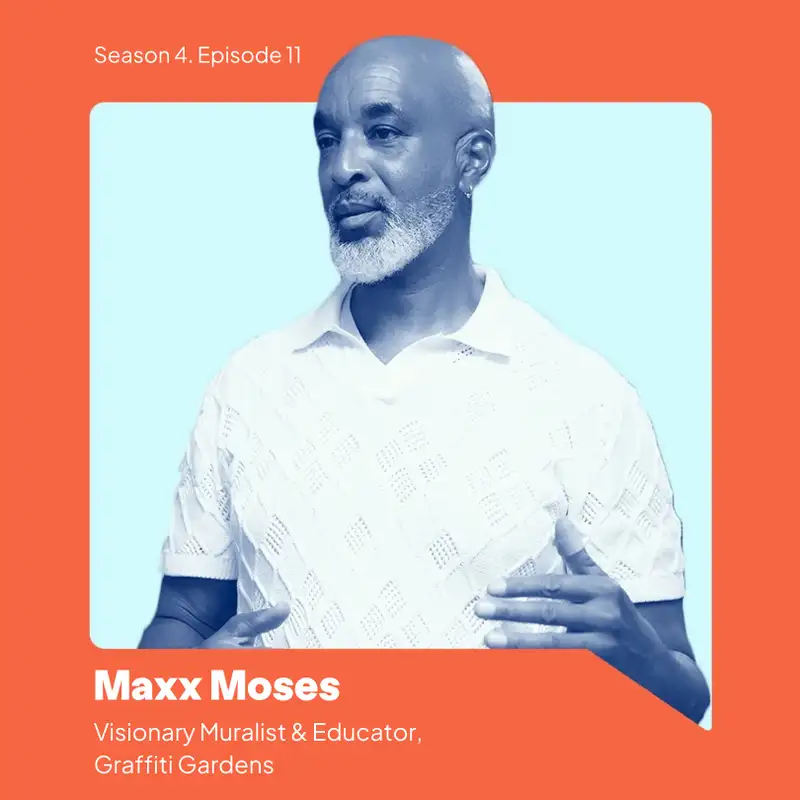
Maxx Moses: The Art of Leaving Your Mark
Maxx Moses 0:02
Tell this can "Do what I want you to do"
Grant Oliphant 0:05
Okay.
Maxx Moses 0:05
Do what I want you to do alright? and then go
Grant Oliphant 0:11
Max. Welcome. Thank you.
Maxx Moses 0:14
How are you?
Grant Oliphant 0:15
I'm good. Good to see you, thank you for having me here. Come on.
Maxx Moses 0:18
I'm glad to have you.
Grant Oliphant 0:19
I appreciate that.
Maxx Moses 0:21
This is special. Welcome, welcome.
Grant Oliphant 0:25
I'm gonna say, automatically, I feel better walking into your space.
Maxx Moses 0:29
That's the space that we want to create. You know, we want to create the space that just feels natural. And I often say that you know you don't have to wear a mask when you're here. You know what I mean. You could just be like your free self. You know, it's so important.
Grant Oliphant 0:47
I mean, first of all, I can see images that speak to the region. I can see images that speak to the people who are here. I can just see stuff that evokes feeling. Like this is kind of abstract, but it just makes me feel good. I can see images that speak to the natural environment and the ecology.
Maxx Moses 1:10
For me, it's like, bro, you have to feel it, like, because you know it doesn't matter who it is, but when you feel it, you're like, whoa, what is that? I want to tap into and then open up these dormant aspects of the human being. Yes?
Grant Oliphant 1:22
So tell me, let's let's talk a little bit about that because the my my hope in in doing this session with you and you know wanting to do more looking at San Diego through the eyes of artists is I'm four and a half years into being in this town now and we're lucky enough to be able to fund artists and creatives in this town. And every time I sit down with an artist, I'm sort of first of all, it awakens something in me personally. So I feel lucky to be able to be in that space. But then I'm also reminded, God, you know, there's this whole perspective on San Diego that people need to know more about, and that I would love to be able to share through a session like this. So, I would just love to start off by asking you who you are as an artist and how you got to creating a room like this.
Maxx Moses 2:17
I, you know, I'm gonna I'm gonna tap into like Paul Robinson, you know. Paul Robinson was always like me as an artist and a human there is no separation. This year, I'm celebrating 50 years of making art. Right?
Grant Oliphant 2:32
Really?
Maxx Moses 2:32
Yes. And I finally came up with a title of what I do. So I consider myself an Afro-transcendentalist.
Maxx Moses 2:42
Oh, I love that. Yes, yes. All right. So, explain what an Afro transcendentalist is?
Maxx Moses 2:48
Oh boy. Afro transcendentalist is like you know, an artist who is tapping into his African roots and also tapping into his transcendental roots, which meaning he's tapping into the eternal aspects of who I am. Yes, so this I am creating artwork that, as I mentioned earlier, speaks to your soul. Your soul is eternal.
Grant Oliphant 3:15
When did spirituality and transcending come into the picture?
Maxx Moses 3:20
You know something? It all happens simultaneously, unbeknownst to me. Because if you know my history as an artist, I started in New York City doing graffiti.
Grant Oliphant 3:29
Okay,
Maxx Moses 3:30
Alright. Every aspect of it is illegal. Every aspect. You have to steal all your supplies. Like it's mandatory. Right. Like to go and paint on the trains, you have to sneak into the subways. You have to sneak into the turnstiles. You have to sneak into the train yards, right where the train is up. You have to worry about other rival crews that are around that might want to steal your spray paint, and you know you have to be concerned about the 600 volts of electricity running along the tracks.
Grant Oliphant 4:00
Yeah, that would focus the mind.
Maxx Moses 4:02
The police are asking you, so you have all these obstacles that are you're faced with.
Grant Oliphant 4:08
Yeah,
Maxx Moses 4:08
you know what I mean. And you know, it was just something that dawned on me. You know, I had to. I didn't know it at the time.
Grant Oliphant 4:16
Right.
Maxx Moses 4:17
I wasn't aware of it until I went to college, and I had to start thinking and start writing papers about my life and experience, and I was just like, "Bro, this was this was a spiritual experience." You really you had to choose your own name, number one.
Grant Oliphant 4:17
Oh, really?
Maxx Moses 4:18
So you get the name that your parents gave you, right?
Grant Oliphant 4:34
Right.
Maxx Moses 4:34
But then you're like, "No, no, no."
Grant Oliphant 4:36
You have to adopt a tag for the street. Yeah.
Maxx Moses 4:39
So now this you're empowering yourself with who you want to be. You're creating identity for yourself, a brand new identity. And now not only are you creating this identity, you're blowing life into it because you're writing it over and over and over and over and over, bigger and bigger and bigger, and more color and more color, and you're getting away with it, right? So you start like, oh, this this is powerful. This is really powerful. So for me, that was my introduction to spirituality. Just realizing, like, whoa, like I created my own identity. You know, I took risks, and I'm sure you know, like, as a being in business, being in the world, risk taking is super important. You have to take risks. You know, you have to bend the rules.
Grant Oliphant 5:27
Were you caught?
Maxx Moses 5:28
Absolutely. And
Grant Oliphant 5:31
what did that experience teach you?
Maxx Moses 5:34
Oh my God! You know something? It's funny because it teaches you a lesson because now you have ramifications, right? Because my parents have to come. I'm still young. They have to come and get me out of jail, and boom boom boom. But the punishment was like, okay, so you have to go on Saturday mornings in the little Clean Subways, right? So I'm like, okay, go way out to Brooklyn to Clean Subways, and you get there, and there's like 15-20 other kids, and they're all riders. And I was like, this was a big mistake, cause now you hooked up with all these other writers. It's like, okay, go to lunch. You go to lunch. You go out, steal more, spray paint, get more markers.
Grant Oliphant 6:09
You learn the craft
Maxx Moses 6:10
and go back out again. I was like, this was awesome.
Grant Oliphant 6:13
That is that's fantastic. Now, was the was the African roots part of the of that time,
Maxx Moses 6:22
the African roots more came from college days.
Grant Oliphant 6:25
Okay, that was understanding it intellectually.
Maxx Moses 6:27
Yeah, that's how I started. Like you know, when I started reading about religions and spirituality and initiation processes, I realized this whole going into subway tunnels and choosing a name was an actual initiation. I was like, "This is very similar." I was like, "Do you see the parallels here?"
Grant Oliphant 6:44
Yeah. I mean, you describe it as this process of empowerment, and did you think of it that way then? As
Maxx Moses 6:53
it just felt that way.
Grant Oliphant 6:54
Yeah.
Maxx Moses 6:54
You didn't think about it because you're just thinking about getting away without getting caught. Yeah. Right. You were doing all of these things that were against the things that your family taught you. Right. Right. Right. Against what society. This is back in the 70s. So at this time, graffiti was hated with a vengeance.
Grant Oliphant 7:12
Right.
Maxx Moses 7:12
It's not like today
Grant Oliphant 7:13
I remember it. You know, you and I are roughly contemporaries.
Maxx Moses 7:16
You know.
Grant Oliphant 7:17
I remember reading about you.
Maxx Moses 7:20
Yeah, it was hated with a vengeance. So I wasn't thinking about being empowered. I was just thinking about like how much I can get my name up there because I wanted to be recognized
Grant Oliphant 7:30
as somebody who all his life has waited for permission to be told to create things. I love that you owned from the the go
Maxx Moses 7:40
right
Grant Oliphant 7:41
the idea of I'm an artist.
Maxx Moses 7:43
That was. Did you think of yourself as an artist? No.
Grant Oliphant 7:46
This is just something I do.
Maxx Moses 7:47
In fact, it's so funny because I remember when I went to college, right, and I was like, okay, cool. So, I'm I'm outside of New York City, like six hours upstate New York, right, and I'm like, man, I don't know where I could bomb because bombing is writing now. I don't know where to go, so I just went into the fine arts building, and I went there and I looked in the room, and there was people drinking wine and painting. I was so like, what the - is happening. I was like, what is this shit? I was so I was angry. I was angry. I was like, yo, do you know how hard it is to create, and you're here drinking wine and painting.
Grant Oliphant 8:22
Yeah,
Maxx Moses 8:23
like I get chased by the police.
Grant Oliphant 8:24
That actually gives me chills to think of that.
Maxx Moses 8:26
I was vexed.
Grant Oliphant 8:26
Yeah, yeah.
Maxx Moses 8:27
So you know what I did? A few nights later, I stuck a stick in the fine arts building door. Came in late at night and did two ginormous big pieces in the hallway pose too. I was like, "This is art,"
Maxx Moses 8:47
and the reaction was?
Maxx Moses 8:50
"That's a whole nother story." I'm telling, like, man, like,
Grant Oliphant 8:54
was it rude?
Maxx Moses 8:54
To make a long story short, yeah, you know, one of the professors knew that I was into graffiti and stuff because we would talk and stuff, and he was always trying to convince me to take a class.
Grant Oliphant 9:04
Yeah,
Maxx Moses 9:04
I I registered for the class. Next thing I know, I get a note in the mail that I'm being brought up on charges on campus
Maxx Moses 9:12
because of the graffiti you put up on the.
Maxx Moses 9:14
I'm like, I'm like, yo, these charges can you know result in you know being expelled from cause, oh no, right? For real, you don't know how hard it was for me to get here.
Grant Oliphant 9:24
Well, welcome to our art program.
Maxx Moses 9:27
I wasn't in the art program.
Grant Oliphant 9:29
Yeah, yeah.
Maxx Moses 9:29
However, I go to court. The only thing that saved me was the fact that I was registered for a class, and I was like, I'm registered. I belong in that building, so I owe so much to that professor.
Maxx Moses 9:43
Oh wow! For talking you into wow. And did you go through taking the class?
Maxx Moses 9:47
I did, and I learned.
Grant Oliphant 9:49
Did you get anything out of it?
Maxx Moses 9:50
Absolutely. So it was an art history course, right? Yeah. And I learned that graffiti wasn't the first rebellious art form.
Grant Oliphant 9:57
Oh yeah.
Maxx Moses 9:58
And I was like, oh wait a minute. There's other art forms that rebellious before this?
Grant Oliphant 10:03
Yeah.
Maxx Moses 10:04
So then I just kind of relaxed a little. I was like, maybe I should investigate some other art, and that was like a doorway to like a creative expansion to looking at other art forms.
Grant Oliphant 10:15
Have you had to during the course of your lifetime as an artist? And we'll get to San Diego in a moment, but have you had to deal with your art form going from rebellion to establishment in how it's perceived?
Maxx Moses 10:29
Oh yeah, that's my fight. Like you know, I actually to some part of it I enjoy it because I I have this great sense of justice in my being. Graffiti as an art form. People were always saying that you guys need to change. You need to change. I was like, no, it's not us that need to change. You do. You need to get a different perspective on this art form. These are young people who want to just self-express. Everybody wants to leave a mark. Right. That's the most natural thing for a human to do. Yeah. And once I got to that realization, then I knew I was on the right path. I was like, "Yo, this is this is most natural. This is the most natural thing for any human to do is to leave their mark. That's what we want. I was here. I I left a contribution. I did something. So after that, I was like, "Bro, I'm like, I'm on."
Grant Oliphant 11:18
Beautiful, yeah. So you you go to college, you get this grounding, and then how do you get to San Diego?
Maxx Moses 11:27
Wow, San Diego is a long way down the line. I mean, I even though I've been here for 20 years, but you know, I went to college and I always had this. I studied business because I was like, I'm I love art. I'm gonna do art regardless, but I gotta know how to make a living out of this. So I took business, and then I moved back to New York. Then from New York, I lived in Philadelphia for a decade. Then I came to San Diego to do an exhibition, and I just met such beautiful people. You know, like we did this exhibition downtown, and right next to the exhibition was this wall. I was like, "Yo, I want to paint that wall." And guy was like, "Oh, you you want to paint that wall?" They get permission for the wall. Oh, they get paint everything. I was like,
Grant Oliphant 12:12
"That's too easy."
Maxx Moses 12:13
I was like, San Di- I was like, "I like this community. Like, they want to support." And at the time, I was living in Philly and I was doing an event called the B Boy Barbecue, which is a hip hop art festival. And I was like, you know, something I think I could do this in San Diego because this is a supportive community. So I asked a bunch of people and they was like, "Yep, we'll help support it." So I moved here for like three months to put the event on. Then I went back to Philly. I was looking around. I was like,
Maxx Moses 12:43
"Why am I back here?"
Maxx Moses 12:43
I think I'm done. I think I'm done.
Grant Oliphant 12:46
Yeah,
Maxx Moses 12:47
and that was it. This is the studio space. It changes because we do events here. We do events called Conversations About Nothingness. We do the Black Friday Artists Market. We do Shine Forever, which is a group for a youth group orientation. We do a lot of things here outside of this being my studio space. So then you see all of our spray paint. You know we got to make sure that we keep a healthy supply of.
Grant Oliphant 13:14
Oh, so this is all live.
Maxx Moses 13:15
Yeah, yeah. Come on, man. This ain't this ain't.
Grant Oliphant 13:17
So I I just thought this was an exhibit.
Maxx Moses 13:20
You thought this is display. That's the real deal. Like that's that's that's close to like altogether it's close to like 800 cans of paint. You know, so we got to make sure that we're ready for everything that takes place. And then those two beautiful people over there. That is Giselle. She's the coordinator of Graffiti Gardens. And that is wait hold on who is that over there? That's Carmina. She's the interim CEO for Urban Collaborative Project.
Maxx Moses 13:49
And people who come into the space are students or?
Maxx Moses 13:52
Everything. We have adults. We have students. We have clients. You know, people just show up sometimes. You know, so it's a variety of people that come through, absolutely. And musicians, we have jam sessions here. So, oh, you want to check out outside? Yeah. Okay, so now you're gonna really get a chance to see what Graffiti Gardens is all about. Right. Okay. Let's do it. Initially, I rented the space. It was during COVID, and my mentor Barry Pollard was like, "I was like, I need a space. I need a place to paint." He's like, "Come over here, Barry.
Grant Oliphant 14:28
I know Barry.
Maxx Moses 14:28
You know Barry,
Grant Oliphant 14:29
of course, yeah, of course.
Maxx Moses 14:30
And Barry was like, "Come over here." And I checked it out. I spoke with the landlord, and I was like, "Hey, I want to rent these walls." And they were like, "Okay, I don't, I can't rent you the walls. Why don't you take the inside space and then you can do what you want. So that's how this space is developed out here. It's ongoing outdoor studio where we have visiting artists come and paint. This is Ink from L.A. Yeah. This is Rain from Jersey. This Booster from Columbia. That piece has been here for. At least four years now, and it's just like it's like our guardian, you know. It's like no, that's that's not nobody's touching that. That's just powerful, you know.
Grant Oliphant 15:10
It really is.
Maxx Moses 15:11
Yeah, you talk about Afro transcendentalism.
Grant Oliphant 15:14
There it is.
Maxx Moses 15:14
I mean, like that's that's the protector of that that concept. So this is interesting because all of this that you see out here, this is all from a grant from the Prebys Foundation.
Maxx Moses 15:26
I knew I loved it here. I actually didn't know that, but I knew I love it
Maxx Moses 15:31
All this beautification. Okay, okay, let's put it in context. Like in 2024, there was a massive flood here. Oh yeah, and the water was almost up to as high as that cement wall there. This whole area back here was just mud, like nasty mud. There was furniture that was all the way situated on that side of the building that was over here. It was just horrendous. So, with the help of Prebys, we were able to just beautify this place. We had a vision, you know. It took a little convincing with the landlord to bring it to fruition, you know. But we brought it to fruition.
Grant Oliphant 16:09
But tell me why you loved San Diego, because that's part of what I'm trying to get at. Is as I deepen my appreciation for San Diego, what do what does an artist like you see?
Maxx Moses 16:19
I'm glad you asked that question because I I was just in New York,
Grant Oliphant 16:23
yeah,
Maxx Moses 16:23
and we were driving in the car and we're in Manhattan. I think we're like on 31st Street, and I was I was saying to my friend like, you see, you see this, this is New York. Like you just trapped in these buildings. You don't see, you're just like all you can see it straight down, like it just surrounded. I was like, California, you can see the horizon line.
Grant Oliphant 16:44
Yeah.
Maxx Moses 16:45
Do you know the difference that is on your psyche?
Grant Oliphant 16:48
Yeah, I've noticed that too. It's true.
Maxx Moses 16:50
Do you know the difference that is on your psyche? Like that's a huge difference. That simple. It's so simple, but like wow, it's like whoa. Yeah, I'm going to go see the sunset. Like boom, like that's energy, like you know, like that's a different energy here. So, I feel that San Diego, in particular, you know, this is a place where you can hone your skills. This is where you come. You want to hone your, and it's interesting because there's a lot of artists and stuff and gurus who have come to San Diego, Southern California, and just kind of cultivated what they're doing. I feel that's what I've done. You can get into your zone. That's what this place is about.
Grant Oliphant 17:31
And just do the craft.
Maxx Moses 17:32
Do the craft and go jump in the ocean.
Grant Oliphant 17:34
Yeah. You know, it's funny. I I hadn't. I'd never thought about this before, but coming from Western Pennsylvania, I've said many times my own version of the of your horizon comment because there it's all rolling hills. The city is the straight up boxes like New York, but the but the landscape is all rolling hills. So wherever you're standing, you're not going to see a horizon. And when I got here, I had the same feeling of like, oh, I can see far.
Maxx Moses 17:35
You can see far,
Grant Oliphant 17:35
which is a really cool discovery if you haven't been living with that.
Maxx Moses 17:35
That says a lot psychologically, metaphorically. You can see far.
Grant Oliphant 17:35
Yeah,
Maxx Moses 17:35
yeah.
Grant Oliphant 17:47
But on the flip side, I hear from the artist community that we fund this is also a hard community to be an artist is that true, and what makes that true
Maxx Moses 18:25
absolutely positively. San Diego doesn't rank in the top 10 art buying cities in the world, anything like that. It just doesn't. That's one aspect of it. But there are there's a bigger influx of people moving to San Diego now, and I think those people are changing the landscape. You know, they're like, okay, you know, I've been here for 20 years now, and I first, my first, I don't know, 10 years, I was like, ooh, this place is like homogenized milk. I was like, bro, there's no flavor. Like, what? That's changed. There's more culture. There's more flavor. There's things happening now. There's more place to venture out and see. There's more restaurants. There's more food. There's the and the pulse has raised.
Grant Oliphant 19:10
Yeah, yeah.
Maxx Moses 19:12
I don't know how it is in terms of buying art, but you know, people commissioning mural projects and businesses having projects in their office and stuff. That's definitely changed. There's one part about you know the artist and it being challenging. Another part is on the artist too. I think it's about artists standing up and being artists.
Grant Oliphant 19:33
Right, right.
Maxx Moses 19:35
Like this is who I am. This is how I create. Do you like it? You called me, yes? Yeah. Okay. Yeah. Let's. We settled that. So now you see what I do. I can listen to what you're saying. Fantastic. Now allow me to create. Yeah. And this is what artists need to make a strong stance for what art represents. It represents an individual expression. That can still embrace a bigger vision, but that individual expression is trusted to interpret and deliver that expression successfully. Like when I did graffiti out there in the streets, I I couldn't tell you why I did it. I was compelled to do it. Yeah. Yes. Yeah. Like something in my being was like you do. It was illegal. It was against what my parents. But every there was so much against it, but I was gonna do it anyway.
Grant Oliphant 20:31
Right.
Maxx Moses 20:31
Yes.
Grant Oliphant 20:32
Right.
Maxx Moses 20:32
So I think from my perspective, it's important that you have that burning desire in you. Like I'm gonna do it anyway.
Grant Oliphant 20:40
I'm going to create this thing.
Maxx Moses 20:41
Yeah, yeah. If you have that in you, then you can magnetize what you need.
Grant Oliphant 20:48
You gave a talk at Creative Mornings not long ago, right? And what was the theme of that?
Maxx Moses 20:55
I really gave a lecture that spoke about my my journey as an artist. You know, my parents didn't even understand like what I was doing, you know. And it wasn't until I was like maybe like 45 years old, and I had been done running art businesses and stuff for a while. And I was on my way to Paris, and he's like, "What are you going to Paris for?" I'm like, "Yo, pops, I'm going to go paint."
Grant Oliphant 21:16
Yeah.
Maxx Moses 21:16
And he's like, "Okay, are you getting paid?" I was like, "Yeah." They're paying you to go over there. I'm like yeah, and he just was like dumbfounded, and then he's like wow, and I'm like he's like you really doing this thing. I'm like yeah, it's real. If you're just doing it for the money, are you gonna be able to survive a drought? Because being an artist, there's droughts. You see how hot it is out here?
Grant Oliphant 21:40
Yeah, it's definitely a drought now.
Maxx Moses 21:47
You got to survive the droughts, and those drought periods are going to question why you are doing this. Yeah, and if it's just for money, then you'll go and get a job.
Grant Oliphant 21:57
Right, right.
Maxx Moses 21:58
But if it's deeper and more profound than that,
Grant Oliphant 22:01
yeah.
Maxx Moses 22:01
Then the universe will. It's almost like the universe is like, "What you gonna do? What you gonna do? You go, you go, you go, you go get a job. Go get a job. You better go get a job, you know. And it's like, no, what you gonna? And sometimes you have to go get a job. Let's keep it 100. Sometimes you have to go get a job to just like sustain yourself, and then get back in the game, but you have to find your pathways.
Maxx Moses 22:26
Yeah, for sure.
Maxx Moses 22:27
Cuz it'll show up. Oh back there
Gisele 22:32
Yes, it's on this side.
Maxx Moses 22:34
Stop it! Let's see. Do I need a darker color? I will bring like a, like a brown.
Grant Oliphant 22:43
Wow, you really do go.
Maxx Moses 22:44
It goes back
Grant Oliphant 22:45
almost all the way down.
Maxx Moses 22:47
It goes back. These are like some cats from San Diego, Boogie and Izzy, Izzy from Wild Style Technicians.
Grant Oliphant 22:56
Yeah. See again, what amazes me over and over again when I look at your work or or a work like this, is how much detail there is.
Maxx Moses 23:05
Right, it's called can control. You know, you could like, yeah, I could manipulate this, man. I could.
Grant Oliphant 23:12
So you can control the speed with which it come. The paint comes out.
Maxx Moses 23:16
It's all about speed, distance, and the pressure on how hard you're pressing on the nozzle.
Grant Oliphant 23:25
How does somebody even get the the filaments in the eye?
Maxx Moses 23:29
Exactly. It's good to let people feel like some spray paint, because then they'll understand sometimes why kids are out in the streets losing their minds because it just feels so good.
Maxx Moses 23:42
All right, so we're gonna keep it simple. We're gonna start. So check it out. I got my cap. I make sure it's not pointed towards my face.
Grant Oliphant 23:48
Yeah.
Maxx Moses 23:49
Snuggle it in. Right. Then you always just test it out in the air. Make sure got a nice little feel going on. And now today we're just gonna catch a tag.
Grant Oliphant 24:00
All right.
Maxx Moses 24:00
It's just like a signature, yeah. Boom!
Maxx Moses 24:38
You made it look so easy.
Maxx Moses 24:39
Well, that's that's a lot of years. That's a lot of years.
Grant Oliphant 24:43
And how does okay? We're we're leaning heavily into we're all artists, right?
Maxx Moses 24:48
Okay, I like that. I like that. Yeah.
Grant Oliphant 24:51
So, but how does how do you get somebody out of their head of thinking, I'm just going to do cursive.
Maxx Moses 24:58
Do whatever. Like don't. Don't. This is the beautiful thing about art. Period. It's like just do you.
Grant Oliphant 25:05
Yeah.
Maxx Moses 25:06
Make sure you're not spraying yourself in the face. There you go. Make a few lines and see where you're at, just to get a feel first. You know. Right, because you're gonna find out, you know, you might need to be a little closer. All right, cool. All right, now we're gonna take. I'm gonna. Can I give you a quick lesson?
Grant Oliphant 25:27
Yes, please, because I'm not doing any.
Maxx Moses 25:29
Check this out. Let's do a quick lesson, right. So what I- It's important about how close you are.
Grant Oliphant 25:34
Yeah.
Maxx Moses 25:35
Tell this can "Do what I want you to do."
Grant Oliphant 25:38
Okay.
Maxx Moses 25:39
Do what I want you to do alright. And then go and make it do what you want it to do. Go very close to it and be very like aggressive to it. So your G like get right in it, get right on it.
Grant Oliphant 25:50
All right.
Maxx Moses 25:51
Say, Can, do what I want.
Grant Oliphant 25:53
Do what I want. This is harder than a word
Maxx Moses 26:02
See what I mean?
Grant Oliphant 26:04
Yeah, I like that better.
Maxx Moses 26:05
See what I mean? There you go. How'd that feel?
Grant Oliphant 26:11
Fun, right? Like I need to do it again.
Maxx Moses 26:14
Of course, it's hard to stop. Yeah. There you go.
Maxx Moses 26:21
Can do what I want you to do. Yeah, I love that. Direct, get direct, more direct, more direct.
Grant Oliphant 26:29
The confidence, you see that?
Tess Karesky 26:31
Yes, yes.
Maxx Moses 26:31
Oh, go ahead, Crystal. Go ahead.
Crystal Page 26:35
That was fun.
Maxx Moses 26:36
Go ahead, go ahead, Carmina. Yeah, come on, Carmina.
Grant Oliphant 26:38
Carmina.
Tess Karesky 26:38
Look at the perfect circle.
Maxx Moses 26:46
I'm not an artist. Ah, nice. I'm not an artist. Now he's showing off for real. He been watching videos
Grant Oliphant 26:55
and a lot of confidence.
Maxx Moses 26:57
Yes, like little effortlessness going on. We see you.
Gisele 27:01
It's like you have little holes where you could still see the background.
Grant Oliphant 27:04
Yeah,
Gisele 27:04
he makes it very clear about like
Grant Oliphant 27:07
making a straight line.
Maxx Moses 27:09
That thing, you know what I'm saying?
Grant Oliphant 27:11
Yeah, right. So we wandered around your space. We talked a bit. We talked a lot, and feel like I I learned quite a bit. Then we went outside and did the you know got our hands dirty actually practicing a little bit of the craft. And you know I have to say it it it feels odd to ask somebody who's been doing this forever to share knowledge with someone who's never done any of it. But I feel great just because of of engaging in that creative act with you. And you know, our call my my colleague Tess was quoting Adventure Time this cartoon about the first step in learning anything is to suck first. Feel like I embodied that, and you were and you were patient with me. So thank you. But it's funny, as you know, as I sat down with you to debrief about this, I turned to one of the affirmations in your book, which is a book of affirmations, and it's ironically the one that's be comfortable with being uncomfortable, pay attention to this uneasiness, and uncover what's hiding behind beneath your emotions, so I'm gonna I'm gonna share with you what's you know what I've been feeling through this interview. First of all, you make it really easy to be in your space. You make it really easy to engage with you as an artist, and that's a gift. And I I just want to honor that, and I have felt, you know, not qualified because I'm, you know, I'm I I feel like I'm a neophyte wandering into your school and asking a whole bunch of questions, but they're they're the questions that we ask in earnest, you know, when we're when we're coming into new spaces and trying to understand what else is going on around us, for sure, and that is kind of the goal of what we're doing with this podcast more more broadly, and then particularly with this series around artists. So I I'd just love you to share, you know what's come up for you in the process of talking about your art and showing me your art.
Maxx Moses 29:28
Well, first and foremost, what comes up is the fact that you come up with this idea, and the organization, you know, to actually want to reach out and touch is huge. Because a lot of times it's like okay, here's the money, and you never hear from organizations that you don't even know what we've done. You know what I mean? You have no clue of what I can write something up and submit it,
Grant Oliphant 29:52
right. Right,
Maxx Moses 29:53
and send it back.
Grant Oliphant 29:54
Yeah,
Maxx Moses 29:55
but you don't really know, right?
Grant Oliphant 29:56
Absolutely right.
Crystal Page 29:57
So it's really valuable. For yourself, being in the position that you're in is very honorable. Actually, to be like, man, you want to come and actually see what we're doing, like that speaks volumes. Number one, and then to come in as like just a human being.
Grant Oliphant 30:17
Do you have any advice for me? You know, I'm I'm looking at your book, and I'm thinking, you know, this is a book of incredible art combined with affirmations that I think the world needs to hear, frankly. You know, the the world is in a really hard, disputed place, and there's a lot of you know, as we were talking about before, there's a lot of uncertainty and and anger and fear coming up. And here we are in San Diego, which is you've described in so many ways this blessed place that gives us a horizon that has the you know the gift of natural beauty that, from what I understand from your perspective, has a a rising diverse and and a varied arts community that isn't sort of the monolith you expected when you came in.
Maxx Moses 31:14
I I consider myself such a visionary and a businessman, and so as you're speaking, you know, like what comes to mind, you know, when you talk about art, is like what kind of incentives can we put in place outside of like the traditional ways that we have been engaging with art? You know, like the Western mentality about art is like, you know, I make a painting, I sell a painting,
Grant Oliphant 31:42
right?
Maxx Moses 31:43
Right? Okay. Oh, okay. All right. We understand that.
Grant Oliphant 31:45
Yeah.
Maxx Moses 31:46
But we need a a different perspective on how we can engage with art and utilize its potency, so it actually not only inspires but actually gives people something that there's an actual an exchange that the artist is benefited, that the consumer or whomever that may be is benefited. So we need to create this other kind of exchange scenario. This word has been utilized a lot as the sustainability. How do we create the sustainability, you know, of art as like a functioning part of this ecosystem. That is a necessity. Yeah,
Grant Oliphant 32:28
yeah. And we didn't even talk about this, but I do. Before we conclude, want to acknowledge. You know, you've mentioned several times. You think as a business person. You think in terms of business. You think in terms of sustainability, and that is an important part of the narrative because because the model that we have in many ways needs help. So if we can inject more thinking around that, I'm also sitting with two other takeaways that I just want to name, because I think you know they're part of my quite aside from the art, the the creative experience and being with you and the energy that you have. One is how do we create more of these reflecting reflect- spaces that promote reflection and contemplation, and also challenge us, which you know I think is what you're doing.
Maxx Moses 33:31
That's exactly what we do, and it's so it's so that's exactly what we do, like with Conversations About Nothingness. And it's so interesting because I think in that last situation, I was just like the amount of wisdom that is shared in that conversation. I'm like, whoa! I thought I was a wise guy in here. I thought I was the only like smart guy, right? But it's
Grant Oliphant 33:53
humbling, isn't it?
Grant Oliphant 33:55
yeah.
Maxx Moses 33:55
Like the the genius. Yeah. Not only that, but it's the willingness of the vulnerability that now exists. Like people are hungry to be vulnerable, hungry to be heard. Just like I was hungry to be a graffiti writer to write my name out in everywhere. Like I was hungry for that. With all this is this is the contrast with all the fear and stuff that takes place. The contrast is that people are hungry to be heard. People are hungry to be vulnerable. Like no, like hear what I'm really saying, and you making yourself available to that is huge. So now, how I'm hearing you saying, how do we create this in a bigger dynamic?
Grant Oliphant 34:32
Yeah,
Maxx Moses 34:33
right. And so it's accessible. You know what I mean? Like,
Grant Oliphant 34:37
well, and you use this is the second thing is you used a phrase that is really banging around in my head, which is, you know, you made the distinction between, you know, art that sits on a wall that somebody buys and takes away, and it's, I forget the term you used, but it was like pushing, pushing paintings, pushing canvas,
Maxx Moses 34:58
right,
Grant Oliphant 34:59
to making it about an experience,
Maxx Moses 35:02
yeah,
Grant Oliphant 35:02
and I, I think that's a really profound shift that we have to lean into more and make it part of the San Diego ethos.
Maxx Moses 35:12
Right, these experiences, because we that's you know, if you think about even like younger people today, like okay, they they want experience, they want to travel. They want to do things. Yeah. People want experiences because that's what you can take with you.
Grant Oliphant 35:25
Yeah.
Maxx Moses 35:26
Yeah.
Grant Oliphant 35:26
That's right. Maxx Moses, thank you. I thank you for letting me come into your space. Thanks for for putting up with the heat out there. That was something. Thanks for sharing both your artistry and your wisdom, and boy, what a! I hope I I feel like I've made a new friend, and I want to say I appreciate it.
Maxx Moses 35:48
Mutual goodness.
Grant Oliphant 35:50
Thank you.
Maxx Moses 35:50
Thank you.
Grant Oliphant 35:52
Yes.
Maxx Moses 35:53
Right. Did we land the plane?
Edgar Ontiveros Medina 35:54
You landed the plane.
Grant Oliphant 35:59
All right. Awesome.