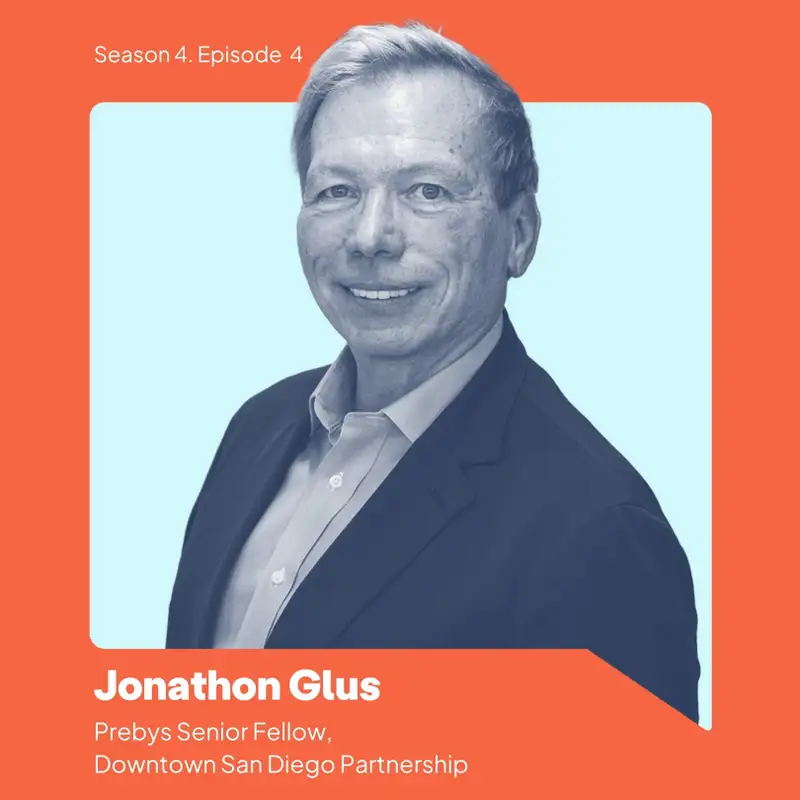
Jonathon Glus: Embracing San Diego as a Creative City
Crystal Page 0:10
We're back with stop and talk. Grant, good to see you.
Grant Oliphant 0:12
It is great to see you,and great to be here, in the context of a conversation that we just had with Jonathan glus, who is the Prebys fellow in the arts for San Diego, working at the San Diego Downtown Partnership on a big vision for reinventing our downtown through arts, culture and creativity.
Crystal Page 0:34
I am excited to have him here, because I recall he was at the city before this.
Grant Oliphant 0:39
He was at the city before this, and I and I think we saw an opportunity, and the city saw an opportunity, frankly, for him to play an even larger role in this sort of independent way. And he is, he is really helping San Diego rethink the role of creativity in in revitalizing downtown and making it be the place that we want it to be as a world class city.
Crystal Page 1:06
Yeah, I'd love to just hear the conversation, and let's do it see on the other side. Okay,
Grant Oliphant 1:16
all right. Jonathon Gluss, thank you so much for joining me.
Jonathon Glus 1:19
I'm glad to be here.
Grant Oliphant 1:20
It is a it is a delight. And I want to say, you know, people heard about you in the run up to the program, but you were the real deal when it comes to being a national export expert on the arts. And I, I think where I want to begin is to talk about what you believed you took on when you stepped into this role as a Prebys fellow working on the arts in San Diego, and what, what attracted you to that role?
Jonathon Glus 1:49
I love that question. You know, I I ran five local arts organizations, local arts agencies, excuse me, so I've been doing the work for a long time, this has given me the opportunity to really focus very intentionally in an identified area. So that's one thing. But number two, you know, cities go through these cycles, and San Diego is at this point where we're going through another phase of growth, and I really want to be part of that change. Prebys is leading it, so it was just a perfect fit.
Grant Oliphant 2:33
Yeah, I appreciate that, and I appreciate your attribution to Prebys. I think there are a lot of players, including the Downtown Partnership, which you're working closely with on this, and a host of folks in the creative and design community who are interested in this. It is interesting that you characterize it as a time of growth, because it could equally be characterized as a time of challenge, where we're struggling to redefine what our downtown is about, in a way that a lot of cities around the world are struggling to redefine what their downtown is about, and certainly in this country. And I am, I am curious to hear what excites you about doing this work at this time, given that it's sort of on the knife's edge between the good and the bad and the potential and the and the things that got us here to needing new potential.
Jonathon Glus 3:20
I think that's the- I think that's what's exciting about it. You and I have talked about this, though before. We've seen cities in the United States go through these evolutions. And yeah, to your point, it's happening all over the world. But we know how American cities in the 70s and 80s were really at a point where they in so many ways they were they were bottomed out. I mean a lot of Americans. You witnessed that in in Pittsburgh, and through a lot of visioning and determination and and centering arts, we rebuilt our cities, and we have this opportunity to do it again. And I think what one of the things that's very exciting to me is the fact that we as a nation have been very intentional about building cultural institutions and cultural infrastructure. We're now centering creatives and creativity, and that's a wholesale change for us that's extraordinarily exciting to me.
Grant Oliphant 4:40
Say a little bit more about that, that difference between institutions and creatives and artists.
Jonathon Glus 4:48
Americans want to understand creative process. They want to be part of it. And we, you know, we've seen this in everything from the way that we watch media. Yeah, and the voice and how people want to be part of that experience today, people don't necessarily want to be to have to see or experience art and culture through a lens that has been given to them. They actually want to be part of it. You experience it, to see it up front, to be part of the craft making, and by centering the actual individuals, the creatives that are doing the work, people feel like they're part of the process. They're part of the experience. And I think by because of that, the creatives become more part of the community. And I'd say wearing my longtime advocacy hats. You know, I've been in the trenches for a long time doing arts advocacy work at all levels. We used to advocate for institutions. Institutions are bedrock. We must continue to invest in them, but it's really now about ensuring that we have creatives and creative workforce in place and protected. And I think that's just more of the larger conversation of making sure that people have the opportunity to do their creative work. Aspire to what they really want to do, what they believe in, and making space and place for them in our communities.
Grant Oliphant 6:29
I love all of that. I think it's important to remind people that you said something earlier about how we had both seen this in our careers and in our experience the process of the arts playing a role in helping a city rebirth itself, in essence, and certainly, I saw that in Pittsburgh with the Pittsburgh Cultural Trust, which really is the reason that Even today, there is a functioning downtown, in that in that city, is because of the role that culture played in in anchoring people to the community, bring bringing people into the core. It's it's been a part of the of a of a city like Chicago's history, where you've seen the arts and culture play such a role and define, redefining what the experience of being in downtown, in downtown Chicago is. Here in San Diego, we're having a conversation about the Civic Center and the when the Civic original Civic Center was built, for all its myriad of flaws in its design, you know, they had the right idea and putting a theater at the heart of it. And so there's been an understanding for a long time, I think, for a couple of generations now, that if you want a city to be lively and for people to want to be there, the arts play a role in that. There's also a very old canard, which is true, which is that if you want to turn a declining area around bring in the artists, and they will take up residence, and they will start doing their work there, and they will make the area attractive to other people. And that happens over and over again. I guess my question is, if we know all of that, why are we having to do it again here in this beautiful city?
Jonathon Glus 8:23
That is the big question
Grant Oliphant 8:27
You did run this for the city for a period of time. I'm really not, but you were, you know, you, you've had the best, I think, vantage point in some so why is it, why is it important that we do this again? Yeah, what have we learned from these past efforts?
Jonathon Glus 8:50
Firstly, market forces are market forces. And we we have seen in every city, as you mentioned, that we we built out these urban cores with artists and creatives and creative businesses, very importantly, the institutions that we invested in that brought a lot of people back into those, into those urban cores to live, to work, etc, which also meant that the artists and creatives could no longer afford to live there, to work there. So following that, covid changed the way we live, all of us, and then people can now live and work in, you know, rural Arizona, and still have a creative business, a creative life, a creative role in really connecting to any city they want to. And I think that's one of the most important things, is creatives are local. Creative Industries are local, but they don't have to be. So the creative talent that comes up through our public school or our communities that are so unique to San Diego, they can and we've been witnessing them moving to pure and aspirational cities elsewhere. And a lot of that is not because, firstly, it's the cost, of course, secondly, it's access to space, but thirdly, and really importantly, it's about brand and invitation. And when I say invitation, 1-:I mean just simply communities, telling artists and creatives, we want you to be part of the fabric here. We value what you what you bring to a community, but you have to do that intentionally. You actually have to say to these individuals, just like you do in other industries, we want you to be here. And a lot of times, it doesn't take much more than that, just making sure that the dots are connected, the introductions are made, that common spaces are created, and those folks know that they are a valued part of the Civic dialog, and they can actually make a living at the same time.
Grant Oliphant 11:13
Has your experience been that you talked about affordability? Is San Diego a tough town to be an artist in?
Jonathon Glus 11:22
Absolutely, absolutely and honestly, I think one of our savings graces over the last 15 years has been the fact that we are a border city, and artists and creatives can actually live and work in Tijuana and still do business here in San Diego. If that wasn't the case, it would be extremely hard to function here, because of prices and because of the physical landscape that we talked about. A little bit a little bit ago, we've transitioned a lot of our warehouse spaces, for example, into live work spaces, business spaces, what have you so kind of the natural type of places that our artists are going to gravitate to, we've built out a lot of that. So we see them going to the desert. We see them going to the mountains, certainly down to Baja. We also see them going to the Denvers and the Austins and the Portland's of the world that have a more of a brand that is about
Grant Oliphant 12:24
they're not exactly cheap cities, either,
Jonathon Glus 12:27
no,
Grant Oliphant 12:28
but you're saying they have more of an invitation. I mean, I wanted to ask you about this because you've had a front row seat to many of the best examples of the intersection between placemaking economy and the arts around the world of anybody, what has a use- What have you seen that you consider to be the best and most promising models that we should be paying attention to? Is it the Denver's and the Portland's and the Austin's? I'm really if it is, what is the model more important than the place. I think
Jonathon Glus 13:01
Those cities have been really successful in their own right. Austin is a great example of a city that really built on their music industry as you know, I'm really interested in it these days, in these the creative enterprise zones that are being stood up in cities like London and Sydney. There's a neighborhood in London called Hackney Wick that is an old industrial area.
Grant Oliphant 13:35
First of all, great name, right?
Jonathon Glus 13:38
It's evolving very quickly. It's kind of like a Williamsburg New York 15 years ago, and they've the City of London looked at it and said, This is an incredibly important place, because it is historically an artist district. We know gentrification is going to happen, so we're going to provide essentially guardrails policy, guardrails to ensure that creative businesses and artists can flourish here. So you if you walk down the street and in that neighborhood now, you see the small pop ups for small fashion lines, and you see the artist studios and the bookstores and that kind of thing. But what's really intriguing is right across the river. You're at the Victoria and Albert east building, which is the new V and a building for Contemporary Arts and the fashion school. So there's this intentional connection to the creative process and the presentation. It's a fascinating area, and you want to be there. It's really interesting just to walk around.
Grant Oliphant 14:43
And you referred to that as a creative district, or creative enterprise zone, enterprise zone, okay, what other models have you seen that you consider to be promising as as potential tools for San Diego, or reference points?
Jonathon Glus 14:58
Sure. Yeah. In a very different way. Some of the work that is happening in Dubai is really fascinating. Obviously, there's a lot of resources, but again, they are very intentionally building out infrastructure for small creative businesses as well as arts and culture. In a lot of ways, they're doing it through kind of made major festival activities, the design Biennale, the art Biennale that they do, inviting individual artists for like residency programs. So they're they're positioning themselves as a destin a global destination.
Grant Oliphant 15:40
And of course, as you said, it's tough to compare ourselves with Dubai, and it's very complicated part of the world at the moment, but tremendous resources that they've used, and it's interesting to hear that they've used also to promote the arts and culture arena. When you look at the landscape around the US, I would like you to name the cities that you think we could learn from. You know when you Who do you think has done something exceptionally well in terms of connecting the revitalization of their downtown for a new era with the importance of arts and culture and creativity,
Jonathon Glus 16:04
I think some of the most interesting cities are the small and mid sized cities, Grand Rapids, Michigan.
Grant Oliphant 16:31
I was not expecting, all right, so say more
Jonathon Glus 16:35
Grand Rapids. Michigan has a deep tradition of design. Through Herman Miller and some of the other design companies there, they established the art prize there they were rebuilding the the waterfront with an emphasis on arts organizations and creative businesses. And it's a city of maybe 150,000 people, so it's compact, but they're really centering their traditions of art and design on this reimagining the city.
Grant Oliphant 17:15
What else you you started to name a list, and Grand Rapids was a small and mid sized city. So what would be another example,
Jonathon Glus 17:23
the river walk in Indianapolis.
Grant Oliphant 17:28
Ah, interesting.
Jonathon Glus 17:29
The museum corridor there,
Grant Oliphant 17:31
yeah, one long, continuous strand of connected cultural spaces. Exactly, right. Interesting is that more? Is that more a marketing thing or a or is it a real transformation of a downtown through arts and culture?
Jonathon Glus 17:49
I think that that city has actually seen a transformation. It has kind of the the the dual parallels between, you know, its deep commitment to sports and building on that, and then art and design, or excuse me, art and culture, building their version of art and culture right along the waterway, both history museums, the State Museum, the art museum, all there in a concentrated way and a really beautiful, beautiful, beautiful space. So it suggests that is actually by intent, by design.
Grant Oliphant 18:30
So when you're talking to people about the relevance of models like that to San Diego, where do you point to say, look, San Diego is has got such an incredible opportunity, but we ought to learn from X. Where do you point them?
Jonathon Glus 18:48
When we're talking about organizations or spaces like Balboa park that is already there, where we're we're talking about institutions that have that are in a space already. I think a lot about Houston, where I did spend 10 years, because of the way that philanthropy and government and individuals came together to invest in probably eight cultural districts at this point, but very, very, very importantly, in the museum district, in the theater district, it was an agreement that all of those live on park spaces. And so part of investing in the cultural institutions is also about investing in those park spaces. So philanthropy for the last 20 years has spent a lot of time making sure that those green spaces in a city that's not very hospitable, weather wise, are beautiful, but also arts rich. So that's one of the first ones that I. That I I point to the other thing is, you know, in a lot of these cities, it is also about lifetime experiences. So Art High Schools have been built in the Dallas cultural district, Houston cultural district, or, excuse me, theater district, I think Philadelphia, and so there's a very clear intent that the experience and the work that's happening in those institutions can actually benefit the students that are in those high schools.
Grant Oliphant 20:33
It also creates a ongoing population of interest that cares about the role of the arts in the community and feeds what could be a virtuous cycle for the sake of the community. All right, so let's be practical about doing this in a city, though, when, when you're working with the Downtown Partnership, tell us why the Downtown Partnership cares about you and the work you're doing in the art space, and how you make the case to the broader community about why downtown matters through the eyes of a, of a an agent for creatives.
Jonathon Glus 21:25
I love that title. Thank you. Sure. It's really interesting to be working with the folks at the partnership. They are very committed to that footprint of downtown, and that is their obligation, top to bottom, everything from the physical experience of keeping downtown clean, keeping it well lit, keeping it safe, but that's just where the work begins. They have to make sure that all of the property owners and the retail in downtown all feel like they are part of a common vision and a common conversation. So a lot of their work is just convening to make sure that everyone in downtown feels like they're moving in the same direction. I have learned a great deal since I've been working so closely with the partnership and the kind of conversations these downtown associations all over the world are having, and what's fascinating is they are all having the same conversation that art and design, art and culture, creative expression, creative experiences, are the driving force In this next iteration of central cities. So it's perfectly aligned. It's perfect timing. In a very practical sense, every American city has empty spaces in their buildings, whether it's storefront spaces or it's high rises, and we have real needs in housing. Our organizations are not individuals, so there's a great alignment here. I guess. The other thing that I would say about it is downtown associations understand how people want to gather and want to want to experience the marketplace, whatever the marketplace is, and we've seen that through pop up experiences and special events and those kind of things, and they're all creative driven. It's really fascinating.
Grant Oliphant 23:32
I think it's fascinating that you, I mean, you just said something that we should, we should call out, which is that downtown associations and organizations like them around the world are all keying in on the importance of creatives and artists and culture in the next round of what cities are about. That's a really significant statement, and I'm curious how well positioned Do you think San Diego is for that next round of reinvention? You know, when we the prebus Foundation got into the civic center work, we did have a conversation with the mayor where we said to Mayor Gloria. Hey, you know, there is a huge opportunity here to be in the vanguard of reinventing what downtowns are about. Let us help you figure that out. To his credit, he engaged in that process. We're now well down the road around a conversation about the Civic Center, which is leading in a really promising new direction and now is anchored much more deeply in a broader visioning or broadening vision around a creative downtown. But conversations and words are one thing, glimmers of hope are another. You know, they, they, they come from sparks and actual things on the ground. What are you. Seeing where you're seeing San Diego moving in the right direction on this
Jonathon Glus 25:04
so firstly, I would say downtown is incredibly well positioned. We already have the outer rings of downtown that are well received, that we've already built out for tourists and kind of big experiences like Petco Park, so people understand that downtown has the potential to be incredibly important to their lives at the same time, and we have that our region's crown jewel just on the north side of downtown, called Balboa Park,
Grant Oliphant 25:42
which is extraordinary, extraordinary, underfunded, though,
Jonathon Glus 25:49
very much. That took too long, very much. But people love that park, and we've learned over the last four months that park is beloved in this region,
Grant Oliphant 26:02
right, because of the paid parking. Exactly. Yeah, exactly, right, yeah.
Jonathon Glus 26:09
But it does mean that people want to embrace and are hungry for civic Commons and civic spaces, whatever that means, right? And we know we don't have that real civic Commons in downtown. We also have a built environment that's actually really nice. We have beautiful historic buildings downtown that we don't necessarily celebrate in the way that we could. We have some large boulevards. We have really solid corporate buildings that were built in the 70s and 80s that are ready for revitalization, and I've learned that we also have a lot of property owners that are very eager to be part of the next iteration of downtown. So I think we're perfectly positioned. What we don't have is those experiences. And I'm obviously, I'm particularly focused on art and design experiences, but thinking of even like the flower festivals that happen in other cities, things that bring people together in very ephemeral ways that aren't necessarily about high dollar but they are about wonderful civic experiences. We haven't really leaned into those kind of things that are going to get people to think differently about this place.
Grant Oliphant 27:33
Why haven't we? Why is that missing?
Jonathon Glus 27:35
I think two things. I think number one, the common understanding, the common belief is its resources. The common belief is resources. I think it's more about will and intent. We know that in every community there, there is that individual or that organization or that time and place where things are aligned that end up bringing major changes or major events. I just don't think that's happened. And then, very specifically, downtown has just been seen as a business place. I can tell you, as somebody who lives downtown, I don't necessarily feel like is it downtown resident, I am invited into the conversation about the future of downtown.
Grant Oliphant 28:27
Oh, interesting. Yeah, yeah.
Jonathon Glus 28:29
And I want to be part of that. And I think the residents of downtown want to be part of the larger and that's, that's, I'm not saying that in in any way discrediting the partnership. They do incredible work. It's just the larger dialog of what this
Grant Oliphant 28:45
that's more of a civic dynamic than Yeah, yeah. I really want to press on this one point, because I think it is important to have clarity around it in any conversation about a downtown in this era, and it requires a little bit of setup. So bear with me, but, but I, you know, we are living in a remote work era, and people, you know, we're seeing a lot of return to the office too. So, you know, there's a counter balance here, but a lot of people are working remotely, at least part of the time. We have a wealth class in American society that is becoming increasingly, increasingly unmoored from place where you know they're they they travel the world. If they don't like the taxes in California, they move to Florida. We're seeing a lot of that at the moment, if, if they're not loving the experience of being in downtown, they move to the suburb, which is an old habit in an American society, but the role of. Place is, I think, more contested than it ever has been in the past. And some people looking at this conversation that you and I are having, and if they're, you know, watching it, they're they they may be having this feeling would say, you know, who cares if downtown survives or not. Who cares if there is this space? Because I can get it by going wherever or moving wherever or living wherever, and that's certainly true of people if they've got extraordinary means to do it. But are we? Is is this truly contested space. Or do you? Do you believe people still want to see the success of their downtown and their civic core in a community?
Jonathon Glus 30:49
I will bet that that person who leaves San Diego to move to x, part of their attraction is because of their urban core of that place they choose to move to.
Grant Oliphant 31:04
I love that. I believe I would guess you're right. Say more about that. Why do you why do you think that,
Jonathon Glus 31:11
what do we do when we travel what? What are those cities that we actually all want to go to, regardless of resources? We talk about? Paris is a very classical tradition or example, but we talk about Paris because it's a beautiful place. It's a walkable place. The built environment is extraordinary, and it's activated, and it's green, and there's buskers that you know, are quirky too. I mean, it's lively. People want that. You know, we we talk about the marketplace. I don't necessarily, when I think of the marketplace, I'm not talking about an abstract place. I'm talking about literally, the plaza, whether it is where the vendors are selling fish 400 years ago, or it's the mall, or it's that downtown commons, but we all want that experience of being together. And every successful city has this urban core that people love, that people gravitate to, whether it's for a celebration of what happened with your sports games, or it's a celebration of, you know, political life, or it's a celebration of the ethos of the city people love that they want to be part of it, and art and culture is always a driving force, Part of that always,
Grant Oliphant 32:41
I think that's such a fascinating concept. And I I just completely agree, and I think it's a wonderful statement that I mean, in a way, what you're saying is, if people become unmoored from a place, it's partly because another place is out competing it in terms of the dynamism and vibrancy of its place and and arts and culture are very typically a part of that. I think that's right. Not willing to concede that to Florida. It's a different conversation when you think about when you think about San Diego, though, why are we slow to get it in terms of the importance of having a creative downtown? I mean, why are you having to lead this con? Help us lead this conversation now
Jonathon Glus 33:38
i i would suggest it's two things. One is there is a reality of resources available resources here, and we know that local government does not have the resources to adequately do what it wants to do. So we know that in philanthropy cannot do everything. Private sector cannot do everything with that said, I think it, it is a question of imagination and grit. And when I say imagination, San Diego struggles to like really decide what it what it wants to be. We are in this phase of change. But are we a major global city with a major global downtown, or are we a region that has a lot of successful places and spaces and bubbles and hubs. I don't think San Diego's really figured that out yet. And then the other thing that I would say about it is, regarding grit, it's hard work to do it, and you you need to be at the table together. You need to when. Say you it does take government, philanthropy, private sector leadership and community leadership to get this kind of stuff done, as we've seen time and time again in different cities.
Grant Oliphant 35:13
And I want to ask you about how you think the con that constellation of forces can get it done, but I want to just key on, stay on this subject for a moment longer, around the factors that have held us back. Don't you think part of it too is that we're a young city that has benefited from both the legacy of the past Balboa Park and the extraordinary asset that that is, and then incredible natural beauty of the place where we are situated. I mean, this is a, this is a beautiful place to live, work and play just period, because you're, you're between the park and and and water, and it's a gorgeous place in terms of weather. Does that make us take for granted what we have and not lean into what we yet need to create?
Jonathon Glus 36:13
Yes, yes. Thank you for framing it that way. With that said, I do think of other cities that are also blessed with environments like this. Barcelona is a great example of a city that it's in it as far as the environment is, is beautiful and it is oceanfront, but it is also a beautiful, active, animated city, right? We can have both, right? We just have to choose to have both
Grant Oliphant 36:48
Great, all right, so you mentioned this constellation of forces that can help make that happen in government and business and civic groups and philanthropy. How?
Jonathon Glus 37:00
ask me that again.
Grant Oliphant 37:05
Well, how would How do you think? What? What do? What do they need to do, working together to make this happen, this transformation that you're talking about.
Jonathon Glus 37:19
Firstly, we have to have the big vision. I'm not sure, for when we're talking about the urban core. We certainly are working towards bettering the urban core. We know that we need to continue to house our population. We need to animate and activate downtown. But at end of the day, what is the real vision? I'm not sure we really have that in place yet,
Grant Oliphant 37:49
and that is, do we need a I'm sorry to interrupt, but do we need a sophisticated vision? Doesn't this process in many other places begin with inroads being made by artists and creatives, or does it in the context of a downtown Do you really need to have that broader vision that sets the table for everyone?
Jonathon Glus 38:13
It's such a great question. I would say yes, and and I'm thinking about when millennial Park was being built in Chicago, that was a grand vision at that time, right?
Grant Oliphant 38:27
And everybody now talks about millennial Park, of course,
Jonathon Glus 38:30
and it's and that was 20 years in the making, and in the early days of that project, it was for corporate leaders and the mayor that said, we are going to get there quietly until they actually got to the point where they could go public. So while that was happening, downtown was animated. There was the Art Institute, School of the Art Institute, those students truly were animating downtown. There was spaces for them to do that, in formal studios. A lot of illegal things were happening. When I say illegal things, I mean just everybody can use their imaginationj. Yeah, exactly. Thank you. So there was a sense of enthusiasm and informal creative expression that was happening all over that kind of lent to this spirit of, we're going to expand the creative experience of this part of the city, right? And it worked, right?
Grant Oliphant 39:40
Did they? Did they do that in the context of a scarcity mindset? No. So how do we overcome our scarcity mindset in San Diego? You know, we, you alluded to this earlier, but we, and some of it is real. You know, there, we're operating in a. Period in city finances when the city finances are very constrained. Every idea for new revenue is hotly contested, one lost recently at the ballot box. You know the we mentioned paid parking as an idea and Balboa Park and saw what, what? What happened there and and, yeah, I interpret that as people love their park and access to their park, and they don't want that to be used as a an ostensible revenue source for the city's broader problems. But the you know, there is a scarcity of resources. There's certainly a mindset around that. And yet, none of those other cities that made that built big parks, or even Balboa Park for that matter, ever did it without making a public investment of some kind. And philanthropy plays a role. And certainly business should play a role, but so should the body politic, and are we? How do we? How do we get past this moment of thinking in terms of what we can't do to what we can?
Jonathon Glus 41:10
I'm thinking about covid and how I'm sorry, not very long ago, we were in, all of us were in a tremendous space of scarcity, and we started planning for post covid. So we know that the the financial issues with the city are going to change, so we need to be planning. But I think before we get there, this is the time where we can really be piloting a lot of the creative work and the creative expression that actually will move us. Well, number one, move us in that direction, but number two, just demonstrate that we have the creative talent here. And I'm thinking about the fact that 80% of the businesses in San Diego are small businesses. So we're driven. We already are driven by kind of a entrepreneurial mentality. Artists are entrepreneurs. So if we're investing in small creative businesses, in the work of individual artists in downtown, the aggregate effect of that actually is substantial, and that's going to elevate the visibility of this type of work. It's going to make us feel like there really is possibility around this as the larger resources become available.
Grant Oliphant 42:48
Now, you've put together an advisory group of 41 or so people in and around downtown who are engaged in some way, shape or form as a stakeholder in this creative concept of a creative downtown. Correct? How would are they? Are they excited? Are they fired up? What do you what do you hear from them about helping to develop a vision for a creative downtown? So we
Jonathon Glus 43:16
had our first meeting yesterday, and it was really wonderful. It was 41 folks that are economic development leaders, policy wonks, downtown stakeholders, and in addition to that, and primarily creatives, so that individuals that run the arts organizations downtown, but also this creative businesses, designers, etc. They are so hungry for this. They want a place. They want a hub. They want this space to actually work together, to share, to be recognized, to be invited, some of what I was talking about earlier. I think the idea of actually, you know, I want to pause on that. I want to say something else the other cities. And I say this with no disrespect to the wonderful institutions in San Diego, but there are initiatives in other cities, like Pacific Standard Time in Los Angeles that galvanizes the nonprofits in a very important way.
Grant Oliphant 44:34
Yeah, say a little bit more about Pacific Standard Time, because not everybody will know what that is.
Jonathon Glus 44:38
So it's a Getty initiative time zone. It's not Pacific Standard Time is an initiative from the Getty Foundation. They invest in as few as 45 and as maybe as much as 80 museums and other nonprofit arts organizations across the region, coming all the way down. Down to San Diego around a common theme every three years. What that does is that creates the opportunity for the education staff in those institutions to work together, the marketing staff, to work together, the executive team, to work together, and all of the creative talent that work within those institutions, across those institutions, to work on common theme. It elevates the unique aspects of those organizations. A lot of times, it's the first time that you see something out of the collections of the museums, for example, that you haven't seen before, and it drives audiences in a different way.
Grant Oliphant 45:43
And your point in raising that as an example was to say that we're not seeing that same level of energy coordination, what
Jonathon Glus 45:52
that we have the opportunity with in this new district to do just that
Grant Oliphant 45:57
interesting. Okay, so when you think about what success looks like five years from now, if, if you're successful in this conversation, you're kicking off and this advisory committee does its job, what are we going to see downtown that is different From what we experienced today?
Jonathon Glus 46:19
We will see an increased number of artists living in downtown in an affordable way. We'll see an increased number of artist studios or workspaces, maybe in high rises, maybe in in the the smaller buildings. We'll see storefronts that have creative businesses. We'll see festival type activities, they're all grounded in contemporary art. We'll see and feel a brand that is a fresh brand, that is about creative expression that is absolutely unique to San Diego. I think that is one of the things that is most important and most exciting. We have the opportunity to actually brand our creative expression, and we've never done that.
Grant Oliphant 47:19
Say more about what you mean by that?
Jonathon Glus 47:23
There's other cities that when you say the name of that city, you kind of instinctually know
Grant Oliphant 47:29
Austin and music,
Jonathon Glus 47:30
there you go, yeah. Well, that isn't instinct. That's because it was branded, right, and that was communicated to you over years. We've never done that, but we can, because we have the talent.
Grant Oliphant 47:43
And what do you imagine the brand would be?
Jonathon Glus 47:45
I'm not sure
Grant Oliphant 47:47
it was. I didn't think you would take the bait
Jonathon Glus 47:54
when part I'm not sure, because I think that's the job of creatives to tell us, and I am a facilitator, but I'm not, I'm not a San Diego creative
Grant Oliphant
Last question. And then we should wrap up, you know, and it kind of connects with the question I asked the when I tried to get you to answer what the city's arts brand should be. But we for a city that has the extraordinary arts assets that we do and the binational culture. You know, it's interesting if, if you ask people about a city in southern California that was known for its binational arts scene, they would name LA, not San Diego, that's right, if you know, and, and, and, which breaks my heart, given what I know about this community. But if, if you you know, if you look at the mix of arts that we have which is extraordinary, the many ways in which we're excellent and the ways in which our arts community and creative community and cultural community all blend in unique aspects of the landscape and the local environment and the local population.
Grant Oliphant 51:38
We should be known as an extraordinary arts town, but we're not. So what would it take for us to make that leap
Jonathon Glus 51:47
an intentional effort? You've spoken a few different times about our natural environment. Everyone knows of San Diego because of our natural environments, and it is extraordinary, and we are the stewards of that. But on that landscape is a community of extraordinarily creative people. We have message to the world that we are an innovation center. We need to message to the world that we're creative center as well. And the artists here are wholly unique to this region, because of the natural environment and because we have this transborder esthetic here that is not Los Angeles, it's not Orange County, it's not Baja, it's a very unique place and space. And the artists we know artists actually respond to where they are. They respond to their environments. So the artists and creatives that we have here actually best reflect who we are. We just need to elevate the extraordinary work they're doing.
Grant Oliphant 52:57
Well, I really appreciate that answer, because I you know, I fully agree that we have all the makings of it, and we have the artists and the creative community for it. We just really need to have a concerted effort to become known for it exactly, and have it be a clear part of our our brand. To go back to your point about the brand, all right, so I won't ask you again this time, maybe the next program. Jonathan, really thank you so much. You know, I was delighted when we had a conversation some time ago about your next role that you were interested in taking this on. I think San Diego is really lucky to have you engaged in the way that you are in, and I think you're going to play a significant role in helping us reinvent what downtown San Diego is about. So thank you.
Jonathon Glus 53:54
Thank you grant. I really appreciate that, and I'm honored to be here.
Crystal Page 53:59
That was a really interesting conversation.
Grant Oliphant 54:05
Yeah, I really thought that it was significant when we were talking about, who really cares if downtown survive the many different ways in which he could point to the role of creative centers as attractors of people, magnets for community, actually facilitators of community. You know, I loved how he talked about people thirsting for a civic commons. You know, we think of downtown as a place of business in San Diego, because historically, that's what it's been but in other cities, it's been reinvented as a place where art happens.
Crystal Page 54:47
Yeah, and I thought it was poignant the moment where you two talked about people may leave here because another city and their downtown core is more attractive, or it offers parks, or it offers, you know, arts and culture like a. I think we don't talk about what attracts someone to a city. We usually talk about why someone leaves. And I think our new strategy around arts and culture are going to lend itself to hopefully attracting more people to downtown and being excited about
Grant Oliphant 55:13
that, yeah, and making downtown a place. You know, I think this idea, I'm struggling with this a lot in my just in thinking about how we make a real impact in San Diego, how unmoored from place our society has become, and this is one of the ways we help anchor people in this place in a way that they really want to be here. I also found it fascinating to ask him about examples, and he talked about creative enterprise zones, and like London, but he also talked about Grand Rapids, Michigan, which I didn't expect. And you know, I shared some of my experience in Pittsburgh, and we talked about Chicago, but Grand Rapids surprised me. Indianapolis surprised me. And you know, the point is, we have amazing bones here, and we have an opportunity here, but we have a lot of folks to learn
Crystal Page 56:07
from, yeah, well, and it makes a lot of sense, right? Like, when you go on vacation, he mentioned, like, you go see different things in different downtowns, yeah? And obviously, we have something to offer, because tourists keep coming here, right? But I loved when he talked about, you know, the idea of the artist and the storefronts, and how we're going to bring into fruition those physical locations for people to engage and see arts and culture. Because I do think it will make a difference in how we experience downtown. Yeah, there's,
Grant Oliphant 56:37
it turns out, you know, I It's so funny how often we relearn this lesson, but it turns out that a lot of the answers to the challenges we're facing we've known for 1000s of years, and when it comes to cities, what people love is they love art and culture and creativity. They like cafes and walkability. They like public spaces that are inviting. They like parks. They like access to nature. They like sidewalks that are welcoming. They want, you know, people, to be able to connect in convivial ways, and we can create more opportunities for that in San Diego, exactly.
Crystal Page 57:21
And I think Jonathan laid out for us what's possible there. I know in a future episode, we will talk in greater detail about the benefit of that. So look forward to that episode in the near future. But I just really appreciate the way you two unpacked. What's really happening downtown at this moment?
Grant Oliphant 57:39
Well, that's a great a great place to wrap up, yeah, thank you for doing this with me.
Crystal Page 57:44
Thanks for stopping and talking.
Grant Oliphant 57:52
This is a production of the Prebys Foundation,
Crystal Page 57:55
hosted by Grant Oliphant
Grant Oliphant 57:57
co hosted by Crystal. Page
Crystal Page 57:59
produced by Adam Greenfield, Tess Karesky, Edgar Ontiveros Medina and Crystal page
Grant Oliphant 58:07
engineered by Adam Greenfield,
Crystal Page 58:10
production coordination by Tess Karesky,
Grant Oliphant 58:14
video production by Edgar Ontiveros Medina,
Crystal Page 58:17
special thanks to the Prebys Foundation team.
Grant Oliphant 58:20
The stop and talk. Theme Song was created by San Diego's own Mr. Lyrical Groove
Crystal Page 58:26
Download episodes at your favorite podcatcher, or visit us at prebysfdn.org