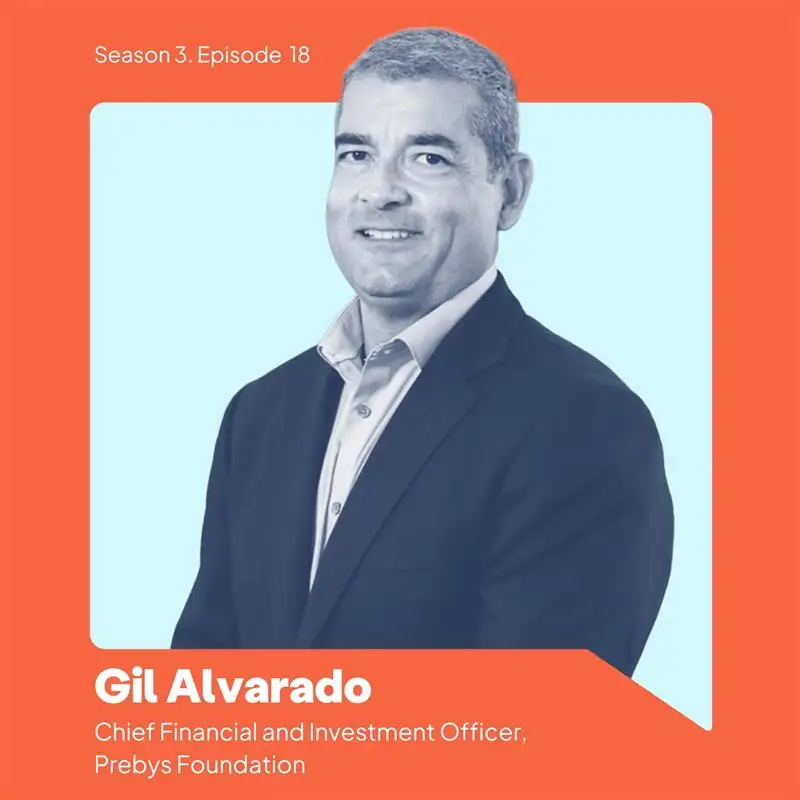
Gil Alvarado: Using All Our Resources to Benefit the Community
Hi. I'm Grant Oliphant, president and CEO of the Prebys Foundation here in San Diego, and it is my pleasure today to be talking with my colleague, our Chief Financial and Investment Officer, Gil Alvarado. We're gonna be talking about a few financial and investment concepts that are important to our work that we hope to help people understand as they try to understand what we do at the foundation. Gil, thanks for being here.
Gil Alvarado:Great. Grant, it's pleasure to be here and great to spend some time with you.
Grant Oliphant:Yeah. Likewise. We have a lot of fun together, but this is a moment where we have to break down for people in the community exactly what it is that we do. So let me start off by asking you, when we talk about impact investing, which we do a lot, what do we mean by that at the Prebys Foundation?
Gil Alvarado:So Grant, when we think about impact investing, we think about our resources on our investment portfolio and how we use those resources that carries kind of a dual purpose. It is a resource that's important for investing, but it also has a community benefit. It has an impact to do things in alignment with what we firmly believe in in terms of our values. And it also brings an additional amount of resource so that we can use those tools to really be additive to solutions that we think are of value to community, but also have more of a long tail or long term.
Grant Oliphant:So you're saying the when we think about an investment at the foundation, we think about how to get a return on it because we have to support the work of the foundation. But you're also saying in an ideal world, we're also thinking about the impact that that investment has in advancing our mission. And how how is that different from what foundations normally do?
Gil Alvarado:So those are two important pieces to what we consider as impact. Because when you think about the roles of function in terms of the investment portfolio, it does have a fiduciary lens to have a certain
Grant Oliphant:So we have to make money.
Gil Alvarado:We have to make money, and we also use that money to provide grants to the community. So they're very two important levers that the foundation has. Impact sleeves carry those same requirements of earning money, but it also aligns with the values of purpose and mission, which carries this doing good and doing well at the same kind approach using those resources.
Grant Oliphant:So give us an example. Like, what what excites you about doing impact investing? Because I know that you really get excited about this work and have been a driver of it here at the foundation. So what's a good example?
Gil Alvarado:You know, this is one of the pieces that, you know, you and I have been working together for several years now, and it excites me that our board has allocated a sleeve of resources from the investment portfolio for impact for San Diego. And what that excites me is we have an opportunity to be innovative. We structure these around an entrepreneurial mindset. And what that has allowed us to do is be very opportunistic in, as an example, creating a Prebys venture fund.
Grant Oliphant:I was gonna ask you how the Prebys Venture fund fits in it. So say more about that.
Gil Alvarado:So so this fund now is designated $50,000,000 fund for San Diego to invest in life science companies and early growth tech companies that we value those companies that are influencing the ecosystem of San Diego. But more importantly, it aligns with our values for health care, for medical research, and it gives a sense that we can invest in San Diego for San Diego in those companies that want to do good in this world. So I'm excited. We brought in a great team, a great staff. We've made five investments in this fund already.
Gil Alvarado:It was launched in April.
Grant Oliphant:Can you give an example of a company or two that we've invested in that illustrate what we're doing there?
Gil Alvarado:So an example of one, we've invested in a company called Welby Health. This is a company that uses telehealth to provide health for access to patients that, may not have access. So the quality of health is done through a technology platform. So one, our core premise is we want to invest in companies in San Diego, and we've done so. This is one example.
Gil Alvarado:Two, the quality of patient care will be enhanced through using these technology advances in these types of platforms. So we're excited about the use of these platforms. You know, the world today is talking about AI, and they're talking a lot about what's happening in the world of this particular technology. It's exciting. I'm excited that we can use it in a way that benefits community through these vehicles.
Gil Alvarado:So that's one example.
Grant Oliphant:Thanks. That's a great example. What's another one that illustrates the point?
Gil Alvarado:Yeah. Grant, so another one that we're very excited about, Aspen Neuroscience. This is a, you know, what I would say just a regenerative science, and it focuses on diseases like Parkinson's where there are now technologies that will allow quality of life for patients. Really exciting stuff, and we are very proud to invest in San Diego companies that are doing wonderful things with technologies.
Grant Oliphant:I mean, what I'm really taking from that example is how it advances. It's a promising technology, but it advances part of our mission, which is to help with research.
Gil Alvarado:It does. It does. 100%. And and I think that's part of what we find exciting about Prebys Ventures is that we have opportunities to dive into these conversations, find companies that are doing some really great work, and make a decision.
Gil Alvarado:And and I think those decisions, hopefully, over time, we'll find ourselves in positions not only from the financial side, but really benefiting society. And that's what makes it exciting.
Grant Oliphant:And when we think about scale in the context of a foundation like ours, where, in a typical year, let's say that the foundation is doing 50 to $60,000,000 in grants, but you're starting with what you called a sleeve earlier of a $100,000,000 in impact investments out of our total $1,200,000,000 portfolio. Right. So a lot of money to work with in that. And the $50,000,000 Prebys Ventures Fund is one piece of that. Give us an example of what you're doing outside the $50,000,000 Prebys Ventures Fund.
Grant Oliphant:Sure.
Gil Alvarado:So one piece, as we described, is the venture fund. The other piece we call opportunistic. And what that means is we're finding values in ways in which we can contribute to housing, affordable housing. Yeah. So we've got several projects that give us an opportunity to really think about what's happening in San Diego, what are the challenges that we're finding in terms of accessibility to affordable housing, and how can we find solutions by investing in those projects that could offer ways to think about what does that mean for San Diego?
Gil Alvarado:How can that scale? So that's one example. We also work on different projects around vehicles of investing that carry, debt component. So we we invest in multiple strategies, one of them being affordable small business loans in which the fund will allow different companies to have access to loans that are accessible that would allow them to continue.
Grant Oliphant:So entrepreneurs who otherwise might struggle to attract funding, you're able to, or the foundation is able to provide resources through that vehicle. So it's interesting, you can cover a lot of different issues all related to moving San Diego forward. How do you think about the foundation's purchase of 401 B Street recently? You know, a big a big office building in downtown.
Grant Oliphant:How does that fit in your in your construct of this?
Gil Alvarado:So that that's an interesting point, Grant, because what we found ourselves in terms of an opportunity to contribute to the impact of civic revitalization. How do we contribute in a meaningful way to look at downtown and activate that? Right. And so on one side of it, looking at it from part of the investment portfolio, it made sense for us to go into an opportunity and buy a commercial real estate property. On the other hand, this gives us now an opportunity to look at an area that's somewhat tired, that leaves an opportunity to give a chance for activation.
Gil Alvarado:How can we think about ways to bring community together? How can we change and be a change agent in that in that space? And so this was just an opportunity that we found ourselves being quite influential, but also one that we have committed to a long term investment. And we're the right players to do so. Foundations have an ability to be long term capital deployers, meaning we can sit out certain cycles of economies, that are much more favorable than other types of, investors in that case
Grant Oliphant:I want to acknowledge, by the way, that the role you've played in all of the investments you've described has been so critical because you're not only a willing partner in those discussions, in many cases, you're the leader. And I remember vividly the moment when we were discussing the purchase of the downtown office building, you saying to me, You know, we've got to diversify our portfolio anyway. Real estate needs to be in the portfolio. We could be buying a REIT in some nameless city, or we can invest in our own community. And that was the conversation that put the deal over the top, which is my way of saying I blame you.
Grant Oliphant:And let me ask you finally in this quick overview how you think about the difference that these investments make in the lives of San Diegans. Some of our grants, it's very clear. You know, we're we're funding medical research directly. We're funding health care clinics directly. We're funding arts organizations where people go and feel a sense of community directly.
Grant Oliphant:How should they think about how they're affected by these investments that we're making of the portfolio.
Gil Alvarado:Yeah. You know, it's a it's a it's a great conversation around what we feel is our role in the community, and that is we wanna use 100% of our resources, not just grants, but all investments to benefit the community. And it may show up directly, as you mentioned in grants, and it may show up indirectly. And what I mean by that is Prebys offers opportunities on the investment side that may not be the the name value at at the front of the list. We may be a part of the the solution.
Gil Alvarado:But I think through that process, community can benefit from, as an example, affordable housing where they may find an opportunity where an individual could have access to a unit that's accessible, affordable, and yet in the background, Prebys had some role in the financing or the tranching to get to that point. So it won't be face value, and it's behind the scenes, but it offers ways to benefit community that in time, we will find our name in a lot of different places that will have meaningful purpose for for community.
Gil Alvarado:And I think that's really exciting for me because it's it's part of part of our work is we can approach solutions in different ways that offer solutions to community that others may not be able to. And that's a that's a real value, I think, to this community. When Conrad Prebys gave us this wonderful gift that he gave San Diego, it really set in motion for me personally.
Gil Alvarado:How can we be as creative and innovative as possible on all levels so that we utilize our resources to be one, impactful, but also prioritize community for San Diego's good.
Gil Alvarado:And I think it shows from our board, it shows from our staff, it shows from you particularly, Grant, as as our CEO, the the ability for us to use all of our resources for purpose, and whether it's short term or long term, I think we're going to have a real strong influence on this community.
Grant Oliphant:Gil, I wanna I wanna take a moment to talk a little bit about how you got here because you have an interesting origin story, and, you know, I think it helps for people to know a little bit about the staff at the foundation. Sure. I'm curious about the journey that got you to this space where you're this high flying CFO, CIO, working in this impact investing space, two decades of of work in the in in philanthropy and
Gil Alvarado:us a little bit about what got you here. Sure. You know, Grant, I've always said that I didn't find philanthropy found in me.
Grant Oliphant:It's true for a lot of us. Yeah. Yeah.
Gil Alvarado:And and it was a different course. You know, I I've always been interested in health care. You know, when I first graduated from college and had my, degree and moved into that route, I always wanted to to focus on health care. And so my goal was to move into becoming a CEO of a hospital system, which I was right on course. Through that process and through kind of just the way things happen, we ended up selling that system, formed a foundation, and I
Grant Oliphant:Suddenly you are in Philanthropy
Gil Alvarado:I never looked back. And through that process, I've learned a lot about myself. I've learned about what I care about. And through that process, I have always leaned towards three fundamental pillars, you know, philanthropy, education, and investments. And and I've lived through that kind of basis that has really guided me on this journey.
Gil Alvarado:I can say by far that I've learned more in this last three years as a team member and as part of the leadership team on how to use all those tools that I've experienced in a way that has been just a really amazing journey. Yeah. So it's been fun.
Grant Oliphant:Well, I'm thrilled to be on it with you. I'm still curious about your background that got you here, though, because and I'm trying to decide to go further back or to further up, but, so I'm gonna go further back first. Okay. And then come back to the healthcare experience that you had. Because you've talked about in other contexts the role that your grandfather played in sort of shaping your worldview.
Grant Oliphant:And I wonder if you would just share a little bit about that.
Gil Alvarado:Sure. You know, my grandfather was a pillar my life in terms of how he just brought a positive energy, you know, always reminding me to stay hungry, not just food wise Yeah. Yeah. In life. And, you know, I I always refer to him as the the young old.
Gil Alvarado:He was very young at heart, and he carried with him a beacon of always looking forward but with a sense of optimism. The the positive nature and the energy that he portrayed really had an influence on how meaningful life can be when you have the right attitude to take on the challenges that you face. We can all dive into the negativity that we see, and it's very easy to fall on that course. Think what it brought to me were really three areas of confidence. One, having a positive attitude.
Gil Alvarado:Two, looking forward to the future. But three, remembering where you came from. I think that's really important because it it set ground for me to recognize for myself, for my family, for my kids that it's important to have grounding, but also with those same fundamental values that he taught me. I can see it in my kids. I can see it in the team that I, work with. And my hope is that if if I can continue working in that way to change, to be a change agent, to have influence, I can think, you know, I've done a pretty good job.
Grant Oliphant:You know, I can attest from from having watched you that you convey those values to your own kids. I'm curious, you know, when was it your grandfather who helped you develop these three pillars you were talking about? Philanthropy, education, and investments, or was did that come later?
Gil Alvarado:It it came later, Grant. You know, what I found myself involved with more and more is, you know, finding, my course like everyone does. You find your course. And through that process, I ended up finding a course in philanthropy where I've moved through life through several different foundations in different parts of the country. Through those conversations, I I did end up in education, an adjunct professor at University of San Francisco, and that gave me an opportunity to really experience the graduate programs of finance and really the energy of students and what that brings.
Gil Alvarado:And then when you think about investing, you know, I I come from an accounting background, but yet I'm I'm probably not your typical accountant. I I do tend to move towards, by more entrepreneurial spirit. And through that process, I found a love for investing. Yeah. And with that, it's carried an opportunity for me to learn not only what I can bring to the foundation, but I carry other roles in leadership and other board service where it's given me an opportunity to look globally at what is happening in the world and use investment as a vehicle to really find myself, thinking about the future.
Gil Alvarado:It's it's exciting.
Grant Oliphant:I I I really like how you formulate that part of your story, and I I it makes me wanna come back to your accidental entree into philanthropy. So you're with this health system that decides that it's going to sell off and form a foundation, and you're suddenly with the foundation. And that's Sierra Health, correct?
Gil Alvarado:This was before Sierra Health. This was Paso del Norte Health Foundation. This was a very similar, a a border city.
Grant Oliphant:Yeah. Because you were living in El Paso at the time.
Gil Alvarado:That's right. The fundamentals of El Paso and San Diego are very similar. The culture, binational. You have Juarez, Mexico. You have El Paso.
Gil Alvarado:You have Tijuana. And that was my first initial experience around jumping into philanthropy. Okay.
Grant Oliphant:Then when you went to work at Sierra Health, you really started getting into some of the impact investing work. And what was it there that made it either important for you to begin to explore impact investing or possible? I mean, did you get there?
Gil Alvarado:You know, I felt that, Sierra Health gave me an opportunity to become more entrepreneurial in how I advanced, our strategies. An example of that is, we had a private foundation, but we also developed a startup, 501c3 . And that five zero one(three) over time, over twelve years, we grew into a business of over 1,000,000,000 in federal and government contracts. So the idea
Grant Oliphant:Over $1,000,000,000.
Gil Alvarado:Over 1,000,000,000. And so that gave us a chance to redirect our mind and process to a revenue based model away from a foundation model. And so this gave, again, another question around what else could we do to have impact? Both organizations carried impact regionally but also statewide. That also began the journey to develop the San Joaquin Valley Impact Investment Fund where I served as president of that fund in the Central Valley under the idea that the Central Valley Of California is underserved in terms of capital.
Gil Alvarado:And so as a result, we formed a fund that would allow us to develop affordable loans through CDFI mechanisms. And through that process, I really began to learn how challenging it can be both fundraise and to develop strategy. But it taught me a lot about how you approach impact investing from a community base and have an all inclusive model that really allows for some really spectacular results, which,
Grant Oliphant:you know, very Like, give an example of what was spectacular that you were that you take a lot of pride in from that time.
Gil Alvarado:So, you know, I I I take a lot of pride because we we developed what I find exciting, like any startup, which Prebys, in in a way, you think about it, it it is my third startup. And what's exciting is you begin with an idea, and then that idea gets shared. And then that excitement raises the level of the energy in the room, and then that energy actually creates a product. Yeah. And that's what's exciting.
Gil Alvarado:The product was the fund, and that the fund then deployed capital to the
Grant Oliphant:CD CDFI, the banks. And then from the bank because the community intermediary that gives money to community development organizations and facilitates the whole engine of community growth.
Gil Alvarado:That's right. And so you see these community members now benefiting from an idea, and that is exciting.
Grant Oliphant:So, Gil, you're networked nationally. You know all the folks at the major foundations who are your counterparts, and you've spoken at all the conferences. And surely you must feel that you've proven this model over and over again, and yet it still remains a relatively rare thing in the philanthropy large foundation field for, and correct me if I'm wrong about that, but it's my perception that the majority of foundations still find themselves in the position of wanting to invest their assets in a way that maximizes the returns without considering social impact and then doing the social impact through the grant making, So, why is that old mindset still so dominant? And how do you attempt to persuade people to think about it differently?
Gil Alvarado:I mean, there definitely is a large percentage of foundations out there, Grant, that see two sides of the coin. The the side that generates the money or the income, the the investment side, and the philanthropic side, and there is a divide. I think the challenge you face with a lot of governance aspects around that is really around legacy. So what I find is in entrepreneurial or early stage foundations, you have an easier route to have new ideas and new roles versus, say, a historic foundation has been around for X amount of years. It's very hard to churn that engine to a different Right.
Gil Alvarado:Yeah. So that's one aspect. I believe the power of change for that is by example. If you can see an example of, say, a solution that happened in another city or another situation or the project, then I think that offers a way for those foundations to ask themselves, how can we maybe think about different ways to to maybe replicate or to find ways that that find solutions in that same manner. And so yeah.
Grant Oliphant:So, one level, I think it's such a great observation that one level of pushback that happens with foundations when they consider this is, But we have an entire history of doing it this way. Yeah. So legacy, you referred to it as that. And it's easier. And, you know, in our condition, we didn't have that history.
Grant Oliphant:Right. So our board was willing to look at it and say, Why not do it a different way? Because we didn't do it that way. So that's one thing that gets in the way. But isn't there still a perception that impact investments are not as good as regular investments?
Gil Alvarado:There is in the field, as investments field or investment, finance. There is a perception that you have a certain, risk attribute to the portfolio, meaning you can only make money a certain way, and this may be a dilutive component to that, meaning it's gonna take away from returns. I think that school is yet out to be determined because there is proof that you can still have great returns with impact strategies. Right. And so there is I think leadership is key to this, particularly on the investment and finance world.
Gil Alvarado:And I think you're finding more and more influence on that. But I would say, Grant, for the majority of foundations, there is still a heavy covenants to the investment side being separated because of a couple of other factors. The way, those foundations are structured from the compensation to the attributes of how those particular functions are rewarded don't allow for maybe opportunity for them to take some lens of risk. And so you have those systems baked in, and sometimes that needs a little changing. And I think if you can have change to that layer, it could be influential in that.
Grant Oliphant:I think what's important about that is, I mean, a number of things, but one of the things that leaps up at me is in fairness to folks who are struggling with this still, as they look at risk, some of these investments are harder to quantify in terms of the risk, right, they represent. Right? I mean, it's just a fact that it's because there's so little history investing in those spaces or community investment might be a one off, and then how do you gauge the risk of it? It's harder.
Gil Alvarado:It is harder, and do recognize that, you know, the toolkit, the toolbox that every foundation has in this scenario, you have a line, and that line defines below market rate tools. Yeah. In the case of below market rate, that could be what's called a program related investment or a grant where there's no return Or Yeah. A And then you have market rate, which are a blend of impact and investment grade, which is a mission related investment. And then you have your kind of pure investment that doesn't factor in these considerations.
Gil Alvarado:I think that's very real. Yeah. And I think for foundations, what has always been powerful for me is that you can blend all of this in an aggregate target. So in other words, you can take all of these pieces and add them all up. And if you can add them to a number that's a certain number or higher, then that's your solution.
Gil Alvarado:Yeah. But if you're always aiming for as high and optimized and there's no wiggle room, it makes it very challenging Yeah. These conversations.
Grant Oliphant:So folks who are responsible for investment portfolios spend a lot of time thinking about that. As you talk to folks around the country about this, I wanna come back to this. How do you persuade them to care? You know, why does from it your perspective, you've done this work now for a couple of decades and you've modeled different ways of doing it. Right.
Grant Oliphant:You started a couple of funds to do the work. When you explain to people why it matters without lecturing them, sure, because nobody wants to be lectured, and everybody's dealing with their own but why does it matter that foundations get better at doing this work?
Gil Alvarado:It matters, Grant, because foundations have a certain level of responsibility that's quite different than any other entity or organization or industry. I think for those that are leading foundations, particularly on the investment side, there is really three areas that are differentials. One, long term capital. The foundations in perpetuity, meaning they're here to stay in the kind of forever phase, patient capital is our advantage. And with that, you have an opportunity and a responsibility, in my opinion, to really think about what those resources bring to community.
Gil Alvarado:And you have the affordability to have longer tails in time. So that's one aspect of being a differential. The the other aspect is as you enter into conversations with community and the needs are there, grants will carry a certain time length. It's kinda like if you're if you're thinking about being a a bond manager, you call it a duration or a yield curve, and and the bonds can be at certain points. Grants are at a certain point.
Gil Alvarado:You have other tools. And so I think educating those in that space around what the spectrum of all tools offer because it is a spectrum. But at the end of the day, everything's about risk. And I think foundations carry the same amount of risk as any other fund out there, any for profit fund with a different alternative to the outcomes. But but the carrying of responsibility, I think, in in the foundation world for these roles of leadership should always be focused on community.
Gil Alvarado:I think that's fundamental. And if you're not in that space, and if your mind is not geared towards that level, I think it may not be the right or trick for you to be thinking about, so.
Grant Oliphant:But I love that. I love that the way you both started and ended with the sense of responsibility that comes with having these massive resources and thinking about how to deploy them more fully, not just through grants, but through investments in ways that are consistent with mission, I think is a very powerful statement. Not as easy as it sounds because I think sometimes people oversimplify that and make it sound like if you and I decided tomorrow that we wanted to go to our board and say we want to deploy the full 1,200,000,000 of our assets and impact investments, the first question they'd ask us is, what are those opportunities? And it takes a long time to realize those opportunities.
Gil Alvarado:To that point, Grant, the basis around managing a portfolio when you think about the investments that are not per se earmarked for investing, those have a certain cadence on risk tolerance and a certain cadence on time and a certain cadence on how you think about those attributes, philosophy, people, process. Impact strategies take a longer time to develop. These are at the fundamental level, you could think of them as ten year projects. And so when you think about ten year projects, what does it take to think about starting those projects, the relationships, the investors, the strategic partners, and it takes time. And at the end of the day, that time can be evaluated and measured both on impact, what how did that influence community, and on return.
Gil Alvarado:Did you meet your KPIs or your indicators to the return that you were seeking?
Grant Oliphant:Now, don't wanna get too far ahead of where we are right now, but I do wanna signal how broadly we can think about or are thinking about this. The way that you have structured it so far is we have made a major commitment through the Prebys Venture Fund of $50,000,000 to support, and we've talked about that, to invest in companies that are advancing the frontiers of medical research and what we call life sciences. Then you talked about the, you know, the opportunistic opportunities that will come our way, some of which include affordable housing as an example, where we're trying to make investments that increase the supply of affordable housing. We've talked about the way in which we've made a major real estate investment to advance the redevelopment of downtown and the Civic Center in particular through the purchase of a downtown office building. But you're thinking even more broadly as you look at this.
Grant Oliphant:You're looking at San Diego as an economy and an ecosystem, and you've been thinking about the future of climate change, which is going to have and is already having real effects on the community. And you're looking at the blue economy, which, this community is uniquely positioned to take advantage of because of where we sit. Can you just say a few words about how you're seeing the synthesis of a Sure. Of a green economy, blue economy play, at a time in history what doesn't seem favorable for that?
Gil Alvarado:You're right, Grant. And I I think you've you've captured the essence of what we all think about in terms of the health, particularly San Diego. San Diego's ecosystem is quite unique compared to other parts of the country. You know, I I was just, in Berlin last week, and the investment conversations are far more different than the investment conversations here in The United States.
Grant Oliphant:In what way? What do you mean by that?
Gil Alvarado:More geared towards sustainability, alternative or green technologies, looking at climate as a priority, factors known as ESG, environmental, social, governance.
Grant Oliphant:But are embattled right now because of the administration's views on those.
Gil Alvarado:That's right. And so so with that, you know, looking at how we can still pivot the portfolio to the blue economy in ways that
Grant Oliphant:Explain the blue economy. Sure. I used the term, but explain what it means.
Gil Alvarado:So the blue economy, when we think about all the resource, including the ocean, you know, what what makes the ocean a resource for for community? And you can think about water, waste, energy. All of those factors can be a part of that kind of lens of what that resource carries. Climate is a big factor in that category because you have an influence that is correlated to that. And so we think of the blue economy in San Diego as what are the challenges we face.
Gil Alvarado:The Tijuana River is one aspect that has enormous impact, whether it's Department of Defense, whether it's the Navy, whether you think about the public health aspect, when you think about the economic influence, that is front and center influencing having a impact on San Diego. When you think about waste and energy, we think about the energy, transition. We all have cars that are either hybrids or electric. How is that gonna be powered in the future? What are the sources?
Gil Alvarado:So those aspects are really influential in how we're thinking about what are the solutions, what are the ideas and technologies that are going to particularly out of San Diego. There's a lot of conversation around what is the next iteration of supporting as as we all are looking at AI. I've heard a a stat that over the next ten years or so, it's gonna be amounting to something like 8% of our total power is gonna be focused on supporting this AI technology. Where is that energy gonna come from? What is the impact on the
Grant Oliphant:So the advances of a company like General Atomics, is based here working on fusion, and the work of companies that are working on sustainable solar or wind or whatever all become more important.
Gil Alvarado:More important. And I do feel that that is one element of the importance of thinking about where can portfolio resources have a game changing impact, maybe not in the short term, but over time contribute to that. Another element may be infrastructure when we think about, you know, what is today's world in terms of looking at pollution aspects, looking at how environment is impacted, what are ways in which there are solutions or technology. When we think about the creative economy, how can we support that? The creative economy, meaning entrepreneurs that are on the ground thinking about starting a company, whether they're artists, bakers, you know, that is the small business dream of how do you support your family by creating something in your own business and growing that.
Gil Alvarado:We talked a lot about, you and I, about ESOPs and how employee owned companies have a value.
Grant Oliphant:Building wealth for future generations. Right.
Gil Alvarado:There was last week, Mark Cuban talked exactly about this, pushing more ownership. It's Mark and us.
Gil Alvarado:You know? I know. We we need to continue to talk. You're right, Grant. There's a lot of ground to cover, and I think the
Grant Oliphant:other So so let me let me ask you then, and and we'll wrap up here. But let me ask you then, I mean, it's so exciting to talk about these things. And what what I hear you describing is a kind of comprehensive picture of how through our investments to move San Diego forward as a national and international leader on these important fronts. And and yet, there's always a small voice in our heads or in adjacent spaces where people are talking to us saying, you know, you guys have a nice portfolio, but it's a trivial amount of money compared to the size of your economy. So why does our portfolio matter?
Gil Alvarado:Our portfolio matters, Grant, because we have a voice through the resources that we carry, and that voice matters because collectively, that voice can carry change. And while some of the if you think about the scale and magnitude of what we are facing, sometimes it's a daunting thought. But our portfolio matters because we can actually have change at a level locally, which then grows regionally, which then grows nationally. And if you can create momentum by using those resources, I think it's a very powerful thing. You know, it's a little bit of a bottom up approach in some ways, but I do feel given the size of our portfolio, even though trivial, it is meaningful.
Gil Alvarado:Yeah. And I think if you can impact that meaningful resource in a very focused or deliberate way and bring on strategic partners, I think you can find yourself in some pretty amazing opportunities in the future.
Gil Alvarado:So Gil Alvarado, from your lips to God's ears, I'm gonna leave it there. Thank you for doing this with me and for doing it all with me. You're a great partner.
Gil Alvarado:Likewise, Grant. I appreciate everything that we do, and appreciate the partnership and working with you as well. All right. Excellent.
Grant Oliphant:This is a production of the Prebys Foundation.
Crystal Page:Hosted by Grant Oliphant.
Grant Oliphant:Co hosted by Crystal Page.
Crystal Page:Co produced by Crystal Page and Adam Greenfield.
Grant Oliphant:Engineered by Adam Greenfield.
Crystal Page:Production coordination by Tess Karesky.
Grant Oliphant:Video production by Edgar Ontiveros Medina.
Crystal Page:Special thanks to the Prebys Foundation team.
Grant Oliphant:The Stop and Talk theme song was created by San Diego's own mister lyrical groove.
Crystal Page:Download episodes at your favorite podcatcher or visit us at prenysdn.org.