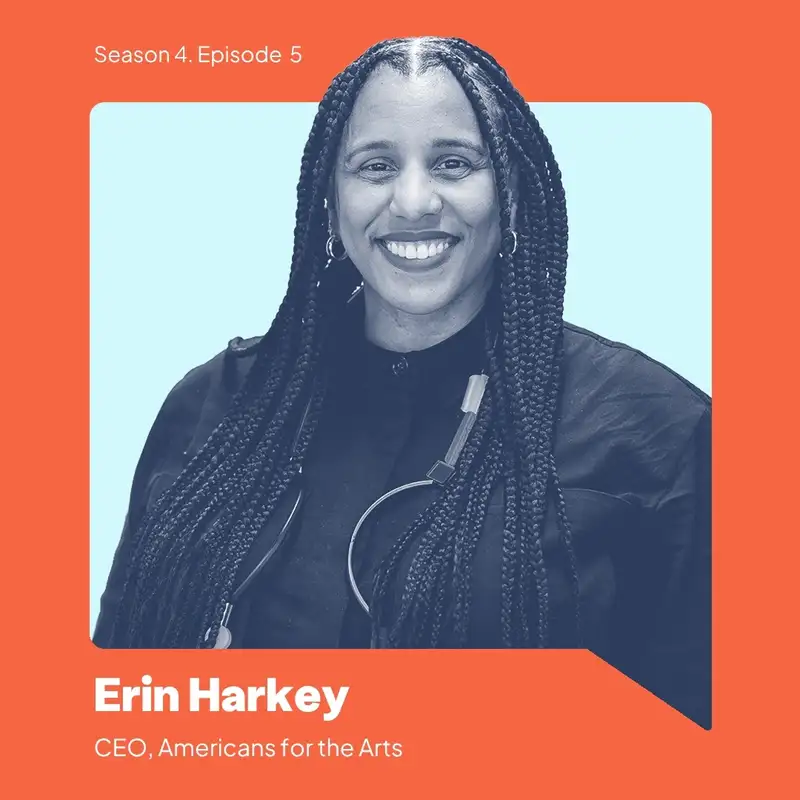
Erin Harkey: Arts, Culture, and a Healthy Democracy
Crystal Page 0:00
We're back.
Grant Oliphant 0:11
We are and for a terrific conversation,
Crystal Page 0:16
yes, anytime we talk arts and culture, I'm on the edge of my seat. Yeah, and this conversation,
Grant Oliphant 0:21
this is a this is a subject that we love, but this time, where you were talking with a person who straddles the the national and the regional and the local worlds, Erin Harkey, who heads the Americans for the Arts
Crystal Page 0:36
Yes. And those who follow the work of Prebys may recall the economic impact report they did about arts and culture and the value of that to our community, right? But tell us about Erin. What do you know about her?
Grant Oliphant 0:47
Well, Erin, you know she she cut her teeth working in local community, and she worked in the arts scene in LA and then she went to Chicago and became a big wig in policy and culture in Chicago before taking on this national role. And she has a very complicated role, because she is trying to help arts artists and arts organizations around the country in all kinds of communities, and at the same time be a voice for the arts at the national level. And I think she's doing a masterful job.
Crystal Page 1:26
Yeah, and we're lucky, she was in town for an event in the South Bay, and we just got lucky to have her come by and visit us. Shall we dive in?
Grant Oliphant 1:34
Why don't we just do it?
Crystal Page 1:35
Let's do it.
Grant Oliphant 1:39
Erin Harkey, thank you so much for being here. Thank you for having me. I'm really excited. It is a delight. And you and I just had the opportunity to talk for a little while, and I can see why you were the perfect person for the role that you're in. But before we get to that, I want to talk a little bit about why you got into the arts in the first place, and why you why you have dedicated your career to the notion that it's important for other people. What drew you into it?
Erin Harkey 2:09
Well, you know, I don't- That's actually kind of a hard question for me to ask, because I just feel like I've been fortunate that things have sort of come naturally to me in terms of my career. You know, of course, you know, as a young person, I was, you know, really fortunate that I had a lot of exposure and access to the arts. I was a young cellist.
Grant Oliphant 2:37
Ah, interesting,
Erin Harkey 2:38
yeah. So I played from the time that I was five, all through high school and was in, you know, competing youth orchestras and all of that. So that certainly was a healthy exposure. But my parents were also, I think, deeply committed civic people. My mom's a teacher. My dad was a small businessman that also was a cultural producer, so he produced jazz festivals and, you know, ran for elected office and all of that. And my mom really sort of demonstrated integrated arts learning in her classroom before it was a thing. So they just had really interesting, I think, practical careers that saw I saw them, you know, sort of value the arts and what they did. So it was kind of natural. I think that I went into a career that was sort of intersecting in both, like public service and and the arts. And
Grant Oliphant 3:32
did you have a value around public service?
Erin Harkey 3:35
Yeah, for my dad, through him, and for my mom as a public school teacher, right? Yeah. And I think as I, you know, developed, I was always, you know, in orchestra, loved writing as a kid, and then went away to college and went to Howard, and was studying business, actually, was studying marketing. And I had some free my senior year, I had some, you know, free time. I hadn't finished all my requirements, and so I took a Afro Caribbean art history class, okay? And I was like, Oh, you mean, like, you can actually, like, study this and sort of dedicate your time to it. And that was the kind of aha moment. And then from then on, I just sort of like sought it out, you know, as a sort of personal betterment, to learn more about the arts. And then found the graduate program at USC that was a combination of urban planning and public art studies. And sort of saw that all of these things that I was interested in or had seen in my life, right, could come together. And I think just, you know, paying attention to that and getting into that program really was like the. best decision. And, you know, the career is certainly like,
Grant Oliphant 5:03
I love that story so much because, well, for one thing, it's the story of an MBA being stolen away to the arts, yes, somebody studying business being stolen into the arts community. But also what it underscores around personal exposure, and just so you had the exposure early in life to the opportunity to think about arts as integrated in your life and public services. Yes, that is integrated into your life. Okay, so that takes you into a career that, again, before we get to what you're currently doing, you were working on the on on the regional, local level and regional level, and you got to think about the role of the arts at a state level. And I'm curious to hear from you about what you learned about the importance of art in community. Yeah, during those early years in your career,
Erin Harkey 5:59
you know, I worked in museums, you know, I worked at the Japanese American Cultural Center. I worked at the Music Center. So I certainly had, you know, sort of nonprofit experience. But the first job that I had in public service was working at the long the Arts Council for Long Beach, and we were doing a lot of work with the planning department. So I, you know, had this planning degree, and I really just saw how art was a tremendous catalyst for so many different things that, you know, we were trying to achieve in terms of economic development, community revitalization, you know, building social cohesion and communities Like I saw, like, it's real practical use. When I started a vacant lot program that was using art to transform vacant lots. So, you know, I saw this sort of, was able to see the kind of practical potential of how arts could be utilized in particular communities. And I think that grew really, I think, in an evolution of that time, really starting to reframe the narrative around what arts are, right, and understanding that it showed up in different ways and looks different in different communities, and it's all valuable and valid, right? And so I also just saw it as a way to, like, really celebrate people and how they interact and sort of express themselves. And when I got to Chicago, I think one of the things that I'm particularly proud of is just that we were able to like integrate the arts across the entire enterprise. So it wasn't just the Department of Cultural Affairs that was doing the arts things. We were working with public health, we were working working with planning, we were working with libraries and parks, right? All of these sort of city departments have use for artists and sort of creative strategy and vision and implementing their missions.
Grant Oliphant 8:01
So I we're going to come back to this, because I think that is such an important part of the work that you're involved in, and it's important to our audience in the work that we do. But let's skip ahead very quickly to Americans for the Arts and the role you've taken on now, so that people have a full framing for this conversation. How do you think about, how would, how do you articulate now, for folks who may not know anything about the arts world, what the role of Americans for the Arts is, and I recognize you're in the middle of changing that. So the the answer is complicated, but can, how do you explain that to folks who are who are unfamiliar, yeah, or who may have the the old answer and yeah?
Erin Harkey 8:52
Well, I think the old answer is still part of who we are, you know. And I think historically, AFTA has been the largest arts advocacy organization in the country, and I think we have that distinction because it's national in scope, and it's also not discipline specific, so we represent the entire ecosystem. And you know, the mission statement is basically to advance the diverse networks that support the arts in America, and we have historically done that in a couple ways, primarily through research. So we do a lot of economic impact and public opinion research about the arts, you know, that the community can use for advocacy purposes on, you know, sort of national, state and local level, in terms of our art impact. We also, you know, obviously have marketing communications and all of those other things, and a healthy government affairs team that works on federal policy, primarily appropriations for the National Endowment for the Arts and the National Endowment for Humanities and to some extent, IMLS, which is the Institute of Museum and Library Services, but also works on various sort of arts related policy matters. So that's been the historic sort of mandate. And I think right now, in you know, a time, I'm sure we'll talk about this sort of in time of, I think, great fluctuation within the arts community, thinking about how the organization now grows, I think to meet some, you know, pretty challenging circumstances, and thinks about the future of the field is, I think where we're we're at
Grant Oliphant 10:26
Great. Thank you. That's, I think that sets the stage well for the next question, which is about the moment that we're in with respect to the arts. And, you know, it's hard for me to believe that anybody who would be listening to this program wouldn't be aware of what's going on nationally in terms of the administration's posture on the Arts, the challenges that arts groups are facing in various states around the country, and just the economic environment that we're dealing with. But I would love for you to set the stage a little bit for us in terms of what folks do need to know about this moment and the tensions that the arts community is facing.
Erin Harkey 11:10
Well, I think, you know, the the arts community, I think the nonprofit arts ecosystem for, I think, more particularly, you know, has been in flux for, you know, quite some time. I think covid was especially hard on the arts, in particular performing arts, but it just sort of covid just sort of exasperated, like already existing challenges within the field, and the influx of cash that we had through federal relief programs allowed us to stabilize some of those organizations, but those underlying issues were still there. So changing nature of audience behavior, changing nature of, you know, philanthropy, you know, individual giving, corporate giving, private foundation giving, all of that stuff is is down or not keeping pace with inflation, right? So there's some real, like underlying, sort of fundamental structural challenges that exist within the arts ecosystem in this country. And to add to that, now I think we also are having some federal instability, right? So the nature of public funding in this country is also more unstable that has than it has been when I started on the job. So a year ago, almost to the day. It's like a year and a week. Congratulations. Thank you. You know almost instantly we saw you know through Doge collapse of public funding going to arts organizations through the federal cultural agencies, again, which is the National Endowment for the Arts, the National Endowment for Humanities and the Institute of Museum and Library services organizations that were counting and had been promised funds and had essentially developed budgets around those that funding saw that funding taken away. And the thing about federal funding, that is, I think, particularly important, is that it it gets multiplied. So a lot of times it will require what we, you know, sort of call, like a one on one match, so that money comes into a community, it then requires the organization to match that through other sources. So the federal investment is a sort of incentive and a multiplier as you go down through states and regions and local governments. So when you release that funding, it's not just that funding, it's then what that sort of catalyzes in terms of additional resources to organizations, yeah.
Grant Oliphant 13:44
I was going to ask you, what, why federal, federal money is a part of the equation, but why it is important to arts organizations beyond the money itself, yeah. And is that the answer? That it is the, is it? Is it simply the multiplier effect, or what else happens to organizations when they lose that money?
Erin Harkey 14:05
Well, the thing about public funding and is that it is the most equitable way to support the arts in this country that we have. So the National Endowment for the Arts did a study that I quote a lot, where they mapped their direct funding to arts organizations adjacent to the top 1000 arts foundations in this country, and they were in some 700 more counties. And so these are rural, small communities, right? Or small urban communities that do not have the benefit of, you know, high net worth individuals or philanthropic support. So you know that is true for, you know, public broadcasting. It's true for the NEA like these funds are really important in communities that don't have access to other sources of funding. So that's the reason that public funding is in addition to the sort of multiplier effect. The main reason that this is important is because it funds in places where there are no additional resources.
Grant Oliphant 15:00
You know, I really appreciate that answer in part, because that you point to the various constituencies that you're working with, and I I'm more mindful than ever of the complexity of your role where and let me see if I get this right, and correct me if I'm wrong, but you're you're coming into a role where you're being asked to modernize the way Americans for the Arts works with partners and how it looks at the classic definition of the arts, so that it, for example, gets at a more equitable distribution and set of audiences, and is less purely driven by a top down institutional model. At the same time, you're asked to work across broad philosophical and political divides, from the reddest of red states to the bluest of blue cities, and to somehow be a part of promoting the arts in those environments. That's a lot to wrap your head around, coming into a role like this. So how are you thinking about getting that balance right?
Erin Harkey 16:21
Well, here's another great statistic that I that I like 76% of Americans believe that the arts are personally important to them. So like in a country of this size, that's everybody, that's a lot of people that agree on something. And I will also say that
Grant Oliphant 16:40
And it's surprising given the dialog that happens around there.
Erin Harkey 16:43
Sometimes, sometimes, yeah. But here's the other thing, even with, you know, all of the challenges that we saw with the federal government and the funding through the cultural agencies, you know, the administration last year, in the the budget that they proposed to Congress, zeroed out the cultural agencies like zero but appropriators on both sides of the aisle restored the funding to those agencies. They're completely whole. It's one of the only federal agencies that didn't receive a cut last year. And so it is something that we agree upon, and it is, you know, something that has broad bipartisan support, which you know, in this climate, hard to find things that you agree upon, but if there's something that you agree upon, like, what is that that that is an entry point, I think, for conversation and For dialog and for finding common ground on other things. So I think we try to really hold on to that, and, you know, we try to, you know, celebrate that as a, you know, key talking point in terms of our advocacy. Because I think it's an important thing that this really does exist in every community. It looks different in every community, but it exists in every community, and people of all backgrounds, you know, find value in it.
Grant Oliphant 18:07
You know that very much is the answer to something I wanted to ask you, but I'm gonna ask it anyway, because I think there's a there's there's more to be gleaned there. The the assumption that what we often hear in the national debate about the arts, especially in terms of how it has been framed by this administration, is that the arts is a niche consideration. It's an elitist activity. It only represents part of the people. These are the arguments that have been framed. So what I wanted to ask you is, how do you counter those arguments and help people understand that, even if they're not in the arts, this is an issue that they should care about, and I'll stipulate that I heard your answer on the previous question where you already answered that people do care about it, the passion around it is much broader than that argument would suggest. But how else do you tell people or convey to people? This is why you should care about this, despite those arguments.
Erin Harkey 19:15
Yeah. Well, I think you know, for the majority of my career, you know, I definitely have seen a change in the way that people are that are in the arts, talk about and also acknowledge, right? I think the way that the arts exist in this country. Am I going to get a little into the weeds and sort of bring up something that was an important movement when I was coming up, which was the sort of creative place making movement that was, I remember it, yes, right? So our town and then art place, right? And I think one of the reasons that that was so like such a fundamental and important shift was that we recognizeed Culture and Art in the like, broadest possible terms, right? So, you know, State Fair was just as important as, you know, big museum, right? And it allowed us to sort of reframe, you know, culture in terms of hyper local expression, not every community, most communities, right, don't have gallery or a theater or a large museum, but culture is everywhere. Arts are everywhere, and so our ability to not prioritize that and to give as much energy. And I think most of us that are in public service, or, you know, in these sort of jobs that we're, you know, looking to fund the arts, find a lot of value in those kinds of things, right? Those things that are happening locally, those things that are happening informally, those things that are happening in churches and in basements and in community centers are just as important and if not even more important in some ways, because that's really what culture looks like in America. So we need to just find a way, I think, to tell more of those stories and make more of that visible for folks, and also to help people in communities recognize that when we're talking about culture, this is what we're talking about. We're talking about the thing that you do every Saturday, you know,
Grant Oliphant 21:31
the thing you do in your community? Yes, your way, it's so interesting that that's the answer. Because I think, I think other folks in your role might just point to the economic study you do, which is critical for the field, yeah, but I think that the field, the the arts arena, the association of folks who care about the health and vitality of of public support for the arts often make that case based purely on economic impact and the creative placemaking movement that you described was valuable in part because it talked about the role of the arts in increasing economic impact in communities, but it also connected that with quality of life and how people experience healthy, vital communities, which is what they really care about at the end of the day. I'm curious how you think in your new role, given that the economic argument is still so important in our society, what gets lost when we frame the role of the arts purely in economic impact terms?
Erin Harkey 22:37
So I always give the economic impact. I have to give it, especially when I'm speaking to arts audiences, is like they put this huge caveat, because people have very visceral reactions to the economic impact argument sometimes. But the reality of it is that in this country, it's a $1.2 trillion industry, 5.6 million jobs, I think 4.6 or 4.8% contributed to the GDP. That's bigger than construction and transportation. That's huge. That is huge. So I think it's important not as a value, but as a sense of scale. Because if you start to think about it in terms of size, like if this isn't healthy, it's a problem, right? If this sector isn't thriving, then something that is that big and that massive and that important to the economy in this country, then they're going to be human, social and economic consequences to that. So we have to look after this, you know. So I think it's important for that reason. But like you said, there's so many other arguments. There's, like, literally no downside to what the arts can provide, right? And so I think it's just important to understand that. I will say, also, you know that there, you know, are other advocates that have been doing a lot of really important research on like resonating arguments that resonates across sort of political spectrum on the arts, and we're finding that the one that is most resonant is the Arts and Health Connection interesting. And I think we all probably have some personal connection to that I had. My great aunt lived to be 104 years old, and she was nonverbal for most of that time, but she could recall any song and sing it with you. Wow. So, like all of us, have these sort of, like, you know, personal stories of how the arts can be beneficial in terms of, you know, mental health, in terms of public health benefits, in terms of, you know, helping to really relieve, I think, a sense of growing, you know, isolation, right, as a sort of public health crisis. And I think people understand, you know, personally from their own personal connection. You know, how important that can be, and especially, you know, I think talking to legislators on the hill, you know, one incredibly effective argument is about, you know, the benefit that these programs provide to our veterans. So, yeah, so I think there's, there are a lot of different arguments, but I think you know, people you know, do really resonate with the sort of personal as much as they understand the economic impact in terms of strategy, et cetera, they also those personal arguments are also really resonant.
Grant Oliphant 25:32
Let's explore that a little bit further, the connection between the arts and community well being, or mental health or personal well being, is that connection has become becoming more and more understood. And in fact, here at Prebys in San Diego, we've launched an entire program of giving really focused on that connection, called Healing Through art and nature. And what we believe is that the arts and nature and nature experiences in a different way, but they both evoke feelings of awe and wonder and connection can build a greater sense of of individual agency and mental well being. But I'm curious, as you think about the role of the arts in in promoting that, how do you talk to legislators about it's not just a nice idea, but it's it works in this way, and it's important for America at this moment, in this way, what is your answer to in this way?
Erin Harkey 26:47
Well, it's, I think it's all the things that we, you know, talk about. I mean, I think, you know, the Arts and Health argument has always been really effective. Of course, the other thing that is also incredibly important to talk about is the arts impact on our young people, you know, that is also something that people really want to, want to talk about. I've spent, you know, before coming to Americans for the arts. I spent the majority of my career working in community, and started out in public art, right? And, you know, so I would often be going into, you know, a community talking about the thing that we were going to do with them, and, you know, the public art mural or the sculpture or whatever. And I kid you not, the question that I got more than anything else from community members were, how can my kids be involved? That was the thing that I got. Not, you know, why are we spending this money like, you know, how can my kids be involved? Because people really saw that this was something that was going to be valuable and unique and an experience that was going to enrich, you know, their kids, right? So we have all of the data, you know, and I think that's one of the things that I really value about Americans. For The Arts, we are wealth of statistics and data and percentages across every argument about why the arts are important to education, around why the arts important as a health strategy, how the arts benefit, you know, economic development. And I think the key is just sort of really knowing, I think who you're talking to, that's part of the advocacy thing, right? Is to really understand what's important to your audience, and then being able to, you know, sort of draw those connections more specifically.
Grant Oliphant 28:33
It doesn't surprise me that parents would bring that up, and I, I it tells me something about what they're hoping for for their kids. Now, what's interesting is, I think we're in a time where how people define the arts and creativity is is changing also because of technology. Yeah, and yet, the arts can be an important alternative to, or antidote to too much technology exposure, and you have to bridge both of those worlds. Yeah, so how do you talk about that?
Erin Harkey 29:06
You know, I'm getting smarter about the AI thing. It wasn't, it wasn't a, I mean, technology, but, you know, I think AI is a big part of this, and I'm trying to, really, you know, educate myself about it. And you know, my instinct as a policymaker is that I really want to understand what we're talking about in terms of impact and what we need to be prepared for, and also what we can sort of get ahead of. I think that there are, you know, enormous benefits to creativity. And I think artists have also always been interested in technology and about engaging new tools, but it is going to change the nature of work period, and certainly going to change the nature of creative work. And so I think it's important that we look at this. Not just as a technology issue, but as a creative labor and human creativity issue also,
Grant Oliphant 30:07
how do you think about, separate issue, But how do you think about the role of the arts in bridging divides in America? We hear about this a lot, and one of the ways in which the value of the arts is articulated is that it can help us understand each other at a time when we are uniquely divided. And there are sort of two schools of thought about this. One is that it can help us tell our stories in a way that they are more vivid and compelling and to a willing audience, could be more understandable and can bridge divides that way. The other is that they can invite others in, and it carries more of a connotation of reaching out across a divide and and there some folks who think, look, what I'm interested in is telling my story and being having that be honored. And there are other folks who think my role is to actually bring other people across different types of belief into into what I'm doing. How do you as a policymaker who is working in a uniquely or a policy person who is working in a uniquely divided policy environment. How do you talk about the role of the arts in this
Erin Harkey 31:32
As a unifying force?
Grant Oliphant 31:35
a unifying force, or as a way of just articulating perspectives that get neglected?
Erin Harkey 31:40
Yeah, well, you know, I think it's one of the few places that invites, intentionally, invites dialog, and also doesn't prescribe what you're supposed to feel about it, right? It's so very few artists that I know are doing anything because they want you to have a specific reaction. They're doing something, and every reaction is valid, whatever you experience like it's one of the few things, maybe even the only thing right? That invites diverse opinion, right, right? So, you know, I think that might not be the, the most, biggest selling point to certain people at this at this moment, and maybe in some ways, you know, that's what makes it an attractive target, because it is one of the places where we can all be together. It's like sports, right, you know?
Grant Oliphant 32:51
And but for it to work, people have to be able to express that yes,
Erin Harkey 32:57
feeling Yes. It has to be
Grant Oliphant 32:59
others have to be able to receive interest. Yeah, yeah. I think that's a fantastic way to look at it and talk about it before we move on to the next area of conversation. I do want to come back to the the economic piece for a moment in the the creative economy is a term we hear a lot, yeah, and I've, I've noted that in in your talking about it, just here, even in this interview, you're very careful to point out that sometimes you're talking about the nonprofit side of it, yeah, which implies that you're also thinking about and mindful of the for Profit side. And they, they tend to experience different things. How are you thinking about the creative economy as a whole right now and and how to, how to make that important for policy makers?
Erin Harkey 33:54
Yeah, well, so so often the policy conversations are totally separate. You know, there's a group of us that are advocating for nonprofits and individual artists, and there's a group of folks, you know, unions and other folks that are, you know, working on challenges for or issues related to the, you know, for profit sector. And there isn't a lot of dialog or coalition building amongst those sort of networks that you would expect, right? So, you know, I think that, as you know, all of us are in sort of, you know, conversations right now about the future of the sector. I think one of the things that we have rightly identified as a key area of work is more coalition across the sort of for profit and nonprofit ecosystems. I think one of the things, and we talked about this a little bit earlier, but it's just about the change. Changing nature of the, you know, sort of nonprofit ecosystem, and whether or not that wholly right is going to sustain the future of the arts in this country, and the need, I think, especially in communities of color, to embrace all kinds of business models and potential futures in terms of how art gets supported and actually gets produced. So I think the benefit of increased conversation amongst the nonprofit and for profit sectors, I think, might then yield, I think, more sustainable sense of infrastructure. But a lot of artists, I would say, you know, sort of go in between those worlds, especially if we start to think about, not a part about, like, sort of institutional frameworks, but in a more sort of creative worker focused policy system that is more about the individual, then you see, you know, gig workers that are, you know, working in both film and television and in theater, right? Good point. So I think some reorientation might help us see sort of greater alignment across those two things.
Grant Oliphant 36:19
So I think this is such a great observation that you had about the inequities that can emerge from a system in which it depends entirely, or it depends largely on philanthropic support and works through nonprofits that may be stronger in some communities than in others, and that that has necessarily missed populations, which you're hoping to see corrected in the future. I know this is a time of incredible stress and tension in the arts community because of the factors that are coming, as you described covid, and then post covid, and then the racial reckoning coming out of the murder of George Floyd, and then the backlash with this administration, and the ways in which they've really not just defunded but attacked the notions of artistic freedom. Do you see an opportunity in all of that to make the arts system of funding and delivery stronger?
Erin Harkey 37:29
Yeah, 100% never, never let a good crisis go to waste, right? I've heard that said, yeah, yeah. I mean, we have, we have no other choice. Like, literally, like, no other choice. Like, have to do this differently. I think we have to be willing, though, to let the evolution happen. And I think we're so, in some ways, so good at this, in some ways the field, right? Like, just kind of perpetually trying to keep everything you know, going that we miss the opportunity to, let's sort of let things evolve right. So I think, you know, there needs to be, you know, really concentrated investment in, you know, the evolution of the sector, the modernization of the sector.
Grant Oliphant 38:25
So I that's a positive that's a positive interpretation of what's happening. And what I am discerning about you is that you are a forward looking person, which makes you an inherently positive person, and you're looking for the opportunity in the crisis, and you've lived this because you've done it in large systems. But I, I am curious to know what, what you what keeps you up at night when you think about the things that worry you in the sector, set aside the organizational concerns that you might have, but is the greatest worry right now? Less funding is the is the greatest worry right now, a diminished sense of the role of the arts in American society is the greatest worry right now, an administration that doesn't value the arts, or is it, well, you know, you know the list. So what is the biggest one for you?
Erin Harkey 39:26
The democracy, I guess maybe just the future. Not so much, the arts. The arts are an indication of a balanced, functional, healthy society. So I think it's the thing that keeps me up at night, is just sort of the the bigger state of the country and everything else and and what we can be doing, what more we could be doing as a community together to, you know. Just protect the things that we care about.
Grant Oliphant 40:03
Let's pick up on that thread around democracy, because we haven't really, I mean, we've talked about it, but we haven't really talked about it explicitly. What is the role of the arts in a healthy democracy?
Erin Harkey 40:13
It's everything to me. I mean, it's, you know, it is like the truest form of, you know, personal freedom and expression, right? I often say that the arts are both an indicator and facilitator of a balanced, functional, healthy society. So, you know, seeing the arts flourish. When the arts flourish in this country, the country also flourishes. So, I mean, you know, I think it's you know, so important. And if you look, you know, across movements and over time in this country, certainly environmental and civil rights, and you know, the arts have played such a critical role. And even now, you know, sort of looking around and seeing how communities are organizing, it's clear, right, that there are artists,
Grant Oliphant 41:07
yes, it is, yeah, that
Erin Harkey 41:09
there are artists present. So, you know, it's just, it's important, you know. And I think that's, that's why it feels, again, like it's, you know certainly targeted. You know under threat in some ways, because it is, it is necessary for you know, a functional democracy to have have that right to creative expression.
Grant Oliphant 41:39
I love that notion of the arts being both indicator and facilitator. So we're sitting here in San Diego, yeah, yes, and it's beautiful, and we're really so delighted to have you here, and the community is excited to have you here. Thank you for being here. Our foundation does its work regionally, but everything we're talking about is, as is so often the case, national in its implications. But as you talk to local leaders in San Diego and elsewhere, what do you hope they will focus on in the national scene, as they're doing their very important work locally.
Erin Harkey 42:26
Well, I, you know, I think that the most important thing that is happening right now is, is the local work. And I think the the antidote to any sort of, you know, instability at the federal level is to refocus on sort of local communities, and what we can do to really fortify support locally. So, you know, it's almost a reverse question, right? Because I'm not really concerned about what they need to do to be advocating for your focus. Yes, is the opposite. So, you know, I think that's part of it. I mean, there are going to be, definitely times coming up now and it well into the future where we need to be acting in concert and sort of lockstep as a unified movement of people that care about and value the arts, you know, for things that have national importance or sort of national significance. But right now, I think that the most important thing is sort of what we can do to, you know, fortify and protect sort of local creative communities.
Grant Oliphant 43:41
I really appreciate that that is your perspective. Historically, it's not the perspective of DC based organizations, which makes you a change agent in a big way. So I do want to ask, since you know San Diego and you have some familiarity with this town and what's going on here. You know, we have an extraordinary level of cultural diversity as a community. We have a cross border identity that runs deep and into the heart of how we think about ourselves as a community. We're also a very expensive place to live and to be an artist, and it's a tough place to be an artist and to apply what apply an artistic trade as you're talking to folks. How do you think we ought to be thinking about what a healthy arts ecosystem looks like here, given the experience you had in places that aren't dissimilar, actually. I mean, Chicago and La are also vibrant, bright, diverse places, yeah, and expensive places to be, yeah, etc, etc. What? What can we learn from your experiences in those places?
Speaker 1 44:55
Yeah? Well, I love that you you sort of gave the answer because you started to sort. Sort of like highlight, sort of unique conditions around, you know, what makes the creative community in San Diego both relevant but also sort of unique to other sort of national conversations. I think the, you know, the the to me, one of the things that I'm very interested in continuing the conversation about with, you know, local arts leaders here is the, you know, the the way, right, that this community has evolved as a border community like that's incredibly interesting, I think, for sort of a national conversation. And, you know, the diversity of, you know, perspectives, and how that has all sort of come together has always been, I think, a really interesting part of how I have observed, you know, what is happening in, you know, San Diego. And I think that, you know, I think the the instinct, right? I think, for anybody that's talking about their city is to really try to focus on the all of the things that you do better than everybody else. But I think there's also great value in identifying, you know, like challenges. I think every American big city is going through interesting conversations about the nature of their downtowns, and then what does that do to, you know, anchor cultural institutions that are in the downtowns. But then, you know, conversely, right? How can the arts be part of paving a new way forward for these downtowns? But that's complicated, and that has, you know, that's not just like, let's do a public art program that's about, you know, the nature of cost and space and housing and all of those, you know sorts of things. So I think there are just so many great conversations to be had by bringing cities together that you know, have, you know, similar challenges to really try to figure out, you know, what are some of the best practice examples that we all can sort of dive into?
Grant Oliphant 47:04
You know, I, we're unfortunately running out of time, or I would spend an hour exploring the next topic. But I, I, I, you're, you've mentioned a couple of times now the connection between the arts and downtown, and that, the way we express that in San Diego is every city in America is trying to figure out what downtowns are about, except New York, you know, in the in the in the wake of covid and remote work and so on, and we're doing that here. If you were talking to our policymakers, what would you say to them about why the connection between Arts and creativity in downtowns matters.
Erin Harkey 47:47
Well, I think that people that one of the challenges is that, you know, I think policymakers tend to think about like arts as a transaction. So if I just, you know, bring an artist, and then they do something, then people will come and, you know, then that's the thing. It's a sort of transactional relationship. But I think the more sort of forward thinking part of this, again, looks at the entire mix of sort of community development, things that we need to think about, and also looks at like what artists need to live healthy, productive lives that then allows them and frees them to do the creative work that they need to do in communities, to revitalize them, which is just about the things that everybody needs. You know, artists have some you know, other needs like space and, you know, creative space and all of that stuff that are different than everybody else, but it's a conversation about housing. It's a conversation about affordable rent. It's a, you know, for businesses, it's a conversation about access to transportation. Like it needs to be a comprehensive conversation that talks about how we make conditions, from a planning perspective, attractive to artists beyond the exchange of please come and do this creative thing, right? So I would just sort of like prompt a more comprehensive discussion, again, that like, looks at not just art. Art as a production, but, you know, an artist is a full person. And I think that there's probably some really interesting things, like,
Grant Oliphant 49:34
is there a city in America that's nailing it?
Erin Harkey 49:36
Not that. I mean, I get around a lot. I don't know that I have seen anything quite like that. I've been, you know, there, there are some really great programs, like Springboard for the Arts is great. They've done a lot of investment. Have the longest running artist guaranteed income pilot right now. I guess it's not a pilot. More because it's been going for so long. But artists guaranteed income for artists program in the country, and they've done a lot, right at, you know, fostering creativity in their community by investing in artists, right?
Grant Oliphant 50:17
Doing what you're what you're saying, Yeah, all right, last question, and I'm sorry that we have to conclude, because this has been so much fun, but the the one of the things that artists have been asked to do, which is unfair in some ways, but it's also the role. They've been asked to be advocates. They've been asked to be the voice of hope. They've been asked to be the voice of conscience. And I'm curious for you as a leader right now, what are you hopeful about, and do you want to leave our audience with as as being a beacon for you around the role of the arts going forward?
Erin Harkey 50:56
Yeah, well, I've spent, I spend most of my time traveling. I've been all around the country, and every city I'm in, I am like, just re energized. People are great. You know, people really are smart and creative and they care, and they're taking care of one another. So whenever anybody is like, what's the thing that you know gives you hope? I'm like people, you know people give me hope. I mean, I think that's it we've got. I mean, we really do. I think have it within us. We just have to decide that we're going to do it.
Grant Oliphant 51:42
Erin, I thank you so much for doing this conversation. We appreciate it. We appreciate what you're doing, and
Erin Harkey 51:50
thank you for having me. This was a great conversation. I appreciate it.
Grant Oliphant 51:54
I loved it. So thanks.
Erin Harkey 51:56
Thank you.
Grant Oliphant 52:01
Well, what'd you think
Crystal Page 52:02
so many powerful things said, right? I really loved how you two talked about art, inviting conversation and the importance of that.
Grant Oliphant 52:10
Yeah, well, I thought that was a very strong point and so important in the context of the national conversation we're having right now. Her clarity about the role of the arts on in multiple ways was just wonderful. I really appreciated the way she talked about art as being everywhere, and culture as being present in every community and the statistic she shared about, I think it's three quarters of Americans seeing the arts as important in their in their lives. Tells us that there's a commonality in the human experience. We may we may experience it differently, but she was just so clear on the role of the arts and how to tap into that around the country, no matter what the community is, I found that very appealing.
Crystal Page 53:07
Yeah, me too. It didn't occur to me that maybe smaller towns don't always have an art gallery or something like that. I think I've taken that for granted. But the idea that, you know, you do a community mural, and the first thing parents say is, how can I get my kid involved so it's clear it's an intrinsic value, that art matters and that it helps us in our communities. You know,
Grant Oliphant 53:27
clearly is, and I, you know, I, I think that conversation connected with the one where we talked about, and she talked about the role of the arts in promoting wellness, in addressing issues around mental health and giving giving young people new tools for navigating the world. That was important, because I think sometimes it the arts do get spoken about as kind of an esoteric thing, or as a, you know, something that a particular audience cares about. But what you know, what she laid out for us was, No, the arts have real economic value. The arts are important as we're having conversations around the country in reinventing our downtowns. That one resonated for us here in San Diego, because we believe that very deeply, the role of the arts in promoting healthier lives and better mental health, again, resonated a lot because we believe in that here and the role of the arts in helping people have the conversations that a healthy democracy needs to have, I think that should resonate everywhere. Oh, yeah, because the role of the arts isn't necessarily to say things that you agree with, but to open your eyes to different perspectives and lives and stories so that we can connect with each other. Yeah.
Crystal Page 54:58
And off of that, I also. Who appreciated not only does it open doors, it heals, but then that right now she sees the anec anecdote, given the impact on the federal government, their their barriers, we solve things by focusing on the local right. And that's the opportunity we as Prebys Foundation, we have San Diego County have in front of us.
Grant Oliphant 55:21
I think it's I think that underscores how valuable it is to have somebody in a role like hers who sees her job not just to focus on national policy makers, but to respond to what communities like ours are saying they need and organizations and communities like ours are saying they need this. This conversation gave me a lot of hope about the role of the arts in our society and revitalizing a new way of supporting that in our country.
Crystal Page 55:59
Yeah, I love that. I think that's a great ending note for this episode.
Grant Oliphant 56:02
Well, let's leave it there, then crystal.Thank you so much as always, and thank you everyone.
Crystal Page 56:07
Thank you.
Grant Oliphant 56:13
This is a production of the Prebys Foundation, hosted
Crystal Page 56:17
by Grant Oliphant
Grant Oliphant 56:19
cohosted by Crystal page
Crystal Page 56:21
produced by Adam Greenfield, Tess Karesky, Edgar Ontiveros Medina, and Crystal Page
Grant Oliphant 56:29
engineered by Adam Greenfield,
Crystal Page 56:32
production coordination by Tess Karesky,
Grant Oliphant 56:35
video production by Edgar Ontiveros Medina,
Crystal Page 56:39
special thanks To the Prebys Foundation team,
Grant Oliphant 56:42
the stop and talk theme song was created by San Diego's own Mr. Lyrical Groove.
Crystal Page 56:47
Download episodes at your favorite podcatcher, or visit us at prebfdn.org, you.