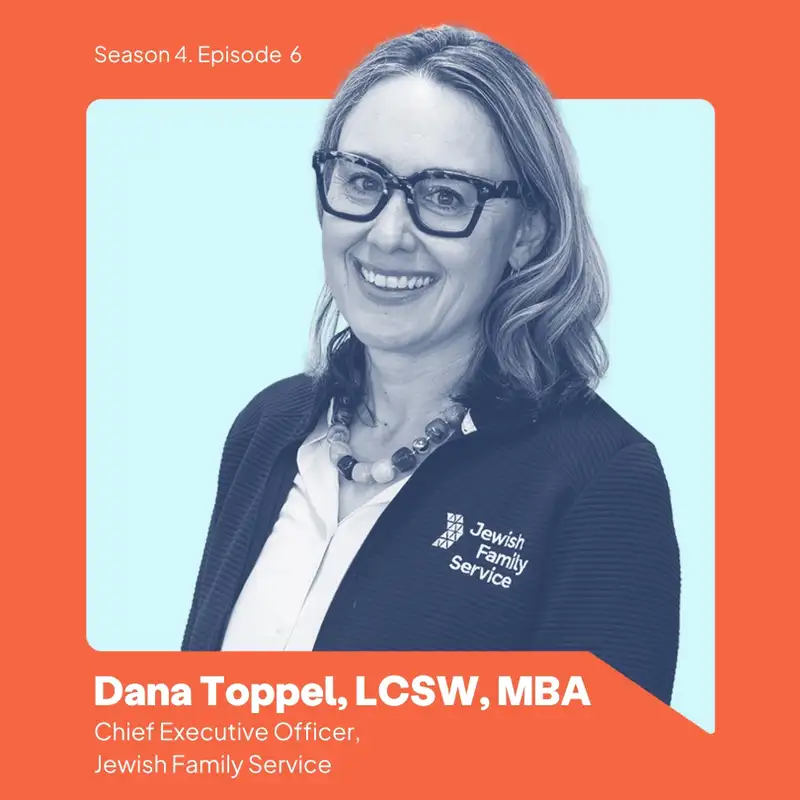
Dana Toppel: Housing, Hope, and Human Service
Dana Toppel 0:00
Crystal. How are you?
Crystal Page 0:12
I'm well. How are you?
Grant Oliphant 0:13
I am. I'm really good. We had a terrific interview with Dana Toppel, who heads Jewish Family Services here in San Diego, and I just found this conversation to be enlightening and uplifting on multiple levels, including what it's like to lead an organization in challenging times, you know, how to, how to lead a big organization, how to think the of the work of community right now, she really brings a lot to the table in terms of the work she's doing.
Crystal Page 0:47
Yeah, I first met Dana when we were going on the trip to learn about housing in Vienna, and I think that trip, but also how she engages, really helped further the partnership that we now have with Jewish Family Services. So I'm excited to dig into this conversation with you.
Grant Oliphant 1:07
Yeah, well, it's not surprising that you all met there, because she, like you, is a learner and curious and wanting to expand her solution set on everything, and I think you'll people will see that on when they listen to this podcast, and and hear about how she approaches the challenges that she's facing.
Crystal Page 1:30
Right on. Shall we stop and talk with Dana?
Grant Oliphant 1:32
Let's doit.
Grant Oliphant 1:37
All right, Dana Topel, thank you so much for being here.
Dana Toppel 1:40
Thank you for having me.
Grant Oliphant 1:42
This, I've wanted to have this conversation for a while, partly because I want to talk about your journey from being a COO to being a CEO. I want to talk about how you came into Jewish Family Services to begin with. I want to talk about the work of Jewish Family Services and what you're encountering in the community, and I, you know, I think it's important context for our listeners, you know, my, my impression coming to San Diego is, and working in the, in the philanthropic social impact sector, is that the story of philanthropy in San Diego is in many ways, the story of the Jewish community, and yet JFS, which is an expression of that, is also a broadly available resource that helps everybody in the community. So I want to start there with a little bit about the organization and how you talk about the work of JFS for a lay audience who don't know the background about it, what its mission is, and how it came into being.
Dana Toppel 2:52
That's great, thanks for that question. Because I think I was, I've been in conversations today, already three, as we're sitting here in the afternoon, about how do we get the message out that JFS, Jewish Family Service, serves the entire community, and that while it was founded by 16 Jewish women over 100 years ago, you know, I'm the sixth CEO, so we've had, you know, we're a long
Grant Oliphant 3:15
You're only the sixth CEO,
Dana Toppel 3:17
yeah, and we let one, one, you know, the person before me was a male, but otherwise it's been four women. I'm the fifth woman and the sixth CEO in 100 years, and, and so, as you said, we're founded. We were founded by Jewish women, were heavily supported by the Jewish community in terms of philanthropy, but of the 60,000 people a year that we serve, the majority of them are not from the Jewish community, and so, while we have programs that are specific that serve Holocaust survivors and the Jewish community struggling with basic needs, a lot of what we do is really in three big areas, and it's really making sure people have a place to live that's safe and stable and affordable, that they have good quality, culturally competent food to eat, so nutrition, and then the rest of what we do is really wrap around, you know, kind of a person, so for some people they need older adult services, for some people they need parenting supports, whether you're an older adult, an immigrant, a young mother, but again that really basic thing that people come to us because they're not having a great day, and our job is to try to say, how is their life meaningfully better because they came to JFS, no matter what their background.
Grant Oliphant 4:28
So, the shorthand on that is housing, food, food, and then supportive wraparound human service, what we think of as human services.
Dana Toppel 4:38
Yeah, And I've been with the organization, as you said in prior roles, to becoming the CEO in July, but we used to talk about that we had 50 different services, 60 different services, and what we found is really boiling it down to come to us if you have a need, especially in these areas, and then it's our job as an organization to figure out what services will meet your needs, but rather than overwhelming people with, we have transportation, we have food services, and we, because it's too much. Yeah, but even
Grant Oliphant 5:09
for me, I, you know, I obviously don't know the organization at all as well as you do, but you, I know you have more than those three areas, but they are, you sort of see them as in support of those three areas, and so if somebody comes to you with the need, they will be connected potentially with more
Dana Toppel 5:27
deeper services. So, an example of that, right now we're seeing so immigration has been a huge part of our work. It was how we were founded, welcoming the stranger.
Grant Oliphant 5:37
You did a lot of work with refugees in recent years,
Dana Toppel 5:40
yes, with refugees, with asylum seekers, it's been a huge part of our work, and what we're seeing right now in this moment is so many people come to us because they're finding housing, they're finding themselves housing insecure, they're finding themselves not having enough food, and then when we dig in, it's oh, because someone in their family was recently detained or deported, and they have immigration legal issues.
Grant Oliphant 6:03
I was going to ask you, how things have changed in the last couple of years. So, you know, when a couple of years ago, under your predecessor, the discussion was almost all about immigration and refugees, and the region really did have an influx of folks who needed help in those areas, but what you're saying today is, well, that's been stemmed, but now people are dealing with deportation issues, and what else.
Dana Toppel 6:34
So we're finding a couple of things, and what that's where we've pivoted to start talking about kind of these basic needs, regardless of if you're a refugee, immigrant, low-income Jewish person, or older adult single parent, because what happened was we were doing these core services like behavioral health, food, and then in 2018 we saw this huge influx of asylum seekers, and JFS does what JFS does, and we step forward, and we had no funding, no plan, but we were like, Governor came and said we need a shelter, we said we'll figure out a shelter, and so from 2018 till actually January of this year, or last year, I guess, we had a steady influx of over 200,000 asylum seekers that we welcome to this country helped get their legal paperwork and onto the next state, so we saw a lot of that, and then because it became such a huge part of JFS, so many people thought JFS was an immigration organization, and so part of what I'm trying to do as CEO is reorient people that yes, we care deeply about immigration, about refugees, and we do a ton of other things, and so what's changed is we were operating a shelter for that period of time, and it was critical, and we stepped forward, and we worked with partners, and it was really, really meaningful. Now what we're seeing is across San Diego, due to our immigrant population, due to our undocumented population and people that just need help, we're seeing increased, as is the country, but especially here in a border town, we're seeing so much enforcement, and so what we're seeing is people who have lived here for decades finding themselves in need of services like JFS, and again, that's food, housing, immigration, so it's changed in that I think it's gotten more complicated, and people who used to leave their house and just live their life are now afraid to do that.
Grant Oliphant 8:32
Are you? I'm trying to think about how to ask this question. It requires courage for you to continue to lean into those spaces, does it not?
Dana Toppel 8:42
It does, it does. And I think courage looks different for every organization right now. And so early on in this presidential administration, we had to make the decision, so we were very vocal in the first Trump administration, and then we saw a shift, kept doing the work, and, and so, for us, courage is still continuing to do the work, and to make sure we're kind of looking at how, how do we keep doing the work, and so I think there's amazing advocacy organizations that can speak really loudly, and really that's what they do, and as a humanitarian service organization, I think just continuing to do the work is courageous, so we've really had to pivot how we're thinking about the work, doing the work, all of our federal grants that, for a variety of things, you know, have new language in them, and so again, we've always seen partnership with every funder, and so we're trying to figure out how to make it work, but it certainly,
Grant Oliphant 9:45
how do you, and I, I promise I will move off this topic in a moment, but I,
Dana Toppel 9:50
I'm here for all of it.
Grant Oliphant 9:52
Well, I want to, I mean, I'm sensitive to the fact that you're, you are trying to communicate to people that you serve a broad San Diego audience, and it's really anybody in the community who needs those, you know, who needs food, shelter, and supportive services, and anything associated with that, but I am, I am curious about how you navigate the complexity of this moment that we're in, where you have a government trying to dictate who you can serve and your impulses to help people in need, and the government's impulse right now is to say you can't help these people. How do you navigate that as a leader of an organization like yours?
Dana Toppel 10:39
Yeah, so I feel like in our previous, I mean, one thing I'll say, that's I can't imagine being the CEO of this organization without having 17 years of other positions before me, because I have the relationships with our community, with our elected officials, with our board, and our donors, and so I was part of conversations in the past where we had to really get clear on what our values as an organization are, and so I think once you're clear on what your values are and what kind of steps you're willing to take and what the work, the critical work of your organization is, then it's easier to kind of navigate these more nuanced situations, because for example, in some cases we won't apply for funding that maybe we would have four years ago, five years ago, because of certain restrictions, but we're able to do that because we have private philanthropy, so we can still meet those needs, maybe at a different scale, but we don't only have to rely on government funds, whereas I know some of my colleagues, their organization is 90% 95% even 80% government funded. That puts you in a much different position, because you're really then dealing with, do I want to shrink, you know, the organization, but I think our diversified funding allows us to be more courageous, and then also because we got really clear prior to this moment about what our values are, what we're willing to do and not willing to do, because I tell people who sometimes wish we were speaking out more, wish we were, you know, kind of with a megaphone, similar maybe to the last time this president was in administration, and what I say is we're still doing the work, we're committed to the work, and that alone should show courage, I think, because it would be very easy to say, okay, we're done with this work.
Grant Oliphant 12:29
Well, that's that's why I used the word courage earlier, and I think you are every day demonstrating courage by doing the work and remaining committed to it. I love your answer around having clarity of values. I also love the pragmatism of knowing that it helps to diversify your funding sources and have backers who will support you in this work. Have you found them to be sticking with you?
Dana Toppel 12:55
Yeah, we're really lucky, and one thing that might be surprising to people, which is a definite strength is we also have diversity in our, the perspectives of the people who are supporting us, and so another thing that's really important to me as CEO that I didn't have to navigate in the past as much is how do we give people the opportunity to invest in what's aligned with their values, and so we do have the ability for someone who really wants to serve the Jewish community and Holocaust survivors who may just not be as passionate about immigration to segment that, and so I think to me there's no judgment in that. We all have things that we care about. So, yeah, people have been sticking with us again. I think we made some hard decisions, I would say more than 10 years ago, when we continued to do this work with refugees and immigration, that I think some people who you know weren't on board with that stepped away, but we've really only seen deeper engagement.
Grant Oliphant 13:51
That's fantastic. You used, you used an expression earlier in this interview about JFS, did what JFS does in stepping up to a crisis, and I'm just curious, where in your experience does that impulse come from?
Dana Toppel 14:10
Yeah, so I think I'm lucky to be part of a team that that just isn't the fabric, I really think it must be from our founders, because there are pieces of culture that just continue on even after people are no longer there, and then I would say personally, as I think people ask, like, why do you have this like pragmatic sense, but also this like social worker sense, and so I'm the daughter of a real estate developer and a social worker, I grew up in Madison, Wisconsin, and I have my, you know, educationally I have an LCS, an MSW, I got my LCSW, and I also have my MBA, so I feel like I just really try to hold kind of both and think about, you know, what would be the business sense to respond, what's the right thing to do, and usually that allows, you know, JFS to step forward because it financially makes. Sense not in terms of like a return, but we can do it because we have the financial wherewithal, so we're not just jumping in without having a plan. I mean, we do do some quick, like, does this make sense, is this going to hurt the organization, and then is it again back to our values and the right thing to do, and so whether it was with immigration or more recently with the government shutdown, and I don't know that my staff always love it, but we saw that a government shutdown happening, and I was like, we have to respond, you know, and so they came back and they said, okay, in two weeks we can respond with the food distribution, and I was like, no, Wednesday, and so, but they do it because they're amazing, so I think, you know, a leader does have to sort of set the tenor for like we're going to respond because it's what we do and so I think we've been it's in our foundation but I certainly think it also requires leadership because it's certainly
Grant Oliphant 15:49
I love that I love that statement because I do believe that especially in an organization like yours if you're not the dreamer and the driver then that's something nobody else can contribute to the organization, and it may be, it may be a little exhausting for your team, but I,
Dana Toppel 16:08
but they're here for it, they're here for it
Grant Oliphant 16:11
and it's, they clearly are, because they, they repeatedly step up and deliver. I mean, if it's, if it's not painfully obvious, I'm a huge fan of what Jewish Family Services does, and how it produces. I am, I am curious. How- so You came into this role after a period as COO, and you mentioned earlier that you had 17 years of prior experience. What were the most important lessons that you walked into this role with, because this was this was not a simple, oh, I became president of an organization, it was at a really difficult moment, not just here, not in our, only in our community, but in American history, difficult moment with lots of issues ranging from demand for all the needs that you're describing, a context of rising anti-Semitism divisions in the in American society. I mean, tough, tough issues. Yeah, and suddenly your CEO. So, what lessons did you draw on in taking on this role,
Dana Toppel 17:21
yeah, can I go back a little bit? So, when I first joined, so I've been in the nonprofit sector for about 30 years, and I actually came to JFS in 2009 when I was getting my MBA, and I was actually looking to leave the sector because I thought the work was really meaningful, but I thought, okay, what else can I do, and then we're gonna put that MBA to practice. I don't know what I was gonna do. I was, I had dreams, I had dreams, different dreams. And then, unfortunately, my parents passed away in 2009 which is a different story. But when, when that happens in your life, no matter what age you are, it really does call you to recenter your values and think about, and I feel it's going to sound weird, but I feel so lucky that if that was going to happen when it happened, it really called me, because I actually was going to go work for a healthcare organization. We'll leave it at that, and I think it just calls to question, like, what am I really wanting to do, and I was fairly young at the time, so it really puts in perspective what's important, and so fast forward, I was the director of senior services, I was our clinical director, I also had experience working as a social worker for a long time, and so I think it was 2013 ish, I became the COO, and then most recently our CEO, and so I can think of at every moment it was about the work, and it was about, like, looking at my personal values and tying it to the work, and so when I was asked, sort of asked, but sort of like, you're going to be the CEO, right, because I actually call myself an accidental CEO, it was never about getting to a certain position, it was really about the work, but it was interesting timing, of which I thought, Who wants to be a CEO right now? I mean, I want to go and be a therapist or nutritionist, or maybe a dog walker. I mean, I, you know, I mean, you're like sitting here going, okay, the government is, you know, funding is going in one direction at the moment, also. But this is where it was helpful that I was internal. We went from $120 million budget to 65 million, and we landed that plane perfectly, because we were ready for it. But that is a huge for your organization to go. It was one program, 50% yeah, it was a 50 right of one program. It was the shelter for asylum seekers. So I think you have to be to do this work, you have to be in the work, I mean, I think being able to draw on experiences of being a social worker, of working with kids in foster care, of seeing myself a little bit reflected in, in the communities we serve, that's what keeps me grounded, because if I think too far in the future, or if I, you know, I mean, dreaming vision wise, okay. It, you know, you got to just take it day to day, and then the other thing I would say I draw on is my team. I mean, I, we don't do this work, as you know, alone. We have to have a phenomenal team, and so I feel so lucky to be part of a group that also draws on their values and experiences.
Grant Oliphant 20:17
So, you've had this, and I, I totally honor that, because I think what you are leading is a very strong team, and, and it's important for a successful leader to acknowledge that, but, but at the same time, I want to, I just want to, you know, I am, I am, I want to press you a little bit on, and it's not because it's about you, but it's about leadership, and it's about leadership in a moment, and you had this set of experiences where you were on the clinical side, you were in operations, you were in strategy, you had this business training, and I'm curious, how that range of experiences served you when you stepped into again this pivotal moment to take over an organization, and I'd forgotten it was right as you were having to cut your, your budget,
Dana Toppel 21:15
yeah, it was, it was really wild times, so I think for me it's to me exciting to look this again, some of this is going to maybe land slightly off, but it's really exciting to be able to look at what are what are the parts and pieces that we need to have land to continue to do this work, and so I do believe I do look at JFS somewhat, as if we were a business that had to survive with people paying customers, if you will, like what are the things that we would have to do to show up, because for example, if people had a need, an emergency, you know, emergency need, like they did for food, and they could go to five different places for that food and say they had the ability to pay, which they didn't, and the government shut down. Like, we would expect that to be stood up in 48 hours. We would expect it to be quality service. We would expect it to be on a day when people could get there conveniently. And so, in some ways, I think about things from that perspective. And while we're in the business of doing good, and we're not taking payments or things like that. I believe people deserve the same quality and dignity and care, and so I do think the sort of business sense, business background of diversified funding, of response time, of quality, of dignity helps me, helps inform my thinking. I also think about new opportunities, and that if you're not growing and you're not innovating and you're not kind of meeting the next need or ahead of that, and getting yourself positioned for that, then you're shrinking, and you're, you're possibly going to go out of business, and so I think all of that mindset of just kind of constantly iterating, constantly thinking about things a little bit outside of the box, and then coming back. I'll give you another example, if it's okay, that we're working on that's an example of that. And then the other thing, actually, before I say that, is relationships. I believe, like relationships, I might - I have a 14 year old son, and he is constantly lecturing me on that. I don't need to talk to everybody. I don't need to touch everybody on their shoulder. I don't need to. He's like, why are you talking to that person again? But I feel I know, but I really feel like I've never met a stranger. And when I look back over 30 years of being in San Diego, it's also, you know, the number of relationships I've made. It's like everything's only a phone call away, so I think thinking about just really thinking about it as a, you know, for profit but for good thinking about relationships, thinking about partnership, thinking about diversification. So, an example of that is I was sitting with our shared friend Dr. Irwin Jacobs, and he was at actually a brunch that we had in name of Joan Jacobs, and he was going the next week to fly out for the naming of the Cornell Joan Klein Jacobs Center for Precision of Health and Nutrition, and I thought I want to partner with them, and so I said to Erwin, I was like, will you introduce me to the head of the organization, so he did Saturday. By Sunday, I had a call with the head of the Joan Klein Jacobs Center. Fast forward, we're now working. We've already applied for co-funding, and we're working on launching a mobile JFS that will go out into the communities with a Libras Corner Market, so our food on it, and it'll have case management. They also work on AI and nutrition and health, and so we're conceiving of this idea of well, whether you're an immigrant or an older adult who can't come to JFS, we need to take JFS to the community, but it's all again thinking outside of the box, thinking of different partnerships, and then also really dreaming of something bigger and again, not having it all figured out, but having the dream and enlisting in people in the dream, and so I think, yeah, there's just so many.
Grant Oliphant 25:07
What an unlikely partner, too. I know I would not have sat there and thought, oh, this is an organization we should partner with, but they're, I mean, they're amazing. Well, you know what comes for me out of that answer is yes. You are a dreamer. You're also, I think, it's fair to say very pragmatic about thinking about how to get there, and you're very customer - what in the business sector would be called customer focused. And I do want to focus on that customer or client of JFS for a moment, because you know, let's come back to where you began, and the, and the fact that you are really trying to communicate to San Diego that this is for everyone, which it is. Remind me of the number of folks you serve, so
Dana Toppel 25:54
around 60 thousand,
Grant Oliphant 25:56
So an extraordinary number of lives that you're touching, and you know, when they, when, when you think about the role that traditional social services can play in our society, still obviously there's a need, but How are you feeling about the, the match of those services to the needs of this moment that we're in,
Dana Toppel 26:23
so the match of the needs of our services are overall sectir
Grant Oliphant 26:27
Yeah, the sector, at large.
Dana Toppel 26:29
Yeah, I mean, one of the things that I've been thinking about a lot, too, and we're modeling, and so we're doing it. Another thing that that I think we need to do more of as a sector is there is so much need and there are so many nonprofits and I think we all do different things well and so at JFS I'm trying to work with my team constantly around what are the things that we do super super well and where could we partner with organizations where they're doing that thing super well and I'll give you an example. And then, what do we need to let go of, if anything, because I'm thinking a lot about not only how we meet the need in this moment, and how do we address that there is so much need, and that if we don't start working on kind of the upstream and prevention and early intervention, which might mean serving less people more deeply, but we're actually going to start solving some of the root cause issues to not need so many safety net services, and so I think as a sector we need to look at how are we reducing duplication, how are we streamlining services, and so an example of that is we go out and provide a ton of services, home-delivered meals, home modifications for older adults, and so that is an opportunity. So we're deploying some technology that will have volunteers note if there's been a change in condition, so if someone seems like they need housing support, food, more additional food support, or something's going on, and then we've privately funded a case manager to kind of do some follow up, and so we're leveraging the fact that we're going out in the community anyway. Why don't we ask a few more questions to those folks rather than having a whole new service of case management that would reach out to them separately? So we're really catching things early, so if someone you know is in their home, they've been doing great, and all of a sudden they can't afford their rent, we catch it right in that first month, instead of waiting five or six months for them to call us, and then we're partnering with another organization that just does rental subsidies, because we don't need to recreate a whole program, we just need to tap in and create pathways to those programs, and so I think, how are we doing? I think we're, we're doing okay, but I think there's so much need, and so much growing need, and I would even look to our foundation partners, have told me, like, there's just no way that we're going to be able to continue to just make grants to, you know, meet the need, and so what I'm thinking about is is consolidation smart, consolidation kind of, how can we all really look really deeply at what are our core services that we want to be offering, and then we have to be partnering more.
Grant Oliphant 29:12
I think you're what you're describing is a formula for excellence and for reaching more people more effectively, but at the same time implicit in that as a critique of the of the sector of safety net organizations, and is the is the critique that one of the ways that that the sector has fallen short is duplication of services and not looking far enough upstream at the root causes,
Dana Toppel 29:39
so I think again, some of this might get me in trouble, but I, but yeah, I mean, but it's truly what I believe, I think that there's other sectors that are constantly looking and revising and and kind of rethinking and our sector can fall to someone has a great idea, and they start an organization, and it doesn't mean that wasn't a great idea, and that you know, but is there a different way than starting multiple organizations on a great idea to look at, like, what we have, and how can we kind of build on what we have, because I think, during my opinion, is during Covid, we had an opportunity to really like look at our sector and potentially consolidate and really kind of think about upstream solutions. We had an influx of funding, we had a different presidential administration, and I think you know we can sometimes look at our own organization and how to sustain it without kind of taking a broader view of, you know the organization, so it's not necessarily a critique, but I think we just, my goal is to try to either have JFS be so look so different 25-50 years from now that it's like prevention, early intervention, or frankly I wish it didn't need to exist, I wish everybody had enough to eat and you know stable housing, and so I just think sometimes our sector reinforces through nobody's fault, you know, some of the wrong choices or behaviors, and I also want to put the caveat that as a larger organization I have the luxury of thinking this way, because I don't have to think about, you know, if we choose to not apply for a grant, we can usually make it, because, you know of our size,
Grant Oliphant 31:22
yeah, I mean, the flip side is we've all seen large organizations grow moribund over time, not able to adapt, and right, and they're the ones who surprisingly succumb, right, and you're obviously not at risk of that because of the philosophy that you just articulated, right, I, you know, I do want to, I do want to underscore something that you said, and alluding to what the foundation community has said, and looking at this crisis right now around basic services, you know, I think it's important to acknowledge that many people in our society may not know that a crisis exists because they're not personally experiencing it, this is, is so much like Covid, and not like Covid. It's not like Covid in that not everybody's sitting at home feeling vulnerable, and the folks who are sitting home feeling vulnerable because of risks of deportation or immigration issues, or because they're not, they can't find enough money, put enough money together to feed themselves or to keep a roof over their heads. That's a different experience than many other folks are having. So, in some ways, it's a hidden - it's not a hidden crisis, but that's the wrong word - but it's a crisis that isn't shared, and, and while those of us who are in this business can feel deeply sympathetic around that, we're also looking at the scale of it and realizing, oh my god, you know, the if these, if we continue to drive people off of healthcare, and if we continue not to address housing issues, and if we continue to throw people off of public food roles. We are creating a perfect storm where the need will reach catastrophic levels, and there won't be enough resources to keep doing this. So, I applaud you for going upstream and wanting to figure out what the, what the deeper prevention strategies are I wonder if you're feeling like colleagues in the sector are ready for that conversation to around how the sector gets better at that through alignment and sharing of resources and rightsizing their organizations and all of the all of the things that would happen in the business sector, but tend not to happen in the nonprofit sector, for the reasons that you described. Are you, are you seeing a greater receptivity to that?
Dana Toppel 33:49
I mean, I would say it's mixed. I think I, that's why I try to say what I think and share this philosophy, because I do think it's just atypical in the sector, and so I think there are people who I know feel this way too, but in our doing this with their organizations, but it's sort of seen as we can't, like, we can't look away, we're here for this, and it just feels like similar to our government, we have to rethink the way we've been doing things, because we can't keep doing things the way we've been doing them for so many years, so I think it's, it's really mixed, and I think it could happen with all of us coming to the table. I mean, literally, government being in the room with foundations, with nonprofits, and not about the funding they themselves will get, but like around a shared ecosystem, and around how could we work on more public-private partnerships. I mean, we are constantly going to our funders and saying we think we can do this maybe more efficiently, because we know that mainly our government partners, because we know that funding is only going in one direction, whether regardless of who's in the White House, at the county level, at the state level, at the city level, and so we need to be doing more. Are together to problem solve ahead of the moment, so I think we need to kind of keep pushing the conversation, but no, I think I think some people also fairly don't have the bandwidth, I mean they're just trying to solve today's problem
Grant Oliphant 35:12
no, I think that's actually real, that yeah,
Grant Oliphant 35:16
it's you have to have a certain amount of resources to be able to think about how to do things differently, and I, but I think the, the crisis is telling us that the systems we had in place have to change for sure, and the, and that organizations that are part of it have to change as well. Yeah, so one example of that, one of the one example of the way that you're doing this is, and we've been in collaboration on it, is an initiative in the housing space where you and Prebys Monarch Klein Jewish Community Foundation have come together and invested money in an affordable housing project here in San Diego. What inspired you to want to put your money there as part of your overall effort? Because it's a non-traditional approach,
Dana Toppel 36:16
it is. It is, and again, I'm. I feel so privileged that JFS has made decisions to kind of put aside certain dollars for different efforts, because I realized that not everybody, you know, in the sector has that ability. So, I would say that we - I - I'll say I, because it wasn't always clear, didn't see our space of becoming another developer, so JFS does a lot of things really well. I think being a housing developer wasn't on my bingo card, in terms of I've done that at another organization, and it's a lot of work, and there are people to my earlier points who do that and do it really well, and so we had a task force of some of our board members and some community members who were really looking at housing is such a critical issue in San Diego. We have to do something, and so I had the opportunity, which I believe travel is always a sure way to come back with innovation. I really, really believe that. And so I had the opportunity to go with members of your team, along with many others, to Vienna. We miss you, yeah, but I think being and seeing kind of the structures in Vienna, while they didn't translate exactly, because they had other things like universal health care and things that allowed for housing to be more affordable, it, it had to start dreaming about what would a partnership, everything had partnership in it, and so when we came back, I think the conversations with Gil and Sarah, yeah, Gil Alvarado on your team, right, and then also Monarch Klein, we started thinking about like what could a model look like, the other thing I have a board member who also was just kind of not perplexed but just disturbed, I guess, with the fact that so much affordable housing, due to the due to the traditional structure, ended up being close to a million dollars a door, and so this is, which is insane and not sustainable, and it takes forever, and then sometimes falls through because it gets more expensive, so when Sarah from on our client shared this innovative funding model, where we could collectively, it was Prebys, JFS, Alliance Healthcare Foundation, and Be Quest could go in, and you know, we were able to pull our funds together and purchase the land and do this creative land lease to Monarch Klein to build, I think it's around 250 units of affordable housing for 30% less, a door, if not more, I think all in, and about half, 40% of the units will be affordable, and it'll be mixed use, with which also to me was very intriguing, because we know that mixed, not mixed use, sorry, mixed income. That's the best way to look at economic mobility, is mixing people in, you know, with other people of other backgrounds. And so, again, it kind of gets at the what can we be doing differently, what can we be trying that could be scalable? How can we use our resources not only to serve the community but to invest in the community, so I'm really excited, and so far I've heard the project's on time, and we're thinking of other ways to partner.
Grant Oliphant 39:26
Have you, is it too soon, or have you made any observations that you think are lessons from a collaboration like this?
Dana Toppel 39:34
So I think to me, in terms of collaboration, it matters not only who can do the work, but that you have shared values and shared vision, and so I think that's where the travel helped, and kind of the conversations leading up to this. So the lessons to me are we had a lot of fun, we had a shared vision around how to do this, we were the only service provider that invested in it, but I think everybody was willing to kind of take a strategic risk. I wouldn't say it was a huge risk in trying something different that was scalable, and everybody came to the table with excitement and kind of the same energy of that, and so, and I think everybody wanted to do things more cost effective to leverage things, and nobody had a huge sense of ego of having to have their name on the building. It was really about getting more housing to the community.
Grant Oliphant 40:26
Yeah, well, I should, since I got it wrong initially. JFS, Prebys, Alliance Healthcare, and BQuest, really, I think a fantastic precedent for the community, and hopefully a sign of other opportunities to come for us to collaborate in creative ways, but yeah, it was actually, I have to confess, it was a surprise to me when I learned that you wanted to be a part of it and were actually helping lead it again, kind of an example of your willingness to do things differently,
Dana Toppel 41:05
hopefully a good surprise.
Grant Oliphant 41:07
It was just unexpected for me that, again, for a service provider to be willing to invest its money in the, in, in what we would call mission-related investing, yeah, is a fantastic thing, and I hope it becomes a model for other places in the country, and your, your colleagues elsewhere, yeah.
Dana Toppel 41:28
And I would say, Grant, on that note, I think your team is really leading, as I've heard a little bit about it around that kind of mission-related investment. It's another example of where we have to just look at, we can do things differently, and it's about providing services, but then also, as we take our money and invest it, that's an upstream solution. I mean, people having quality housing in a mixed income environment is an example of it's better than any amount of subsidies we could provide them.
Grant Oliphant 41:57
Yeah, we, I know we believe that very much. And so, at what point did housing become something that you thought was so important you had to invest in it directly?
Dana Toppel 42:08
Yeah, so what happened is, when I mean, again, over my 30 years, but really at JFS, what we found was if people didn't have stable housing, nothing else really mattered. I mean, we have so another one of our signature programs is our Safe Parking Program. So, we have six different lots across San Diego of people who have really just become homeless, and so they're still living in their vehicle, they've become homeless, they didn't know how to navigate the situation, and the faster we get them back into housing the better. And so it just occurred to us that these are people working full time, they're working at sharp different organizations, they're working full time jobs, they have their families, and so to us it was really housing is at the center, housing and food, if you don't have those two things, so many other things can't be in place, and so again, I don't think we will become a developer, but looking for other opportunities to like, whether it's subsidies, whether it's just catching it early and getting in front of it, will be a priority. So I would say just through the number of calls that came in, that just more and more, especially in the last five years became the number one issue people were facing,
Grant Oliphant 43:25
so I, I know in your seat you're, you're sitting atop, you would hate, you'll, I know that's not how you view it, but you're sitting atop a big organization, and you're helping 60,000 people, and sometimes it's hard to get visibility on the 60,000 people, but I know you work very hard at making sure you do, and sometimes it must be overwhelming to hear all those stories, and as you look around and see the work that you're doing, What is giving you hope at the moment that we, in fact, can turn this ship around, and that we can not only meet the needs of the moment but invent a different future for ourselves? Yeah, so
Dana Toppel 44:18
I, I tend to be a hopeful person, even in, like, I think, to do this work, to show up every day, to do this work over and over again. You have to believe that there's a different future possible. I think you know, if I just think about the last week, we, you know, on Saturday night had our fundraising gala with 500 people in the audience, and people showed up and were passionate about the work, and philanthropically generous. And then I headed off to, you know, a conference in New York, where it was a different view, you know, some different perspectives. It was in the financial kind of services arena, and there there was hope too, around it was very different, and so I. Do feel like, while not everybody realizes what's going on, and the impact of, you know, on our immigrant neighbors, on our lower-income, you know, San Diegans, around people just aging without the ability to kind of afford it. I do see more good than challenging, and I probably choose to see that, because that's what gives me hope. So, I think it's about telling the stories of people who can't. I mean, to your point, I constantly am trying to at least speak to a couple of the people we serve every week, so I can lift up their voices to people, my neighbors, my friends, who may not understand that, while their life hasn't changed a ton, other than when they turn on the news or scroll and see the horrors, it's not impacting them personally, and so I feel like being able to be in the seat at this time gives me the opportunity to lift up the voices of people who can't, and then I've been around people with various backgrounds in the last seven days, and I believe that everybody with kind of conversation relationships and the invitation we can create a better future for for everybody.
Grant Oliphant 46:09
Do you, since you've mentioned a couple of times that you deal with people of all kinds of backgrounds and perspectives, are you finding it easier or harder to talk across political lines of division right now, and, and to help people, regardless of where they may be on in terms of their politics, understand the stakes behind what you're doing.
Dana Toppel 46:37
Yeah, so one of the things that I think I learned, probably from my parents, because their perspectives were not always the same as maybe the people in their group, was to focus on the topic, and so what I found is if I focus on the individuals and their stories around nutrition, look, immigration is polarizing, so that aside, I think the people who are supportive of our immigration work are supportive of our immigration work, and so I intentionally try to make sure I'm speaking about things that people can understand and resonate with, and I feel like that's a pathway in to then talking about some of these issues that are more divisive, and so again, because it's less, I try to kind of put my personal opinions aside and really focus on the work that JFS does and the impact it has on the community, and I do think that issues like food and housing broadly, not the specifics, can be bipartisan or can bring people together, and the other thing I've found is, if you talk about the person and the personal story, and, and kind of leave out some of the, the maybe details that are polarizing, most people then will be open to having a conversation, so at that human level, yeah, so really humanizing it, because I think I think it has been, been people have been so dehumanized in this, in this last, you know, administration and beyond, that I think rehumanizing and making it about the work and the people we serve, and the people serving those people, I've tended to see kind of a coming together. I also think the reality is some of the people who are the most polarized, probably in either direction, aren't probably supporting JFS. So, I mean, I'm working with kind of people who are, you know, middle or a little bit to the edges, but not all the way to the edges, right?
Grant Oliphant 48:31
And they still, they still sort of believe in the fundamental mission of helping others in their community, right? So, yeah, it is. It is not an exaggeration to say that what you do is is an expression of the best in human character. It's folks bringing folks who care and want to help together with those who need services but also need dignity, and you're, and you're concentrating on their dignity, and we live in an age where there's a lot of cynicism about what I just described, and you know it's dismissed as highfalutin, it's dismissed as well, in some cases it's dismissed as not true when you talk to people, and you want them to understand this is a real thing, and this is our community coming together. Is there one thing you say to them to make that point, or one story you share with them
Dana Toppel 49:35
around the point of that people are coming together, kind of really making a difference, I mean, I see it every day. So, what do I tell people? I think some people are very cynical right now and can't believe anything good is going on, and so I am not a social media person, but I post a lot of, like, I think. Videos and stories, and like I said, the kind of human connection, and then I do a lot of like encouraging people to come and see it for themselves, so like really serve a safe parking dinner, or come with me to deliver a meal, because I think we can stay in our like corners and you know, spend a lot of time on social media and the news, and then, yes, you're going to have this belief that the world is one way, and whatever way that is for you, but kind of stepping foot into JFS, stepping foot into another organization doing great work, and seeing it for yourself is the best way. So I use kind of video stories, a little bit of guilt sometimes. I'm not gonna lie, and then you know, calling people out, and like, if they don't want to see this other version that's on them. Yeah, so fantastic.
Grant Oliphant 50:50
Anything else that you wish we had covered, or last thought?
Dana Toppel 50:53
No, I just want to say, I really appreciate your leadership. I met you when you first came to San Diego in the LEAD program, and I just am so glad you're here and leading this exceptional work.
Grant Oliphant 51:06
Likewise, one of the great joys of my job is getting to work with folks like you in the community who are really modeling good leadership, and so I appreciate it on behalf of all of us doing this work. Thank you for being such a great example.
Crystal Page 51:25
Wow, you covered so much in that conversation.
Grant Oliphant 51:27
We really did. I have to say, I have so much respect for Dana. I think that in this interview, as I said, we covered a lot of ground, and, and she illustrated why she is the leader for the moment of this very important organization. You know, part of what I took away from this interview was the work of JFS, and how broad it is in the community, that although it springs from Jewish values and is from the Jewish community, it's a gift from the Jewish community to the broader community, and they, they work on so many fronts on problems around hunger and food, and problems around housing, and general services that lift people up in the community. So, just hearing more about the work was extraordinary, but so was hearing more about Dana's approach to it. Right, you know, I don't know how you felt about it, but I was really struck by her talking about the work that she had to do almost right off the bat, coming into the role when JFS, which had been doing so much in the immigrant and refugee space, was suddenly faced with that huge part of their mandate, essentially vaporizing and having to figure out staffing issues, and service issues, and funding issues all at once, that was powerful for me.
Crystal Page 53:06
Yeah, I was, my brain was going to the same place too, because to lose, like, a major grant, but because Dana's so relational, she was able to pick up the phone and talk to different funders who were committed to different parts of the mission, and she acknowledged people have different perspectives, you know, different approaches, but in the end, like you said at the top of this episode, she's looking to solve problems, and that's what she did. She got the staff in place, got the funding in place, and I think that it's a good reminder to me, knowing that Dana had led operations, and now here she is at the top, leading both vision and has the energy to carry that forward, that's that's a lot to ask anyone to do, let alone do it during this moment in time.
Grant Oliphant 53:47
Yeah, when you know when your organization is under attack because of who you serve, that's tough, and you know, I, we talk on this on this show periodically about leadership styles, and this would be a good moment to reflect on that for a moment, you know, and what what came across in our conversation with Dana was part of her leadership style is always to come back to values, you know, it's she shared that story about the tragedy with the loss of her parents and how values brought her back to the work of the nonprofit sector and then facing this transition at JFS and values brought her back to the core work of the organization that I think is a really powerful message around how leaders can navigate uncertainty.
Crystal Page 54:44
Right, well, and navigating uncertainty, we know that Dana wrote that commentary with Gil, our CFIO, our Chief Financial Investment Officer, and a few other folks to really hone in on a difficult path we're navigating, right. We're trying to figure out how to build housing in this region, and Dana, I know, worked hard to bring that to her board with a why that's based in those same values of community, and when you have housing, when you have services, you can then meet the other needs that folks have. I think that's why she's also a terrific partner, but JFS is also a terrific partner to Prebys as we move forward.
Grant Oliphant 55:23
Yeah, it's an expression of a willingness to do things in a different way, and, and yet to stay committed to core values, and you know, I enjoyed the aspect of that conversation around courage too, that she thinks a lot about courage and the role and what courage looks like with with her organization, and clearly the part of what it looks like for her is remaining committed to the work and figuring out how to advance the work, no matter what people may be saying or thinking or or attempting to influence them to do, I thought that was especially useful, and yeah, I think JFS has for Prebys been an important partner in that housing investment that we, you know, we're both trying to learn together about how to use assets to drive community change,
Crystal Page 56:23
well, and I think the idea of courage is dependent on the context, right? Because she talked a little bit about how maybe her positions may appear moderate sometimes, but it's because they're choosing to have restraint in one place, so that they can move elsewhere, and I think the same is true for probably other nonprofits. It's certainly true for prebys, but the idea that courage and leadership may look different, or it may move in different ways. It may be loud in one place, and, and we know, you know, Dana's is good at the one on one, but I've heard her in big rooms where that courage looks and feels different. So I do appreciate that reflection on leadership. It plays out differently, and even her leadership in her current role versus her past role was different, right.
Grant Oliphant 57:05
Yeah, yeah, I mean, she, when you, when you step into the CEO role, she's had to step into a different way of doing these things, and I thought that her sharing around that was power, you know. The other something else that I really loved in our conversation was the story she told about on herself about how when she dreams no one sleeps, and that is, you know, in a way she is what, what, what came across is the story of a leader really trying to move an organization forward and having 1000 different ideas for how to do that, but she was also very clear about the importance of her team and of the of the organization and the board, you know, this is something we, we often gloss over in conversations about nonprofits and community groups. You need, you need leadership to really make it deliver, but you also need that entire organization to work together, and I appreciated her consciousness about how they'redoing that,
Crystal Page 58:23
yeah, I 100% agree, I appreciate what JFS does, what Dana brought to the table for us, and it was a good reminder that they serve the entire community, not just Jewish folks, so I'm grateful you did the interview, grateful to Dana,
Grant Oliphant 58:38
and I'm, yeah, that was it, was a great opportunity for us to talk with a terrific leader. And thank you again for our time on this.
Crystal Page 58:49
Thanks for stopping and talking.
Grant Oliphant 58:53
This is a production of the Prebys Foundation,
Crystal Page 58:59
hosted by Grant Oliphant,
Grant Oliphant 59:01
co-hosted by Crystal Page,
Crystal Page 59:04
produced by Adam Greenfield, Tess Karesky, Edgar Ontiveros Medina, and Crystal Page,
Grant Oliphant 59:12
engineered by Adam Greenfield.
Crystal Page 59:15
Production coordination by Tess Karesky.
Grant Oliphant 59:18
Video production by Edgar Ontiveros Medina.
Crystal Page 59:22
Special thanks to the Prebys Foundation team.
Grant Oliphant 59:25
The Stop and Talk theme song was created by San Diego's own mr. Lyrical Groove.
Crystal Page 59:31
Download episodes at your favorite podcatcher or visit us at Prebysfdn.org