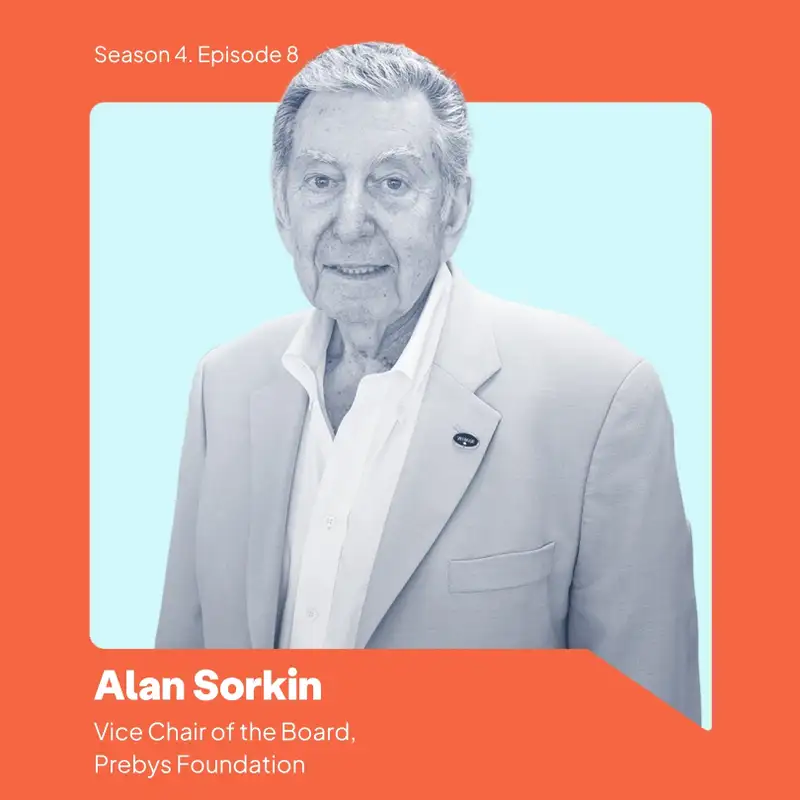
Alan Sorkin: The Power of Business Meets the Passion of Giving
Alright.
Grant Oliphant:Alan Sorkin, thanks so much for being here.
Alan Sorkin:My pleasure.
Grant Oliphant:I I've been excited about doing this interview. I was just joking with you before we walked in that you are, in some ways, the person I know the most about that I've interviewed because you actually wrote an autobiography, and I that's where I wanna start. You have described your life as quite a ride. What do you think is the through line?
Alan Sorkin:The through line is service, giving, and giving better. And do you want me to elaborate on that?
Grant Oliphant:Sure. Please.
Alan Sorkin:My background is in real estate, so I learned the concept of leverage very early. In fact, my earliest episode with philanthropy was my grandmother was being honored at a dinner. And for that honor, she was supposed to raise money. And so she came to me, and she said, will you go door to door with this can and raise money? And I did it.
Alan Sorkin:And then she came back to me the next year, and she said, I'm not being honored, but now now I have to raise money. So will you do it again? And I said, only if you give me 25 cans. Wow. So I took the 25 cans, and I went to every store in the neighborhood.
Alan Sorkin:And they all took them, and I came back a month later, and we raised a whole lot more money.
Grant Oliphant:You had 25 times the money. Amazing. Amazing. So that's
Alan Sorkin:where I first learned about leverage. And in in in all of the charitable and philanthropic efforts that I've had, always trying to figure out how we can lever because there's so much need, and there's gotta be a better way.
Grant Oliphant:Yeah. I think I think part of and we'll get to this, but people in San Diego probably know you much more as a philanthropist and as a nonprofit leader and expert, as well as a coach, because you do that also, than they do as a very successful entrepreneur and and business person. And it is interesting that you find the through line through all of that experience to be around leverage and giving. So it's gonna be a very that's why in part we wanted to do this interview.
Alan Sorkin:I wanna be known as a philanthropist. I try very hard not to talk about that.
Grant Oliphant:Yeah. I get it. I get it. Yeah. But the association with giving is hard to is hard to take away.
Grant Oliphant:I understand. You wrote the book for your granddaughter. So you wrote your autobiography, and you talked about wanting her to have this. What was the message that you wanted to convey to her and your other offspring?
Alan Sorkin:So it started out my daughter sent me this book, and it was a fill in the blank. Mhmm. And I started answering the questions, and I have a lousy handwriting. So I I knew that she'd be frustrated. And so one day, I got industrious, and I dictated all the questions into a word doc.
Alan Sorkin:Mhmm. And then I started filling it out. And a lot of the questions weren't germane to what I was doing in terms of charity and philanthropy. Mhmm. So then I just started rewriting the questions.
Alan Sorkin:And, you know, I I had a really good role model in my father and learned a lot from him, but I didn't think I would have the opportunity with my granddaughter because she's not here in San Diego. And so I wanted her to get to know me, but more importantly, my philosophy of life. And so that was the impetus.
Grant Oliphant:And And what motivated you to put it on paper? And then did you did you know when you started to write it that your philosophy of life was around leverage and and No. Giving back?
Alan Sorkin:No. They say you live life forward and understand it backward. Yeah. So I was a psych major in college, so I've always been a study of human behavior. And the the most study has been directed at myself.
Grant Oliphant:Mhmm. Mhmm.
Alan Sorkin:And and so as years have gone by, I'm always reflecting back on what I did and then why I did it and how that can be useful moving forward.
Grant Oliphant:Mhmm.
Alan Sorkin:And so that through line became fairly obvious to me.
Grant Oliphant:In the process of writing.
Alan Sorkin:Yeah. Yeah. Well, it became obvious to me long before that.
Grant Oliphant:Yeah.
Alan Sorkin:But then as I was answering the questions about, you know, who is your favorite friend in school? I decided to take it to You know, as I
Grant Oliphant:do, I laugh because I can imagine you getting impatient right away with that question. Next. And and only only because you're always focused on what's important. You know, my experience of you is that you're always focused on what's important, and that sort of superficiality isn't interesting to you. It has led to surprising candor in your life.
Grant Oliphant:I mean, in the book, you talk openly about having a nervous breakdown in law school. You know, you you write about having the sense of obligation about succeeding in a certain way and wanting to prove yourself and prove yourself to your father who you referred to as a good role model, but he was also tough on you. And you're open about that too. And so you you went away to law school like many of us aspired to do and some of us failed to do. Mhmm.
Grant Oliphant:But and there you you're you had a moment of a meltdown. Can you talk about that and why you were so open about it in your autobiography?
Alan Sorkin:So from the time I was six years old, I wanted to work with my father Mhmm. In real estate. So that was a lifelong dream with one or two times in between thinking something else. But he felt, because he was a chemical engineer, that he wanted me to have a background different. So he insisted I go to law school, and I hated it from the first day.
Alan Sorkin:The Socratic method is barbaric. You have this professor who's working with the same 10 cases year after year, and he calls upon you. And the minute he calls upon you, he knows exactly where you're going and then proceeds to make crap out of your argument.
Grant Oliphant:Right.
Alan Sorkin:And that was just not something I was used to and didn't like. I did okay in law school, but by the third semester, I was really fed up. And it was just before finals. And as I look back now, it was probably a panic attack. And I just said, I'm probably not gonna pass.
Alan Sorkin:I've never failed anything in my life. It's better if I just withdraw and get out. And that's what I did. Mhmm. You know, if you wanna be a role model, you gotta you gotta take the the bad with the good.
Alan Sorkin:And I think it's important for certainly, it was important for my granddaughter, my kids, and anybody else who's gonna take the time to read the book to understand. You know, life is a series of roller coasters. There's ups and downs, and you never know what's good what's gonna be good and what's gonna be bad. It was the best thing in the world for me, primarily because it was probably the first time in my life that I disappointed my father and stood up to him and said, I'm not doing it. And so many people get trapped into doing things that they don't wanna do.
Grant Oliphant:Out of a sense of obligation to
Alan Sorkin:someone else.
Grant Oliphant:Exactly. Yeah. Yeah. So what did that I mean, certainly, that taught you a lesson about being your own person and standing up to your father. But it also taught you important lessons about how to manage your own anxiety and how to think about mental health issues for others.
Grant Oliphant:What were your takeaways from that?
Alan Sorkin:So the takeaways come about much later in life. You know? I dropped out of school. My father then relented and basically said, well, nobody else is gonna hire you, so you might as well come work for me.
Grant Oliphant:There's a setup.
Alan Sorkin:He was a wonderful teacher. Uh-huh. He had strange methods. But that led to very quickly my lifelong dream becoming a nightmare. And six months later, I was on my own.
Alan Sorkin:Started my own first company. And, you know, I'm a serial entrepreneur. I've I've started five for profit companies and six nonprofit companies and then board chair for an international foundation and social entrepreneur. So that was the journey. And as I said, it's always been about looking back at my own behavior Mhmm.
Alan Sorkin:And what did I learn from it. Mhmm. And what I learned was this too shall pass. You know, the failure of dropping out of law school led to, I guess, could say another failure working with my father, but that ultimately led to me becoming a successful real estate developer. Mhmm.
Grant Oliphant:But you had to go through that rite of passage to
Alan Sorkin:Yeah. And I think, you know, nobody gets out unscathed. Everybody's got a rite of passage. And and the lesson is, you know, in many cases, you'll come out.
Grant Oliphant:You've even written and spoken about this idea that you never know what is a truly good or bad moment. You know, the Buddhist parable farmer. Yeah. Yeah. Right?
Grant Oliphant:The farmer who a series of things happen, and everybody says, oh, that's a terrible thing. He says, good, bad, maybe.
Alan Sorkin:We'll see.
Grant Oliphant:Yeah. We'll see. And how have you internalized that lesson?
Alan Sorkin:Again, I did internalize it for many years. Yeah. You know? I saw success is success is a trap Mhmm. Especially if you're an overachiever.
Alan Sorkin:You know, you you work really hard to to get to a goal, and then you get there and you celebrate it for about ten minutes, and then you go on to the next one. So that's kind of a treadmill kind of thing. And the disappointments, for me, my mother used to say, the measure of a man who can get knocked down who who who gets up one more time and he gets knocked down.
Grant Oliphant:Mhmm. Mhmm.
Alan Sorkin:So if something turns out to be bad, for me, that's just more encouragement to work harder to fix it, to move on to the next level. So, hopefully, it keeps on steps stepping up as it has Yeah. To to being on the Preface Board.
Grant Oliphant:And we'll talk about we'll talk about that eventually. But I I laughed when you said success is a trap because we we get to this point of being succeeding at something and immediately wanna climb the the next mountain and are disappointed with ourselves for not having climbed that mountain. Yep. You coach a lot of executives, and I wonder how common know, you I think people who wrestle with anxiety issues sometimes feel like they're the only one. How common is this among the people that you work with, would you say, and have known over the years?
Alan Sorkin:I I admit to meet a CEO who doesn't feel impostor syndrome.
Grant Oliphant:Mhmm. And
Alan Sorkin:and I would say, in many cases, it's because of relationship with their father. And so the I'm not good enough generally spurs him on to be successful. I mean, I worked a hundred hours a week for fourteen years to prove him wrong. It was it was expensive Yeah. In lots of ways.
Alan Sorkin:Yeah. But I did it. Right. And and I I see that with a lot of my CEOs.
Grant Oliphant:Yeah. Still trying to prove themselves. Always true. Yeah. We may have to take a break here for a little therapy between Alan and me.
Grant Oliphant:I no. I really I really appreciate that perspective because I do think I do think that this is really common, and anxiety comes from lots of different sources, but this is certainly one that people who feel it feel almost ashamed of because they feel like they shouldn't feel that anxiety. But I think what you're describing is that we do. And I I
Alan Sorkin:And and and the higher up you go, the more anxiety you have.
Grant Oliphant:Yeah. Well, in that in that way, that type of anxiety. Yeah. I think I well and I think I think what's liberating that what you the gift you gave to people was that you're a candidate about it yourself, you know, about what had happened to you. So I am I wanna switch for a moment now to talk about how you go from being well, being a serial entrepreneur is also another through line.
Grant Oliphant:So you you you mentioned that you were you started a a a series of successful companies, and then you started a series of nonprofits.
Alan Sorkin:Actually, they they were kinda simultaneous.
Grant Oliphant:That's right. They overlap with each other. But what was the let's talk a little bit about the background that led to your involvement in the nonprofit sector. And, you know, you've you've already shared about the the 25 cans. Yeah.
Grant Oliphant:So you came in as a fundraiser. Mhmm. You're a development expert as a 10 as a kid, 10 years old. Right? But but starting an organization, leading an organization is a different matter.
Grant Oliphant:And what took you in that direction after after all the work you'd done in the in the real estate business and then restaurant business. Yeah. Yeah.
Alan Sorkin:So there was a personal situation around substance abuse that got me involved in my first organization.
Grant Oliphant:And And this wasn't you, but a member of your family. Correct. Yeah.
Alan Sorkin:And when it happened, I wound up at a at a support group, and they gave me some really good advice, advice I couldn't get anywhere else. I was able to network up to the surgeon general and the director of National Institute of Drug Abuse. And they both said, we'd love to help, but we do policy work. And this organization helped me deal with this situation. And I went back to them, and I said, you know, I got better information here than all of these people in much higher positions, and I would like to expand this organization.
Alan Sorkin:And at the time, we were working with about 25 families a week. And I didn't know anything about nonprofits, but my brother's an attorney. And I called him, and I said, get me a nonprofit status, and I'm gonna raise some money. Mhmm. You mentioned sales.
Alan Sorkin:I remember my father telling me when I was very young. Says, if you can rent if if you get good at sales, you can make a $100,000 a year. That's many years ago. That 100,000 is millions today. And and so I was fairly confident that I could raise money for this organization.
Alan Sorkin:And very quickly, we expanded from 25 families a week to 250 families, five different locations. And then I realized that we had to get ahead of this and start doing prevention. And there was a SAMHSA federal grant for a $100,000 for community organizations that were dealing with teenage alcohol and drug abuse. And so I wrote my first grant, which didn't even get scored.
Grant Oliphant:It's hundreds humbling.
Alan Sorkin:Hundreds of hundreds of hours. Yeah. And turned out that a friend of mine knew the woman who scored them. Mhmm. So she said, the next time you're in Washington, I'll set up a meeting with you and Alvera.
Alan Sorkin:And I showed up for breakfast, and she had my print filled with red. Looked like a high school term paper, questions in here. And she basically told me what I did wrong, and I rewrote it, and I got the $100,000. And I went to this organization that I had been going to marketing my program, and it was made up of primarily school counselors, principals, law enforcement, DEA, who were all dealing with adolescent substance abuse. And I said to the founder, who's a veterinarian, I said, Frank, I said, you know, if you're willing to turn this organization from a discussion group into an action group, I can get us $100,000 He said, have at it.
Alan Sorkin:He says, but who's gonna run it? I said, well, I'm serving as the volunteer CEO of my organization, and I think I can do both. So I did, and we built that coalition into the third largest anti drug coalition in the
Grant Oliphant:country. Amazing.
Alan Sorkin:From that, I was rewarded with building my national coalition in Tijuana. Mhmm. And one day, I woke up exhausted. I've been working harder there than I'd ever worked for profit.
Grant Oliphant:Mhmm.
Alan Sorkin:And realized that there was never gonna be enough money to fix all the broken kids.
Grant Oliphant:Mhmm.
Alan Sorkin:And so I shut down one organization, transitioned the other two, And I was out of work again. But then I heard about a group in Seattle called Social Venture Partners, which was helping nonprofits become more effective and sustainable. So my wife and I, along with five other couples, started that program here.
Grant Oliphant:And it's such a logical transition for somebody like you who, having run yourself into the ground
Alan Sorkin:Failed again.
Grant Oliphant:With well, I mean, you built things that that Yeah. We we helped. We
Alan Sorkin:helped a lot of people.
Grant Oliphant:Yeah. But, yeah, what you
Alan Sorkin:realized was it is
Grant Oliphant:cycle would just keep going on. Right. So
Alan Sorkin:Nonprofits need a lot of help.
Grant Oliphant:So what you then looked for and found was a solution that would help lots of nonprofits to get better at their at and more sustainable at their work.
Alan Sorkin:And and, you know, it it's it was getting the business community involved. Mhmm. Because what I found was the business people had this mentality of, oh, those nonprofits, they never accomplished anything. They waste money. They're always in the papers, you know, theft, etcetera.
Alan Sorkin:And then nonprofit people look at the other people and say, the damn business people, all they care about is making money. Right. And I would say, you know, you're both right and you're both wrong. Yeah. And what about the power of putting the two together?
Grant Oliphant:And that's what you saw in Social Venture Partners, which today is Amplify.
Alan Sorkin:Correct. And and and I called that, you know, where the power of business meets the passion of giving.
Grant Oliphant:Right. And I wanna explore that in a moment, but I wanna I wanna come back for a moment to you as a leader across these platforms. And so, you know, where we are and what you're describing is you've had a successful career in entrepreneurism. Your father notwithstanding, you've done very well. And you have experimented with a number of approaches in the nonprofit arena and made an impact and now found a more sustainable way to continue contributing there.
Grant Oliphant:You're also, at a certain point, taking on the role of being a coach through Vistage and taking everything you've learned from being a leader in those different realms into advising leaders who are still on the journey. I'm I'm curious, as you have as as you went into that, what did you see as the through lines around leadership that you were ready to impart to these leaders who were still more actively in the game?
Alan Sorkin:So I've made a lot of mistakes I love how you say it. As a leader. Yeah. And there's there's no reason not to help people that I care about not make those mistakes.
Grant Oliphant:Yeah. Yeah.
Alan Sorkin:You know, I tell them, you're gonna make mistakes, but make new ones. Mhmm. You know, you don't have to make all of these. And I it's
Grant Oliphant:So give give us a I mean, what for you give us an example of something you had to learn the hard way by leading people.
Alan Sorkin:Probably the one of the best lessons I learned was to listen. You know, leadership to me is is helping people to get where they wanna go. And oftentimes, if you're successful, you know better. And you wind up trying to direct them in a way that they're not comfortable with. They don't buy into
Grant Oliphant:it. Mhmm.
Alan Sorkin:And and, you know, the best way to lead a horse is is where it's going. And and I remember one of my mentors was Alpha Chapman, who was the publisher of Knight Ridder Publications. Right. He was also the cofounder of the Miami Coalition Against Drugs.
Grant Oliphant:Yeah. Have a mentor to have.
Alan Sorkin:And I I was talking to him one day, and he said because we when we try to build a coalition here, it's like, who do I need? What do I have to do? And he said, the first thing you need to do is find someone like a university president. And I said, why a university president? And he says, well, university presidents have a whole lot of constituents, and they have the amazing ability to listen to this one and this one and this one and this one and then parrot back something where they all feel that they're part of the vision.
Grant Oliphant:Mhmm.
Alan Sorkin:And so what I've always found is if you listen to what people care about and you can create a vision that everybody can buy into, you have a much better chance of success.
Grant Oliphant:So what what would you say are as you have sat with now hundreds of leaders who have gone through one of your programs. And I know that you have alumni all over this town because I meet them, and they talk glowingly about working with you. What do you see for all of us who are leaders? What's the most common blind spot that you encounter with leaders? You you named one that we all think we're right, which which I think is absolutely a a challenge.
Grant Oliphant:But what else did you encounter as major blind spots?
Alan Sorkin:I I think that's it.
Grant Oliphant:That's it.
Alan Sorkin:Yeah. They they not only think they're right. They think they tend not to wanna get other opinions that might conflict with theirs. And and so they often embark on a direction that's not helpful.
Grant Oliphant:Right. And so how do you help them see that, own that, and not do that?
Alan Sorkin:For me, because I have a group of 16 CEOs. They all think they're different. Yeah. But in reality Yeah. In eighteen years, we see the same problem over and over again.
Alan Sorkin:So it's usually very easy. Hopefully, I can point out to someone in in the in the group that's still there and say, you remember when Grant did this? And if I don't have someone in the group, I can tell them a story about someone that's been there. And if they hear that often enough, it's like, maybe I ought to rethink a little bit. Because, you know, there's hundreds of thousands of books on leadership.
Grant Oliphant:Mhmm.
Alan Sorkin:And every leader aspires to be a great leader, and there's really no playbook. Mhmm. And the beauty of my group is new leaders get to try on what somebody else has done or conversely go the opposite direction of the way somebody has done it wrong. So it's it's a great learning opportunity. Right.
Grant Oliphant:So it really is that pure learning opportunity.
Alan Sorkin:Absolutely.
Grant Oliphant:The you know, you have you have said that and this is a really interesting way of looking at working with a group of leaders. You have said that it's not my group. I'm just the leader, which is not how most leaders would talk. What unpack that for me a little bit, what you mean
Alan Sorkin:by that. So that that's a very specific situation. Uh-huh. So the book that I wrote for my granddaughter, I shared it with a friend of mine, and he said, have you shared this with your Vistage Group? And I said, no.
Alan Sorkin:Why would I? And he said, well, you've said to me, you've learned more than they have. Mhmm. So why don't you share those lessons with them? And so I went out, self published, and and did that.
Alan Sorkin:And one of the lessons in that, which does not apply to any other situation I've been in, but, you know, CEOs are a rare breed. And when you put 16 of them in a room together, there's a very unusual dynamic. And when I started eighteen years ago, being the control freak that I am, I tried to control them, and it didn't work. And so I I now have learned that my job is more of a facilitator. I I can share my lessons with them, know, because I I meet with each of them individually.
Alan Sorkin:But in a group setting, it's it's just much easier. Because if I try to control a CEO, he or she is just gonna push back Mhmm. And then we have this, And that doesn't serve anybody. But if I can facilitate that because they're all there for the same reason. They all wanna become better leaders.
Alan Sorkin:And so that that's why.
Grant Oliphant:I I actually think it's a it's a beautiful statement, a lesson in how to herd cats.
Alan Sorkin:Mhmm.
Grant Oliphant:Exactly. Because Big big rid one of those
Alan Sorkin:Big cats with big egos.
Grant Oliphant:Right. Yeah. And and an important insight into how you view leadership itself. So let's come back. Let's let's think about how you have applied these leaderly skills to the social enterprise work.
Grant Oliphant:When you got involved with, Social Venture Partners, now Amplify, you you were thinking about the need for disruption to the nonprofit model. So was philanthropy. And part of that was to marry the skill set of the business community with the the needs of the non profit, different needs of the nonprofit community. How how relevant now years later are you feeling that that model still is? And how receptive are you finding nonprofits to be for that kind of assistance?
Alan Sorkin:So I think it's more true today, especially today, with what's going on in the current environment. But, you know, twenty five years ago when we started Social Venture Partners, we basically took what we know in the business world and try to jam it down the throats of nonprofits. And what we've learned is nonprofit leaders are as good or better than for profit leaders because they got that triple bottom line. Mhmm. And so by combining that knowledge and I think there's a more people retiring at a younger age and and even people who are still working, a need for purpose.
Alan Sorkin:And the caliber of partners that we're attracting today is higher than it's ever been. And the tools that we have to help nonprofits You know, when we first started, we gave them a modest sum of money and some consulting help. And what we learned was they came for the money, and they stayed for the help. Interesting. So we shifted our model, which was basically two organizations a year for three years.
Alan Sorkin:We had a portfolio of six. Two would roll on, two would roll off. And about five, six years ago, one of our newest executive director said, I think there's a better model here. Mhmm. And I had always felt that what we did was great, but six organizations at the time were probably 9,000 nonprofits.
Grant Oliphant:Mhmm.
Alan Sorkin:You know? Not gonna have much effect. And so by switching the model to doing three to six month consulting engagements, we got to serve a lot more organizations. You know, we served a 120 organizations in the last five years. We did 60 consulting agreements last year.
Grant Oliphant:Amazing.
Alan Sorkin:And and and the profits are coming back over and over again.
Grant Oliphant:So a very deliberate decision to scale up with a very different model. And, you know, we probably don't have time to talk about it here, but, again, an expression of a willingness to disrupt because
Alan Sorkin:And leverage.
Grant Oliphant:And leverage, but And scale. Of those things. But you were you were willing to make changes that the National Social Venture Partners didn't see as their model any longer. So you effectively grew the organization out of its national affiliate. Right?
Grant Oliphant:And and decided to become a I mean, you collectively decided to become a different thing. How scary was that? Any Talk about leaving the nest. You you had started by bringing that model to San Diego.
Alan Sorkin:Any organization that twenty five years later is not looking at their model Yeah. It's destined for disruption. And it was very clear to me that it needed to be scaled. We had the tools to do it, and it was just getting the right people in place to make it happen.
Grant Oliphant:So you're very I mean, this just demonstrates this point, but you're very strategic in how you think about helping an organization and what it what what good effective giving looks like. When when you took on the role as a board member at Prebis, how were you thinking about what how how an entity that is in the philanthropy business or that is in the giving business goes from generosity to impact?
Alan Sorkin:So I got a call from Dan Yates.
Grant Oliphant:Who has been on this program and is chair of our board.
Alan Sorkin:Right. About I think it was 2020. No. It was it was after five years ago. And Dan had been recruited on the board, and he called me and said, nobody on this board knows anything about nonprofits or philanthropy.
Alan Sorkin:Would you come on? And at that point, I had turned down probably four or five other board positions. I probably served on 10 boards over the years, and I was just sort of done. But when I heard about the assets that Prebis had, it was just something that I I can't not do. Mhmm.
Alan Sorkin:So I came on, and really, I knew I knew a lot about San Diego and nonprofits, but I really didn't know anything about philanthropy. So I called a friend of mine, Paul Shoemaker, who was actually the founder of
Grant Oliphant:Social Venture Partners.
Alan Sorkin:Yeah. And Paul knows everybody. Mhmm. And I said, I wanna meet a half a dozen foundations, find out how they got started, what did they do right, what did they do wrong. And it was during COVID, now that I think about it, because half the foundations were in New York and the other half were in the Bay Area.
Alan Sorkin:And had it not been for COVID, I would have to get on an airplane and And go and learn all of that. And hope to get ten minutes Yeah. With each of those. As it turned out, they were more than willing to talk. So I spent an hour, an hour and a half with each of them.
Alan Sorkin:And the the first thing that they taught me was that we had to get the board on the same page. Same thing I knew before, but it's like, what do I know about getting a board on
Grant Oliphant:Mhmm. And on which page?
Alan Sorkin:Yeah. I I had no idea what pages there were.
Grant Oliphant:Right.
Alan Sorkin:So we hired a philanthropic consultant. Mhmm. And they did a great job with the four board members. In fact, as I remember when you came on, you said that we had a really good strategic direction from which you could work on. So we had all of our board members on the right page.
Alan Sorkin:And then when it came time to hire a CEO, she found the right search firm who found the right CEO. And
Grant Oliphant:Yeah. That is the that is the pathway that led to
Alan Sorkin:And the rest is history.
Grant Oliphant:Yeah. I I'm very fond of that of that group. It no longer exists, actually.
Alan Sorkin:Right.
Grant Oliphant:The Alexa Caldwell, who headed it, is is
Alan Sorkin:She's gone on to do bigger and better things too.
Grant Oliphant:She's right at the Sobrato Foundation in in the Bay Area, so doing extraordinary work. But it is the reason I asked the question was really that and and what I was hoping to get from your answer was that you saw the importance of of having a strategy and and setting a a true north and some expectations so that the giving wasn't just giving. It was about trying to have an impact. And that was very important to you, I think, when you came on this board.
Alan Sorkin:Yeah. In fact, if you remember our conversation Mhmm. It was like we have four focus areas, and you gotta come up with a 10 plan that's gonna show impact.
Grant Oliphant:Right. Right. So you have had this remarkable career spanning work in the in the in the for profit sector that provided you powerful lessons about being a human Mhmm. And being a leader that you also migrated over with you into the nonprofit arena. Taught you a lot about impact, think, as well.
Grant Oliphant:Then you had to learn some humbling lessons in the nonprofit arena about how different impact is Yeah. In an organization where there's no apparent bottom line.
Alan Sorkin:Different and difficult.
Grant Oliphant:Yeah. Right. How how would you, synthesize those very different life experiences? You know, looking back, you said your through line is about leverage. Having talked about it for a little while here, is there anything else that leaps out at you?
Alan Sorkin:So I think building an organization is building an organization. Mhmm. Whether it's a for profit company, a nonprofit, or a foundation. You know? It's getting the right team in place, coming up with the North Star, coming up with a vision, and trying to get as many people behind that vision as possible.
Grant Oliphant:And that that actually suggests the last question that I wanna ask, which is across the span of all these experiences you've had. And we haven't I mean, there's you have such a rich background. We haven't even talked about some of your personal experiences where you you you encountered the need to bet depend on other people and other and then you helped out those other people, and you've got a you've got good karma in your life, or good karmic exchange. But what have you learned about what brings community and people together in the work that you've done? Because we're sitting here at this moment where people and there's a there's a a high level of despair in the country about who can make a difference, what can get done, how we can have an impact, what what would you say to people as they're struggling with all of that that you've learned that you believe in we can still have an impact and make a difference?
Alan Sorkin:I don't think I'm that smart to answer that question. But I will I
Grant Oliphant:love I do love your humility. You are
Alan Sorkin:Well, if it were that simple, it would have been solved already.
Grant Oliphant:Yeah. Yeah.
Alan Sorkin:But I think a clear vision with a clear strategy made up of listening to all the disparate voices
Grant Oliphant:Yep.
Alan Sorkin:So everybody feels heard and feels that they are they wanna be part of the collective solution Mhmm. And good leadership.
Grant Oliphant:Well and I think, you know, I the reason I wanted to press you on that is and you certainly are smart enough to answer that question. But the reason I wanted to press you on it is I just think that what you have described over the course of this too brief time together is a formula for how people can lead even in difficult times. And, you know, what we encounter in our work, and you know this because we talk about it all the time, is that every organization we are privileged to fund and every community partner that we get to work with, there's a leader in there who is making something happen, and the formula exists for turning things around, and I I think you just shared an important part of it, so I appreciate that. Alan, is there, anything that you wish I had asked you in the course of this time? It's sped by.
Grant Oliphant:And I'm I'm sort of surprised how quickly it's gone. But is there is there anything any part of your very interesting life story that we should have covered or some other insight from your work with with the community in philanthropy and nonprofits that you would wanna comment on?
Alan Sorkin:No. Probably not.
Grant Oliphant:Okay. This is a for those of you who don't know Alan, this is very typical of he says what he wants to say.
Alan Sorkin:Say it straight or comes out crooked.
Grant Oliphant:Right. And I love that. And I listen. I I just wanna say I so appreciate you as a board member of this organization. You have you to me, you embody the concept of community stewardship, and you have you have you have actually been in the game of trying to and I'm referring to it as though it's a game, but you've been in this business, and you have tried to to work with it yourself, and you have learned hard lessons and rich insights, and you share them.
Grant Oliphant:And we are really lucky to have you, and San Diego is really lucky to have you. So thank you for everything you're doing.
Alan Sorkin:And likewise, we are lucky to have you.
Grant Oliphant:Appreciate it. Alright.